
If your dog keeps scratching, licking their paws, or dealing with irritated skin, food may be one part of the picture.
Homemade dog food for itchy skin can be a useful way to build meals around well-tolerated proteins, omega-3-rich foods, and simple dog-friendly ingredients that support healthy skin, coat, digestion, and overall nutrition.
These 10 recipes give you options ranging from salmon and sardines to turkey, venison, rabbit, duck, and white fish.
Important: These recipes are homemade meal ideas, not automatically complete-and-balanced diets for long-term exclusive feeding.
If homemade food will make up most or all of your dog’s diet, ask your veterinarian or a veterinary nutrition professional about calcium, essential fatty acids, vitamins, minerals, calories, and an appropriate balancing supplement.
🐶 Which Recipe Should You Try First?
Not every itchy dog needs the same bowl. Start with the reason you are considering a diet change.
| If You Want… | Try This Recipe |
|---|---|
| An omega-3-rich fish meal | #1 Salmon & Zucchini |
| An alternative to chicken or beef | #2 Turkey & Leafy Greens |
| A less-common protein | #3 Venison & Sweet Potato |
| Another novel-protein possibility | #4 Rabbit & Brown Rice |
| A richer protein with skin-supportive nutrients | #5 Duck & Asparagus |
| Something gentle and simple | #6 White Fish & Pumpkin |
| More protein variety | #7 Lamb & Kale |
| An affordable everyday meal | #8 Chicken & Turmeric |
| Budget-friendly oily fish | #9 Sardine & Vegetables |
| More oily-fish variety | #10 Salmon & Sardine Bowl |
💡 Remember: “Novel protein” does not mean an exotic protein by default. A protein is novel only if your dog has not eaten it before.
If your dog tends to do better with simpler meals, you can also explore these limited-ingredient recipe ideas for more combinations built around shorter ingredient lists.
🍲 10 Homemade Dog Food Recipes for Itchy Skin
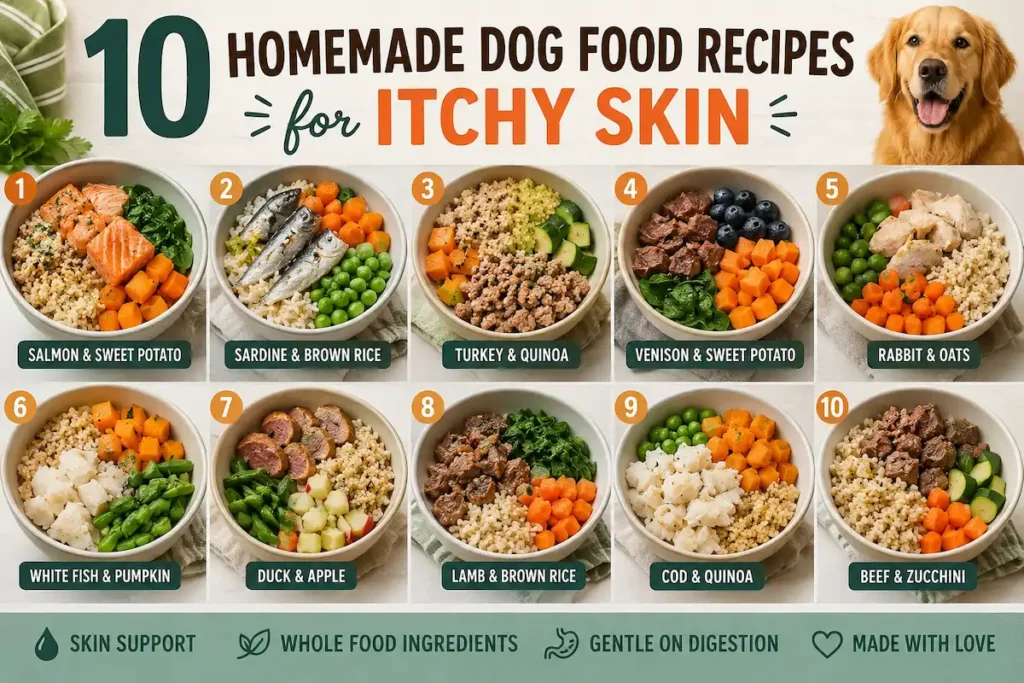
1. Salmon & Zucchini Omega-3 Bowl
Salmon is one of the most useful proteins to include in a skin-supportive homemade rotation because oily fish naturally supplies EPA and DHA, two marine omega-3 fatty acids commonly associated with skin and coat support.
🎯 Best for: Dogs that tolerate fish well and dog parents who want an omega-3-rich whole-food meal.
🥕 Ingredients
- 2 lbs boneless salmon fillets
- 1 cup chopped zucchini
- 1 cup chopped broccoli
- 1 cup grated carrot
- ½ cup chopped green beans
- ½ cup chopped spinach
- Water as needed for cooking
👩🍳 Instructions
- Add the zucchini, broccoli, carrot, and green beans to a large pot with enough water to steam or simmer them.
- Cook for about 7 to 8 minutes until they begin to soften.
- Place the salmon over the vegetables.
- Cover and cook until the salmon flakes easily and is fully cooked.
- Flake the fish carefully and check for bones.
- Stir in the spinach while the food is still warm.
- Allow everything to cool before serving.
🐶 Why This Bowl Makes Sense
Salmon provides EPA and DHA, which support normal skin-barrier function and participate in inflammatory signaling. The vegetables add fiber, moisture, and useful micronutrients without making the bowl overly complicated.
2. Turkey & Leafy Greens Bowl
Turkey is widely available, relatively easy to cook, and can be useful when you simply want to rotate away from chicken or beef.
🎯 Best for: Dogs that tolerate turkey well and dog parents looking for an accessible alternative protein.
🥕 Ingredients
- 2 lbs ground turkey
- 1 cup chopped kale, tough stems removed
- 1 cup chopped spinach
- 1 cup chopped broccoli
- ½ cup chopped green beans
- ½ cup chopped zucchini
- Water as needed
👩🍳 Instructions
- Cook the turkey thoroughly in a large pot, breaking it into small pieces.
- Drain excessive rendered fat if necessary.
- Add broccoli, green beans, zucchini, and a little water.
- Cover and simmer until the vegetables are tender.
- Add kale and spinach for the final few minutes.
- Cool before serving.
🐶 Why This Bowl Makes Sense
Turkey provides high-quality animal protein, while leafy greens add fiber and a wider range of plant nutrients and antioxidants.
💡 Note: Turkey is not automatically a hypoallergenic or novel protein. If your dog has eaten turkey in kibble, treats, toppers, or table scraps, it is no longer truly novel.
3. Venison & Sweet Potato Novel-Protein Option
Venison is less common in many dogs’ everyday diets, making it an interesting protein to consider when food reactions are being investigated.
🎯 Best for: Dogs that have not previously eaten venison and need a less-common protein option.
🥕 Ingredients
- 2 lbs ground venison
- 2 medium sweet potatoes, peeled and cubed
- 1 cup chopped green beans
- ½ cup grated carrot
- Water as needed
👩🍳 Instructions
- Cook the venison thoroughly in a large pot.
- Add sweet potato and enough water to simmer.
- Cover and cook until the sweet potato is soft.
- Add green beans and carrot for the final several minutes.
- Mash some of the sweet potato into the mixture.
- Cool completely before serving.
🐶 Why This Bowl Makes Sense
Venison offers protein variety, while sweet potato contributes carbohydrate, fiber, beta-carotene, and a soft texture that works well in homemade meals.
⚠️ This recipe should not be confused with a properly controlled veterinary elimination trial. During a diagnostic food trial, ingredient selection must be based on the dog’s complete previous diet history.
4. Rabbit & Brown Rice Simple Protein Bowl
Rabbit is another protein that many, but not all, dogs have had less exposure to than chicken, beef, or lamb.
🎯 Best for: Dogs that have not eaten rabbit before and households looking for more protein variety.
🥕 Ingredients
- 1½ lbs boneless rabbit meat
- ½ cup dry brown rice
- 1 cup chopped green beans
- ½ cup grated carrot
- ½ cup chopped zucchini
- Water for cooking
👩🍳 Instructions
- Cook the brown rice according to package directions.
- Cook rabbit thoroughly in a separate pot or pan.
- Chop or shred the rabbit into dog-friendly pieces.
- Steam the green beans, carrots, and zucchini until tender.
- Combine everything and cool before serving.
🐶 Why This Bowl Makes Sense
Rabbit is relatively lean and supplies complete animal protein. Brown rice adds digestible carbohydrate and fiber while helping stretch a more expensive protein.
Whether rabbit counts as novel still depends on your dog’s previous exposure.
5. Duck & Asparagus Skin-Support Bowl
Duck brings something different to the rotation: a richer flavor, useful animal protein, and several micronutrients involved in normal skin and coat maintenance.
🎯 Best for: Dogs that tolerate richer proteins and need variety beyond the usual chicken and beef options.
🥕 Ingredients
- 2 lbs boneless duck meat
- 1 cup chopped asparagus
- 1 cup chopped zucchini
- 1 cup chopped broccoli
- ½ cup chopped spinach
- ½ cup green beans
- Water as needed
👩🍳 Instructions
- Trim excessive visible fat from the duck.
- Cook the duck thoroughly and drain excess rendered fat.
- Add asparagus, zucchini, broccoli, and green beans.
- Add enough water to cook the vegetables until tender.
- Chop or shred the duck and mix it back in.
- Stir spinach into the warm mixture.
- Cool before serving.
🐶 Why This Bowl Makes Sense
Duck provides protein along with nutrients such as zinc, which contributes to normal skin function, cell division, tissue repair, and coat quality.
Because duck can be considerably fattier than white fish, turkey, or rabbit, overall calorie intake still matters.
6. White Fish & Pumpkin Gentle Bowl
This is one of the simplest recipes in the group and a useful option when you want both a fish-based protein and a relatively gentle texture.
🎯 Best for: Dogs that benefit from a leaner, moisture-rich meal with added fiber.
🥕 Ingredients
- 2 lbs boneless cod or another dog-safe white fish
- 1 cup plain canned pumpkin
- 1 cup chopped green beans
- 1 cup chopped zucchini
- ½ cup grated carrot
- ½ cup broccoli
- Water as needed
👩🍳 Instructions
- Steam or simmer the vegetables until tender.
- Add the fish and cook until opaque and flaky.
- Check carefully for bones.
- Flake the fish throughout the vegetables.
- Remove from heat and stir in plain pumpkin.
- Cool completely before feeding.
🐶 Why This Bowl Makes Sense
White fish provides lean animal protein, while pumpkin contributes soluble and insoluble fiber that can support stool quality and digestive regularity.
Digestive health also interacts with immune function, which is one reason the gut-skin relationship receives increasing attention.
White fish and pumpkin can be especially appealing when skin concerns show up alongside digestive sensitivity. If that sounds familiar, these gentle recipes for sensitive stomachs offer more simple meal ideas using easy-to-tolerate ingredients.
7. Lamb & Kale Protein-Rotation Bowl
Lamb is useful when you want another red-meat option with a different flavor and nutrient profile.
🎯 Best for: Dogs that tolerate lamb and need more variety in a homemade rotation.
🥕 Ingredients
- 2 lbs lean ground lamb
- 1 cup chopped kale
- 1 cup chopped broccoli
- ½ cup green beans
- ½ cup grated carrot
- ½ cup zucchini
- Water as needed
👩🍳 Instructions
- Brown the lamb thoroughly.
- Drain excessive fat.
- Add broccoli, green beans, carrot, zucchini, and a little water.
- Cover and simmer until tender.
- Add kale during the final few minutes.
- Cool before serving.
🐶 Why This Bowl Makes Sense
Lamb provides protein along with iron, zinc, and vitamin B12. Kale and broccoli contribute fiber and antioxidant-rich plant nutrients.
💡 Lamb is not automatically hypoallergenic. Many commercial dog foods already contain lamb.
8. Chicken & Turmeric Everyday Bowl
Yes, chicken can still appear in an article about itchy dogs.
Chicken is a potential food allergen for some dogs, but that does not mean every itchy dog should avoid it.
🎯 Best for: Dogs with no known or suspected reaction to chicken and families looking for an economical homemade meal.
🥕 Ingredients
- 2 lbs boneless, skinless chicken
- 1 cup chopped zucchini
- 1 cup green beans
- 1 cup broccoli
- ½ cup grated carrot
- A small culinary amount of turmeric, optional
- Water as needed
👩🍳 Instructions
- Cook the chicken thoroughly.
- Remove and chop or shred into bite-size pieces.
- Cook zucchini, green beans, broccoli, and carrot until tender.
- Return the chicken to the pot.
- If using turmeric, stir in only a small culinary amount rather than treating it as a supplement.
- Cool before feeding.
🐶 Why This Bowl Makes Sense
Chicken is affordable, widely available, and nutritionally useful for dogs that tolerate it.
The important question is not whether chicken is “inflammatory.” It is whether your individual dog actually reacts to it.
9. Sardine & Vegetable Budget Omega Bowl
Salmon gets most of the attention, but sardines deserve a place in a skin-supportive pantry too.
🎯 Best for: Dog parents wanting a more budget-friendly oily-fish option.
🥕 Ingredients
- Sardines packed in water with no added salt, enough to suit the batch size
- 1 cup chopped green beans
- 1 cup chopped zucchini
- 1 cup grated carrot
- ½ cup chopped spinach
- ½ cup broccoli
👩🍳 Instructions
- Cook the vegetables until tender.
- Drain the sardines.
- Check the product for unwanted sauces, seasoning, onion, or garlic.
- Fold the sardines into the cooked vegetables.
- Stir in spinach while everything is still warm.
- Cool before serving.
🐶 Why This Bowl Makes Sense
Like salmon, sardines naturally provide EPA and DHA while often costing less than fresh salmon fillets.
Choose plain products, and remember that frequent sardine feeding still needs to fit the calories, fat, and overall nutrient balance of the full diet.
10. Salmon & Sardine Omega-3 Variety Bowl
This bowl combines two oily fish sources for dog parents specifically interested in a fish-forward homemade meal.
🎯 Best for: Dogs that tolerate fish well and families who want omega-3-rich whole foods to be the nutritional focus.
🥕 Ingredients
- 1 lb boneless salmon
- Plain sardines packed in water
- 1 cup zucchini
- 1 cup green beans
- ½ cup broccoli
- ½ cup grated carrot
- ½ cup spinach
👩🍳 Instructions
- Cook zucchini, green beans, broccoli, and carrot until tender.
- Add salmon and cook until it flakes easily.
- Check carefully for bones.
- Remove from heat.
- Fold in the drained sardines.
- Add spinach while warm.
- Cool before serving.
🐶 Why This Bowl Makes Sense
Salmon and sardines both provide marine omega-3 fatty acids, giving this bowl a strong whole-food omega-3 focus.
There is no need to automatically add large amounts of fish oil on top. More omega-3 is not always better.
📌 Quick Reference: All 10 Recipes
| Recipe | Main Protein | Why Choose It? |
|---|---|---|
| Salmon & Zucchini | Salmon | Whole-food EPA & DHA |
| Turkey & Leafy Greens | Turkey | Accessible protein variety |
| Venison & Sweet Potato | Venison | Less-common protein option |
| Rabbit & Brown Rice | Rabbit | Potential novel protein |
| Duck & Asparagus | Duck | Rich protein + zinc |
| White Fish & Pumpkin | White fish | Lean protein + digestive fiber |
| Lamb & Kale | Lamb | Red-meat variety |
| Chicken & Turmeric | Chicken | Affordable if tolerated |
| Sardine & Vegetables | Sardines | Budget-friendly oily fish |
| Salmon & Sardine Bowl | Salmon + sardines | Oily-fish variety |
🥗 What Should You Feed a Dog With Itchy Skin?
Instead of searching for one magical “anti-itch food,” build the bowl around a few useful nutritional ideas.
🥩 1. A Protein Your Dog Tolerates
Protein supplies amino acids needed throughout the body, including for normal skin and hair growth.
Possible choices include:
- Salmon
- White fish
- Turkey
- Chicken
- Duck
- Rabbit
- Venison
- Lamb
The best protein is not automatically the rarest one.
For a normal homemade diet, choose something your dog digests and tolerates well.
For a veterinary elimination trial, the rules are much stricter. The protein must fit your dog’s previous diet history, or a hydrolyzed diet may be used instead.
🐟 2. Omega-3-Rich Foods
This is one of the most useful nutrition concepts in the entire article.
EPA and DHA are marine omega-3 fatty acids found especially in oily fish such as:
- Salmon
- Sardines
- Certain other oily fish
- Fish-oil products
- Algae-derived omega-3 products
Fatty acids form part of cell membranes and contribute to the skin’s outer barrier. They also influence the production and activity of inflammatory mediators.
That is why omega-3 fatty acids frequently appear in veterinary nutrition discussions around dry, flaky, irritated, or allergy-prone skin.
But omega-3 support should still be viewed as one piece of overall management, not a substitute for diagnosing fleas, infection, environmental allergies, or other causes of itching.
🥑 3. Enough Essential Fat, But Not Just “More Fat”
Healthy skin requires appropriate dietary fatty acids.
That does not mean pouring coconut oil, olive oil, and fish oil into every homemade meal.
Fat is calorie dense, and different oils provide very different fatty-acid profiles. A dog eating salmon or sardines is already getting a different fat profile from one eating very lean white fish.
Balance matters more than chasing the largest possible dose.
🥕 4. Dog-Friendly Vegetables and Fiber
Vegetables will not replace the nutritional role of animal protein, but they can add fiber, texture, moisture, and useful micronutrients.
Good choices include:
- Pumpkin
- Zucchini
- Green beans
- Carrots
- Broccoli
- Spinach
- Kale
For a dog with sensitive digestion, you may want to start with fewer ingredients instead of putting six different vegetables into every meal.
Simple can be useful.
🍗 Does an Itchy Dog Need to Avoid Chicken?
Not necessarily.
This is one of the biggest misconceptions around homemade diets for itchy dogs.
Chicken can cause a food reaction in an individual dog, just as beef, dairy, wheat, fish, lamb, or another dietary protein can.
But the presence of itching does not prove chicken is responsible.
Food allergy occurs when a dog’s immune system reacts to a dietary component, usually a protein. Dogs can react to chicken, beef, dairy, or other ingredients, but removing foods without evidence can unnecessarily restrict the diet.
Food allergy is also only one possible cause of itching. Environmental allergy, flea allergy, parasites, and skin infection can produce very similar symptoms.
That means automatically removing chicken, grains, or another popular “villain” ingredient from every itchy dog’s diet can create unnecessary dietary restrictions without identifying the true problem.
If your veterinarian suspects food allergy, a controlled elimination-challenge diet is the useful diagnostic tool, not guesswork based on an online allergen list.
If you suspect your dog reacts to something in their current diet, it can help to look beyond chicken alone. Our guide to homemade meals for dogs with food allergies explores other protein choices and ways to simplify the bowl without unnecessarily cutting out everything at once.
🦌 What Is a Novel Protein, Really?
“Novel protein” gets used loosely online, but the concept is actually very individual.
A protein is novel when your dog has not previously been exposed to it.
Rabbit might be novel for one dog but completely familiar to another dog that has spent three years eating rabbit treats.
The same applies to:
- Venison
- Duck
- Turkey
- Lamb
- Fish
Before considering a protein truly novel, think about everything your dog has eaten:
- Kibble
- Wet food
- Treats
- Training rewards
- Dental chews
- Table scraps
- Supplements
- Flavored medications
This dietary history becomes especially important when a veterinarian is investigating possible food allergy.
🔍 Could Food Actually Be Causing the Itching?
It can, but food is far from the only explanation.
Possible signs associated with an adverse food reaction can include:
- Persistent itching
- Paw licking or chewing
- Red or irritated skin
- Recurrent ear problems
- Recurrent skin infections
- Gastrointestinal signs such as loose stools or vomiting in some dogs
The problem is that these signs overlap heavily with other conditions.
A dog scratching because of environmental allergy can look remarkably similar to a dog reacting to food.
That is why changing from chicken to salmon for a week does not diagnose a food allergy.
Food is only one piece of the puzzle. If your dog is still scratching despite diet changes, these natural ways to support an itchy dog cover other common triggers and skin-soothing strategies you may want to discuss with your vet.
🧪 How an Elimination Diet Actually Works
A proper elimination-challenge diet is much more controlled than simply feeding “clean food.”
Your veterinarian typically selects either:
- A novel-protein diet using ingredients the dog has not eaten before, or
- A hydrolyzed-protein diet, where proteins have been broken down into much smaller pieces.
The diet must then be fed exclusively for the recommended trial period.
That means no random:
- Treats
- Table food
- Chews
- Toppers
- Flavored supplements
- Flavored medications unless approved
If symptoms improve, ingredients from the previous diet may later be reintroduced in a controlled challenge to see whether signs return.
This process is important because improvement after switching diets alone does not automatically reveal which ingredient, if any, caused the original problem.
Treats count too. Even a small snack can introduce another protein or ingredient, so during a true elimination trial every chew and reward needs to match the plan your veterinarian gives you. Outside a diagnostic trial, you can keep things simpler by choosing homemade treats with short, easy-to-check ingredient lists.
🏠 What About Homemade Elimination Diets?
They can be used in some circumstances, but a long-term home-prepared elimination diet needs to be properly balanced.
A bowl of venison and sweet potato may be intentionally simple, but “simple” and “nutritionally complete” are not the same thing.
If the diet will be fed exclusively for weeks, especially to a puppy or dog with additional health needs, formulation matters.
🧱 Why the Skin Barrier Matters
Think of the skin barrier as part wall and part seal.
It helps keep moisture inside the body while creating a physical boundary between the dog and the outside environment.

Normal skin maintenance depends on adequate:
- Protein
- Essential fatty acids
- Zinc
- Copper
- Vitamins
- Other micronutrients
That is one reason nutrition problems can show up visibly in the coat and skin.
It also explains why a skin-supportive homemade diet should not focus only on one trendy ingredient.
Salmon can provide useful omega-3s, but salmon plus vegetables alone does not automatically supply every nutrient in the correct proportion for long-term feeding.
The whole nutritional pattern matters.
🌿 The Gut-Skin Connection
The digestive tract and skin may look unrelated, but both interact extensively with the immune system.
The gut microbiome, which is the community of microorganisms living in the intestinal tract, is involved in digestion, production of certain metabolites, and communication with immune pathways.
That relationship is why researchers increasingly discuss a “gut-skin axis.”
For a practical homemade meal, you do not need to turn this into a complicated microbiome protocol.
Instead, focus on basics:
- Use proteins your dog tolerates.
- Introduce diet changes gradually when appropriate.
- Include suitable sources of fiber.
- Pay attention to stool quality.
- Avoid unnecessary ingredient overload in sensitive dogs.
Pumpkin is useful here because its fiber makes it an easy ingredient for adding digestive support to meals such as the white fish recipe.
For dogs whose skin issues seem to come with digestive upset, loose stools, or a sensitive stomach, keeping meals simple can make it easier to see what agrees with them. You may also find these sensitive-stomach meal ideas useful when building a gentler rotation.
🐠 What About Fish Oil?
Fish oil can be useful, but it deserves more care than “add one tablespoon to every meal.”
Different fish-oil products contain very different amounts of EPA and DHA.
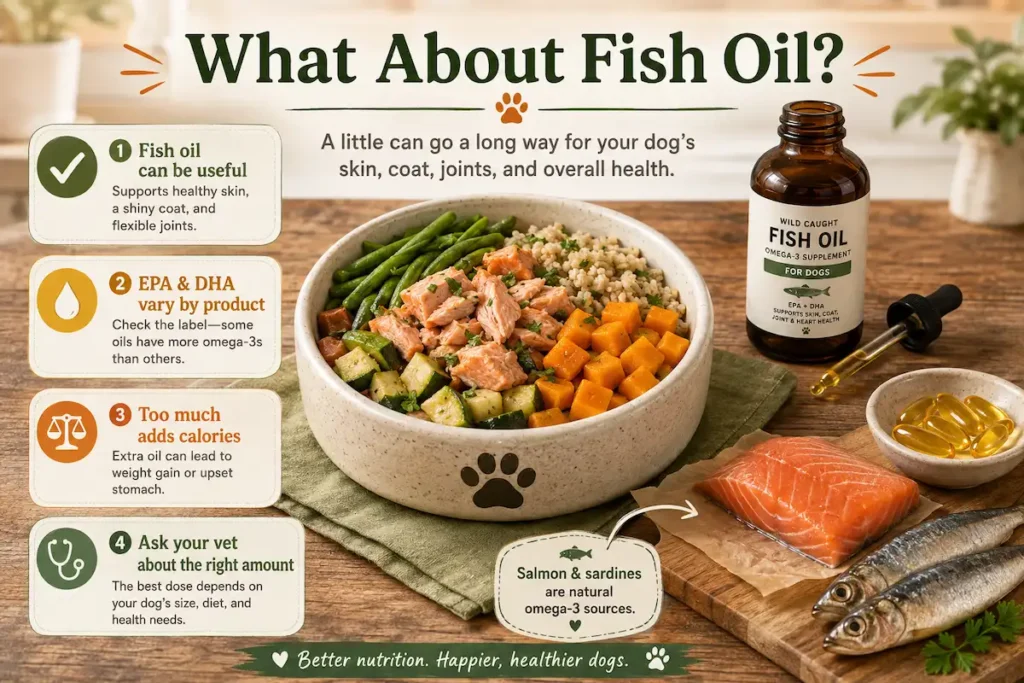
Two products can both provide “1 teaspoon of fish oil” while delivering substantially different amounts of the fatty acids you are actually interested in.
Large amounts of oil also add calories and can cause digestive problems in some dogs.
So if you want to use concentrated fish oil specifically for a dog with ongoing skin problems, ask your veterinarian about an appropriate EPA/DHA amount for your dog and the particular product you are using.
Whole-food sources such as salmon and sardines can still be incorporated into recipes without treating every bowl like a supplement protocol.
⚖️ How Much Homemade Food Should You Feed?
Avoid feeding homemade food solely according to generic “cups by body weight” charts.
A cup of white fish and pumpkin does not necessarily contain the same calories as a cup of duck or lamb.
Portion needs depend on:
- Body weight
- Age
- Activity level
- Body condition
- Whether weight loss or gain is needed
- Neuter status
- The actual calorie density of the recipe
Use your dog’s body condition and calorie needs rather than assuming every homemade recipe can be fed at the same cup measurement.
If homemade meals make up a substantial percentage of the diet, proper formulation becomes even more important.
❄️ How to Store Homemade Dog Food Safely
For convenient meal prep:
🧊 Refrigerator
Store cooked food in sealed containers and use it within a few days.
Fish-based meals are especially worth portioning carefully so food is not repeatedly warmed and cooled.
❄️ Freezer
Divide large batches into meal-size containers before freezing.
That lets you thaw only what you need instead of defrosting the entire batch.
🌡️ Thawing
Thaw frozen portions in the refrigerator rather than leaving them on the counter for long periods.
🐟 Fish Oil
If your veterinarian recommends a fish-oil supplement, follow that product’s storage instructions. Many omega-3 oils are sensitive to heat, light, and oxidation.
❤️ Final Thoughts
Homemade dog food for itchy skin should focus on your individual dog, not automatically avoiding every ingredient that gets blamed online.
Start with a protein your dog tolerates, consider omega-3-rich foods such as salmon or sardines, and keep meals simple enough to understand what works well.
If food allergy is suspected, a controlled veterinary diet trial can help determine whether food is actually part of the problem.
And if homemade food becomes your dog’s primary diet, make sure it is properly balanced for long-term feeding.