
Allergies are one of the most frustrating chronic conditions a dog can deal with — and one of the most frustrating for the dog parent watching it happen.
The constant scratching, the recurring ear infections, the paw licking that never quite stops, the skin that looks perpetually irritated no matter what gets tried.
It’s exhausting for everyone involved, and the conventional approach of repeated vet visits, antihistamines, and steroid cycles often manages symptoms without addressing the underlying drivers.
Natural allergy remedies for dogs aren’t a replacement for veterinary care — a proper diagnosis matters enormously because environmental allergies, food allergies, and contact allergies require different approaches.
But alongside a vet’s guidance, natural interventions genuinely move the needle for many dogs in ways that medication alone doesn’t.
This guide covers the most evidence-supported options, the dietary approaches that make the biggest difference, and the topical remedies worth trying. 🙂
Understanding Dog Allergies: The Three Types
Before any remedy — natural or otherwise — works effectively, it helps to understand which type of allergy is being managed. Treatments that address environmental allergies have limited effect on food allergies, and vice versa.
🐾 Environmental allergies (atopic dermatitis) are the most common type. Triggered by airborne particles — pollen, mold spores, dust mites, grass — these allergies are typically seasonal in onset but can become year-round as sensitivity increases over time.
Signs include itching that worsens in spring and summer, face rubbing, paw licking, and recurring ear infections.
🐾 Food allergies develop over time as the immune system mounts a response to a specific protein — most commonly chicken, beef, dairy, wheat, and egg in that order of frequency.
Signs include year-round itching, digestive symptoms alongside skin issues, and ear infections that don’t resolve with standard treatment. A proper elimination diet is the only reliable diagnostic tool.
If your dog’s allergies seem food-related, the real fix might start in their bowl. Check out these 15 Limited Ingredient Dog Food Recipes for Allergy Relief — and if you want to go the extra mile, these 12 Homemade Dog Food Recipes for Itchy Skin can help your pup feel and look their absolute best from the inside out.
🐾 Contact allergies are less common — triggered by direct skin contact with specific materials (certain grasses, cleaning products, synthetic fabrics). Signs appear on areas with direct contact — belly, paws, and muzzle.
Dietary Approaches: The Foundation of Allergy Management
Diet is the most powerful lever available for managing dog allergies — both because food allergies are directly addressed by dietary change, and because the right diet reduces the systemic inflammation that makes environmental allergies significantly worse.
Switch to a Novel Protein
For dogs with suspected food allergies, a novel protein elimination diet is the single most effective intervention available.
Novel proteins are proteins the dog has never been exposed to — venison, rabbit, duck, kangaroo, or bison — making them unlikely to trigger existing sensitizations.
✔️ How an elimination diet works:
- Feed a single novel protein and a single carbohydrate source exclusively for 8–12 weeks
- No treats, chews, flavored medications, or supplements that contain other proteins during this period
- If symptoms resolve, reintroduce previous proteins one at a time to identify the trigger
- The identified trigger is then permanently removed from the diet
This process requires patience — 8 weeks minimum before drawing conclusions. Most dog parents see noticeable improvement within 4–6 weeks if food allergy is the driver.
✔️ Novel protein homemade food options:
- Venison & sweet potato (simple, widely available)
- Rabbit & brown rice
- Duck & quinoa
- Kangaroo & pumpkin (less common but excellent novel protein)
Anti-Inflammatory Ingredients to Add
Regardless of allergy type, systemic inflammation drives the intensity of allergic responses.
These ingredients actively reduce inflammatory load and are appropriate additions to any allergy dog’s diet:
✅ Omega-3 fatty acids from oily fish — salmon, sardines, mackerel — directly reduce inflammatory cytokines.
The EPA and DHA in marine omega-3s are more bioavailable than plant-based ALA and produce measurably stronger anti-inflammatory effects.
For allergy dogs, including oily fish 2–3 times per week in the food rotation is one of the most impactful dietary changes available.
✅ Turmeric contains curcumin — one of the most well-researched natural anti-inflammatory compounds. Safe for dogs in small amounts and absorbed significantly better when paired with black pepper and a fat source.
A basic golden paste recipe for dogs:
- ½ cup turmeric powder, 1 cup water, 1½ teaspoons black pepper, ¼ cup coconut oil or olive oil.
- Cook over low heat stirring constantly for 7–10 minutes until a thick paste forms.
- Store in the fridge and add ¼ teaspoon per meal for small dogs, ½ teaspoon for medium dogs, ¾–1 teaspoon for large dogs.
✅ Coconut oil contains lauric acid, which has documented anti-inflammatory and antimicrobial properties.
Add 1 teaspoon per day for small dogs, 1 tablespoon for large dogs. Start with a smaller amount and build up gradually — coconut oil can cause loose stools when introduced too quickly.
✅ Quercetin — found naturally in apples, blueberries, and broccoli — is a flavonoid antioxidant often called “nature’s antihistamine” due to its ability to inhibit histamine release from mast cells.
Including quercetin-rich foods in an allergy dog’s regular rotation provides modest but consistent anti-inflammatory support.
✅ Foods high in quercetin safe for dogs: Apple (no seeds), blueberries, broccoli, kale, green beans, spinach.
Foods to Remove for Allergy Dogs
Some ingredients actively worsen allergic responses through the same mechanisms that make them problematic for yeast-prone dogs — high sugar, high glycemic index, and pro-inflammatory fat profiles:
- High-glycemic carbohydrates — white potato, corn, wheat in large quantities — drive blood sugar spikes that increase inflammatory mediator production
- Omega-6 heavy oils — sunflower oil, corn oil, soybean oil — the omega-6 to omega-3 imbalance in many commercial foods drives chronic low-grade inflammation that amplifies allergic responses
- Artificial additives — preservatives, artificial colors, and flavor enhancers in commercial treats and food contribute to total inflammatory burden
- Common allergens — chicken, beef, dairy, wheat, and egg for dogs with suspected or confirmed food allergies
Natural Topical Remedies for Skin Relief
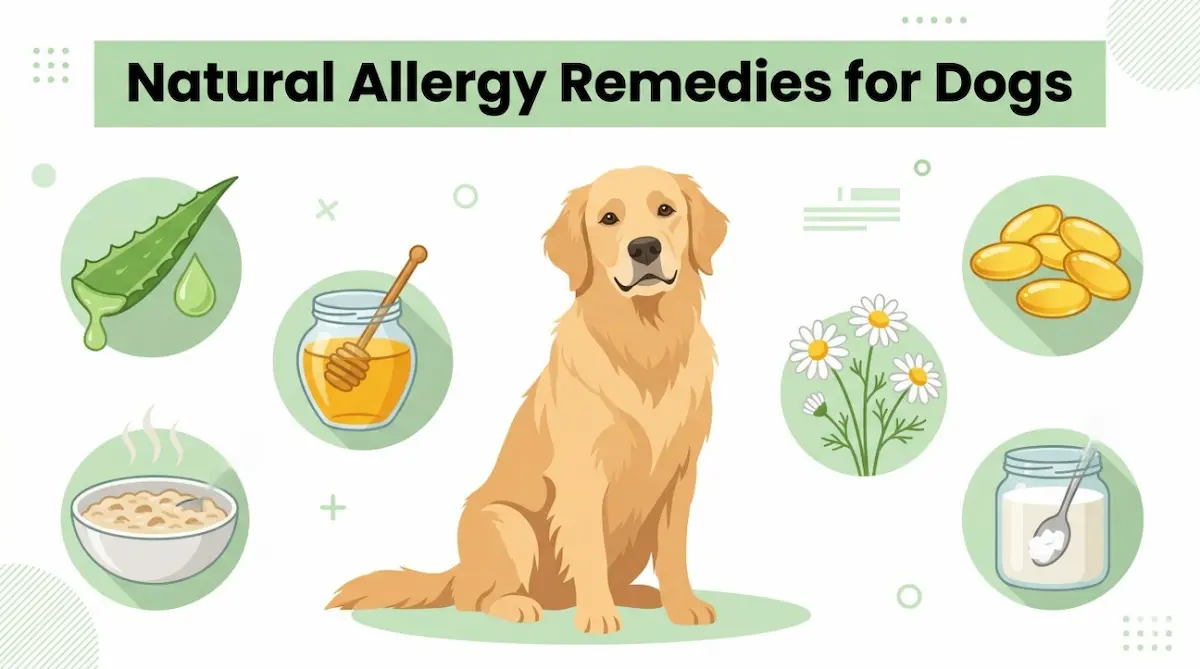
1. Oatmeal Soak
The most well-established natural topical remedy for itchy, inflamed dog skin — colloidal oatmeal has documented anti-inflammatory properties and is gentle enough for daily use on sensitive skin.
2. Apple Cider Vinegar Spray
Raw, unfiltered apple cider vinegar (ACV) has mild antimicrobial and antifungal properties that make it useful for surface skin relief and paw soaks.
The acidity helps restore the skin’s natural pH, which becomes disrupted in allergic skin conditions.
3. Coconut Oil Topical Application
Coconut oil’s lauric acid disrupts the cell membranes of bacteria and yeast on the skin surface — useful for the secondary infections that commonly develop on allergy-affected skin.
It also provides a physical moisture barrier that reduces transepidermal water loss in dogs with compromised skin barriers.
4. Chamomile Tea Rinse
Chamomile has documented anti-inflammatory properties and is one of the gentlest natural topical remedies available — appropriate even for puppies and dogs with sensitive or broken skin.
The cooled tea acts as a mild anti-inflammatory rinse with no risk of irritation.
5. Aloe Vera Gel
Pure aloe vera gel — directly from the plant or from a product that is 100% pure aloe with no added ingredients — provides immediate cooling relief to inflamed skin and contains compounds with genuine anti-inflammatory and wound-healing properties.
Supplement Protocol for Allergy Dogs
These supplements have the strongest evidence base for allergy management and are appropriate to discuss with a vet before adding to an allergy dog’s routine:
✅ Fish oil (omega-3) — the most important supplement for allergy dogs. Reduces inflammatory cytokines, supports skin barrier function, and decreases the intensity of histamine responses over time.
Dosing: 20mg EPA/DHA per pound of body weight daily. Effects build over 4–6 weeks of consistent use.
✅ Probiotic (canine-specific) — gut health and immune regulation are directly connected; approximately 70% of the immune system is located in the gut.
Canine-specific probiotics containing Lactobacillus acidophilus and Bifidobacterium strains support balanced immune responses and reduce the hyperreactivity underlying allergic reactions. Human probiotic formulations are not equivalent.
✅ Quercetin supplement — available in capsule form at higher concentrations than dietary sources alone provide. Acts as a natural antihistamine by inhibiting mast cell degranulation.
Discuss dosing with a vet — typical canine dosing is approximately 5–10mg per pound of body weight twice daily.
✅ Vitamin E — antioxidant support that specifically benefits skin health and reduces oxidative damage in allergic skin. Can also be applied topically by puncturing a capsule and applying directly to affected skin.
✅ Colostrum — bovine colostrum contains proline-rich polypeptides (PRPs) that help modulate immune responses, potentially reducing the hypersensitivity underlying environmental allergies. Emerging evidence is promising though not yet definitive.
Environmental Management Alongside Natural Remedies
Natural remedies work best alongside environmental management strategies that reduce allergen exposure — the lower the allergen load, the less the immune system has to respond to, and the more effective any remedy becomes.
For seasonal/environmental allergy dogs:
- Wipe paws and coat with a damp cloth after every outdoor walk during peak pollen season — removing surface pollen before the dog licks it off or tracks it inside significantly reduces allergen exposure
- Wash bedding weekly in hot water during allergy season — dust mites in bedding are a major year-round environmental allergen
- Use a HEPA air purifier in rooms where the dog spends most of their time
- Vacuum with a HEPA-filter vacuum at least twice weekly during peak allergy season
- Bathe with a gentle, fragrance-free shampoo every 1–2 weeks during flares to remove surface allergens
For contact allergy dogs:
- Switch to fragrance-free, natural cleaning products for floors and surfaces
- Wash dog bedding and toys in fragrance-free detergent
- Consider the dog’s play surfaces — artificial grass and certain lawn treatments are common contact allergen triggers
When Natural Remedies Aren’t Enough
Natural allergy remedies genuinely help many dogs manage their symptoms more comfortably — but they’re support tools, not cures, and there are circumstances where veterinary intervention is the correct primary approach:
- Skin infections (pyoderma) — secondary bacterial infections on allergy-affected skin require antibiotics; natural remedies alone won’t clear an established infection
- Severe ear infections — recurrent yeast or bacterial ear infections need proper veterinary treatment alongside dietary management
- Anaphylaxis — any acute, severe allergic reaction (facial swelling, difficulty breathing, vomiting after insect stings or new foods) is a veterinary emergency
- Uncontrolled scratching that breaks the skin — open wounds create infection risk that needs medical management
- No improvement after 8–12 weeks — if a genuine dietary elimination trial and consistent natural remedies produce no improvement, further diagnostic workup (intradermal allergy testing, comprehensive blood panel) is warranted
The goal with natural allergy management is to find the minimum effective intervention — ideally one that reduces reliance on repeated steroid cycles and antihistamines without compromising the dog’s quality of life.
For many dogs, that combination of dietary change, fish oil, probiotics, and consistent topical support gets them to a genuinely comfortable baseline. 🙂
Quick Reference Guide: Natural Allergy Remedies
| Remedy | Type | Best For | Frequency |
| Novel protein diet | Dietary | Food allergies | Ongoing |
| Omega-3 fish oil | Supplement | All allergy types | Daily |
| Turmeric golden paste | Dietary/Supplement | Systemic inflammation | Daily |
| Quercetin-rich foods | Dietary | Environmental allergies | Daily |
| Canine probiotic | Supplement | Immune regulation | Daily |
| Oatmeal soak | Topical | Generalized itching | 2–3x/week |
| ACV spray/paw soak | Topical | Paw licking, surface irritation | After walks |
| Coconut oil topical | Topical | Dry skin, paw pads, hot spots | 1–2x/day |
| Chamomile tea rinse | Topical | Sensitive/broken skin | After baths |
| Aloe vera gel | Topical | Acute hot spots, inflammation | As needed |
Final Thoughts
Natural allergy remedies for dogs work best as a comprehensive approach rather than isolated interventions — diet as the foundation, supplements to address systemic inflammation, and topical remedies to manage skin symptoms as they arise.
No single remedy resolves allergies completely, but the combination of the right diet, consistent omega-3 support, a quality probiotic, and appropriate topical relief genuinely moves the needle for most allergy-affected dogs.
Start with the dietary changes — novel protein if food allergy is suspected, anti-inflammatory additions regardless. Add fish oil immediately. Introduce the topical oatmeal soak for immediate skin relief. Build the rest of the protocol from there.
A comfortable dog is the goal — and with the right combination of natural support and veterinary guidance, that goal is genuinely achievable for most dogs dealing with allergies. 🙂