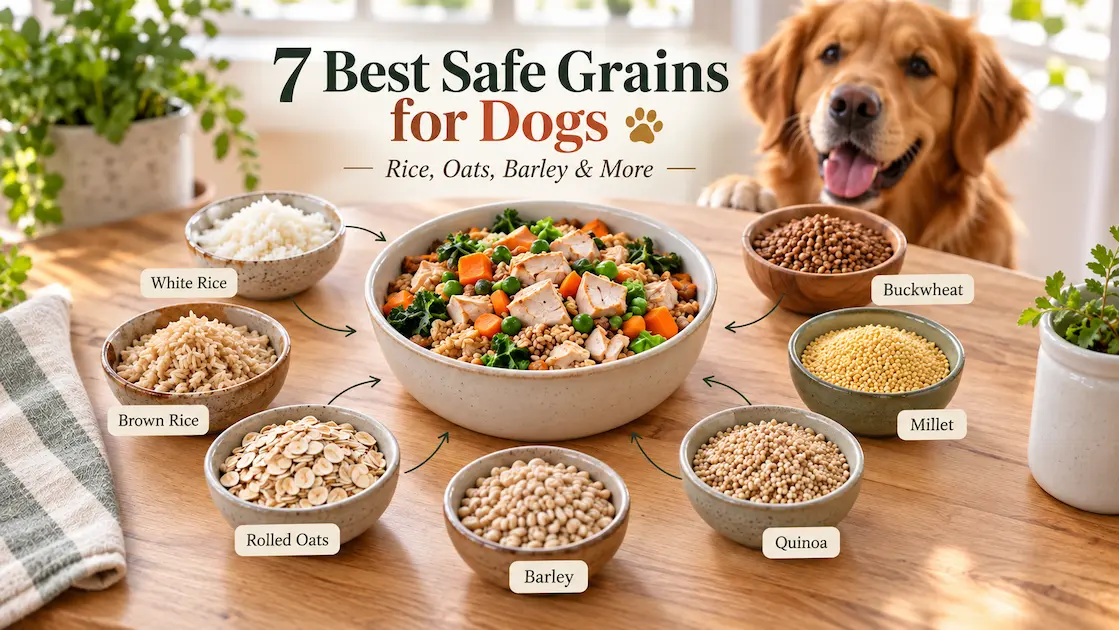
If you are looking for safe grains for dogs, rice, oats, barley, quinoa, and several other options can all bring something different to the bowl.
Some are soft and easy to digest. Others provide more fiber, a heartier texture, or a wider mix of nutrients.
And despite what grain-free marketing may suggest, properly cooked grains are not just empty “fillers.” They can provide useful energy, fiber, vitamins, minerals, and variety in a well-planned diet.
The better question is not simply, “Can dogs eat grains?”
It is:
Which grain makes the most sense for the dog and the meal you are building?
Here is how the most useful options compare.
Important: A safe grain does not automatically make a homemade meal complete and balanced. Dogs still need the right overall amounts of protein, fat, vitamins, minerals, essential fatty acids, and calories.
Can Dogs Eat Grains? Quick Answer
For most dogs, the answer is yes.
Dogs can digest properly cooked starches very efficiently, including starches from grains. That means rice, oats, barley, and similar ingredients can play a useful role in homemade dog food when they are prepared properly and used as part of a balanced diet.
Grains can contribute:
- Easily available energy
- Dietary fiber
- B vitamins and minerals
- Useful meal texture
- Variety in homemade diets
- A practical carbohydrate base for meat and vegetables
They are not nutritionally identical, though.
Some grains are easier to digest. Some provide more fiber. Some work better in soft meals, while others are better suited to hearty slow-cooker recipes or batch cooking.
The key is choosing the grain based on what it actually contributes to the bowl.
Which Grain Fits Your Dog Best?
Here is the quick comparison before we look at each grain in more detail.
| Grain | Best For | Texture | Main Strength |
|---|---|---|---|
| White rice | Soft, gentle meals | Very soft | Easy digestion |
| Brown rice | Healthy adult dogs | Chewier | More fiber |
| Oats | Soft meals with added fiber | Creamy | Soluble fiber |
| Barley | Batch cooking and hearty meals | Chewy | Fiber + structure |
| Quinoa | Ingredient rotation | Light/fluffy | Nutrient variety |
| Millet | Simple grain rotation | Soft | Mild and versatile |
| Buckwheat | Alternative carbohydrate source | Soft | Fiber + variety |
There is no single “healthiest grain” for every dog.
The best option depends on digestibility, fiber needs, texture, and the rest of the recipe.
7 Safe Grains for Dogs Worth Adding to the Bowl
🍚 1. White Rice: Best When Easy Digestion Matters
White rice deserves more credit than it often gets.
Because the bran and germ have been removed, white rice contains less fiber than brown rice and cooks into a softer, easier-to-digest starch.
That makes it especially useful when you want a meal that is gentle, simple, and easy to chew.
It also pairs easily with lean proteins such as turkey, chicken, beef, eggs, and fish.
It is also one of the easiest grains to use in beef and rice dog food, especially when you want a simple bowl with familiar ingredients and a soft texture.
White rice is sometimes dismissed as an inferior carbohydrate because it contains less fiber than brown rice, but that misses the point.
Its strength is precisely that it is:
- Soft
- Mild
- Highly digestible
- Easy to portion
- Easy to combine with other ingredients
Those same qualities are why white rice is so common in sensitive stomach recipes, where soft texture and simple ingredients can make meals easier to work with.
✓ Best for: softer meals, dogs that do better with lower-fiber starches, and recipes where you want a simple carbohydrate base.
Cook it thoroughly in plain water and skip butter, salt, onion, garlic, or heavily seasoned broth.
🌾 2. Brown Rice: More Fiber, More Texture
Brown rice keeps its bran and germ layers, giving it more fiber and a firmer texture than white rice.
That makes it useful for healthy adult dogs that tolerate fiber well and for meals where you want a grain that feels more substantial.
Fiber can influence stool consistency, intestinal transit, and overall digestive function, so brown rice can be a valuable ingredient when a dog does well with a higher-fiber meal.
But more fiber does not automatically mean better.
Some dogs do better with the softer texture and lower fiber content of white rice.
✓ Best for: healthy adult dogs that tolerate fiber well and meals where you want more texture than white rice provides.
🥣 3. Oats: A Soft, Fiber-Rich Alternative to Rice
Oats are one of the most useful grains to keep in rotation.
Once cooked, they become soft and easy to mix with meat, pumpkin, vegetables, eggs, or fish.
Oats are also a useful source of soluble fiber, which can add nutritional value while helping create a soft, satisfying texture in homemade meals.
That softer texture can also work well for picky eaters, especially when oats are paired with familiar proteins, pumpkin, or egg.
That makes oats especially useful when you want something gentler than a chewy grain but more fiber-rich than white rice.
Use plain oats cooked in water.
Avoid assuming that human breakfast oatmeal is automatically dog-friendly. Flavored packets can contain large amounts of sugar, chocolate, raisins, artificial sweeteners, or other ingredients that do not belong in a dog’s bowl.
✓ Best for: soft homemade meals, dogs that tolerate fiber well, and owners who want an easy alternative to rice.
🌾 4. Barley: The Hearty Choice for Batch Meals
Barley is a strong option when you want something more substantial than rice.
It provides fiber and a satisfying chewy texture, which makes it especially useful in slow-cooker meals, stews, and larger meal-prep batches.
That is why barley fits especially well into slow cooker dog food recipes, where it can absorb liquid without disappearing into the meal.
🎯 Barley works particularly well alongside:
- Beef
- Turkey
- Chicken
- Carrots
- Green beans
- Pumpkin
It absorbs liquid well while still maintaining more structure than oats or white rice.
That makes it useful when you want the finished meal to feel hearty rather than soft or porridge-like.
✓ Best for: slow-cooker meals, batch cooking, and dogs that tolerate higher-fiber foods well.
🌱 5. Quinoa: A Nutrient-Rich Alternative Worth Rotating In
Quinoa is technically a seed, but it is commonly used like a grain.
It offers a useful way to add variety to homemade dog food, especially if you do not want every meal to rely on rice or oats.
Quinoa provides carbohydrates along with protein and minerals, and its light texture works well with lean meats and vegetables.
The preparation matters.
Rinse quinoa thoroughly before cooking to remove the naturally occurring coating that can give it a bitter taste, then cook it until soft.
✓ Best for: variety, rotation, and meals where you want a lighter alternative to traditional grains.
🌾 6. Millet: A Mild Grain for More Variety
Millet is less common in homemade dog food, but it can still be a useful addition.
Once cooked, it becomes mild and soft, making it easy to mix with meat and vegetables without dominating the texture of the meal.
It works especially well as a rotation grain.
That means you do not need to use millet every day. It simply gives you another dog-safe carbohydrate option so the diet does not rely on the same grain repeatedly.
✓ Best for: variety and soft homemade meals.
🌰 7. Buckwheat: Not Wheat, and Not Just a Trend
Despite the name, buckwheat is not actually wheat.
It is a pseudograin, much like quinoa, and it is naturally gluten-free.
Cooked buckwheat provides carbohydrates, fiber, minerals, and a more distinctive flavor than rice or oats.
That makes it useful when you want to rotate ingredients and introduce a less common carbohydrate source.
Use plain cooked buckwheat rather than sweetened breakfast mixes or baked products containing extra ingredients.
✓ Best for: dietary variety and dogs that already tolerate plant-based carbohydrate sources well.
Rice vs Oats vs Barley: Which One Should You Use?
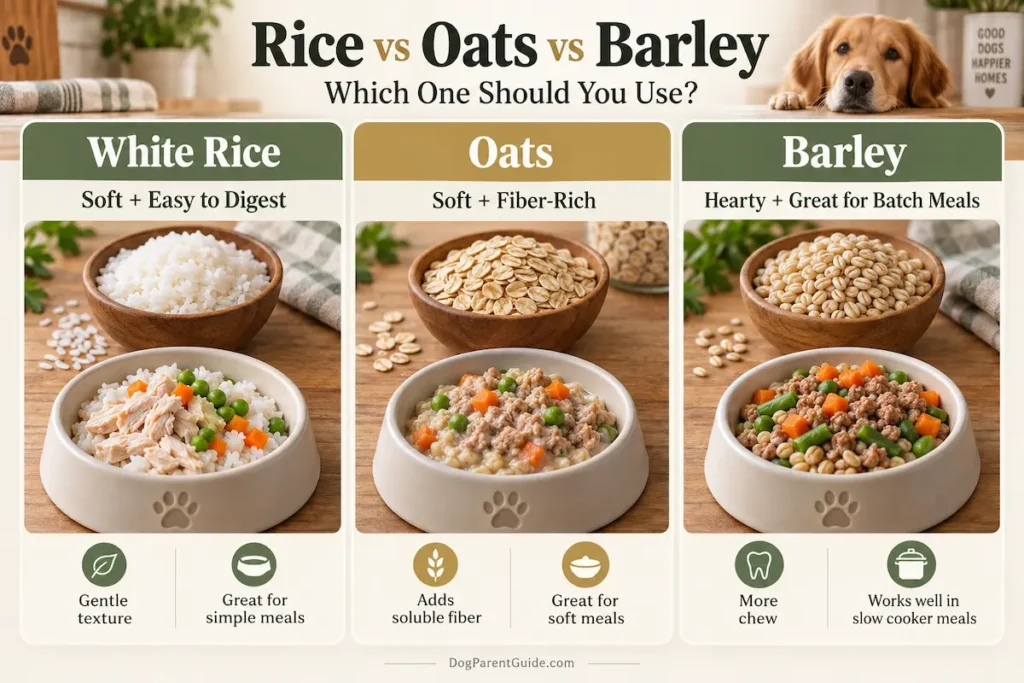
Among the most useful safe grains for dogs, rice, oats, and barley each serve a slightly different purpose.
🍚 Choose Rice When…
You want something soft, mild, and easy to digest.
White rice is especially useful when you want a simple carbohydrate base that does not add too much fiber or texture.
🥣 Choose Oats When…
You want a soft texture but more fiber than white rice provides.
Oats work particularly well in meals with pumpkin, eggs, meat, or vegetables where you want a softer, more blended consistency.
🌾 Choose Barley When…
You want a heartier grain with more chew and structure for slow-cooker or batch meals.
There is no nutritional rule saying every homemade dog meal needs the same carbohydrate source.
Choosing based on digestibility, fiber needs, and texture makes far more sense than trying to crown one grain as the universal winner.
White Rice vs Brown Rice: Which Is Better for Dogs?
Brown rice often gets the health halo because it contains more fiber and retains more of the original grain.
But that does not mean it is always the better choice.
White rice has real advantages when you want:
- Softer texture
- Lower fiber
- Easier digestion
- A very neutral carbohydrate source
Brown rice makes more sense when you want:
- More fiber
- More texture
- A firmer grain
- A heartier meal
So there is no need to automatically replace white rice with brown rice.
They serve different purposes.
For some dogs, the extra fiber in brown rice is useful.
For others, the simplicity of white rice is exactly what makes it the better choice.
Are Grains Actually Good for Dogs?
Yes, they can be.
Properly cooked grains can provide much more than calories.
Depending on the grain, they can contribute:
- Digestible carbohydrate for energy
- Fiber
- B vitamins
- Minerals
- Essential fatty acids in smaller amounts
- Texture and variety
The idea that grains are automatically nothing more than cheap filler is too simplistic.
A well-formulated diet does not become nutritionally poor just because it contains rice or oats.
Likewise, removing grains does not automatically make a diet higher quality.
What matters most is the nutritional value of the whole diet.
Grain-Free Isn’t Automatically Better
Grain-free diets have become popular, but removing grains does not automatically improve a dog’s nutrition.
Some dogs genuinely need specific dietary adjustments, especially when food allergies or intolerances are being investigated. But that is different from assuming that all dogs benefit from avoiding grains.
In many cases, rice, oats, barley, or other properly prepared grains can fit perfectly well into a healthy diet.
A grain-free food can still be poorly formulated. A food containing grains can still be nutritionally excellent. The label alone does not tell you which one is better.
If you are considering grain-free dog food, the more useful question is why you want to remove grains and what ingredients will replace them.
And if you are avoiding grains across the whole routine, including snacks, there are also plenty of grain-free dog treats you can make without relying on wheat, oats, or rice.
4 Rules for Preparing Grains Safely
Even safe grains for dogs need to be cooked and served properly.
🍳 1. Cook Them Thoroughly
Cooked starch is far easier for dogs to digest than raw or poorly cooked starch.
Rice should be tender.
Barley should be fully cooked.
Oats should be soft.
Quinoa should be rinsed and cooked through.
🧂 2. Keep Them Plain
Dogs do not need:
- Butter-heavy sauces
- Excess salt
- Garlic
- Onion
- Rich gravies
- Sweet syrups
- Seasoning blends
Plain grains are much easier to fit safely into a homemade meal.
🔄 3. Introduce New Grains Gradually
Changing the amount or type of fiber in a diet can affect stool quality.
If your dog has never eaten oats, barley, or another grain before, introduce it gradually rather than replacing a large part of the meal overnight.
🥘 4. Look at the Whole Bowl
Adding a healthy grain does not make an otherwise unbalanced meal complete.
The grain should fit into the overall calorie and nutrient structure of the recipe.
Safe Grain, Wrong Dish: What Not to Feed
One of the easiest mistakes is focusing on the grain while ignoring everything else in the dish.
Rice may be safe.
Fried rice may not be.
Oats may be safe.
Flavored oatmeal may not be.
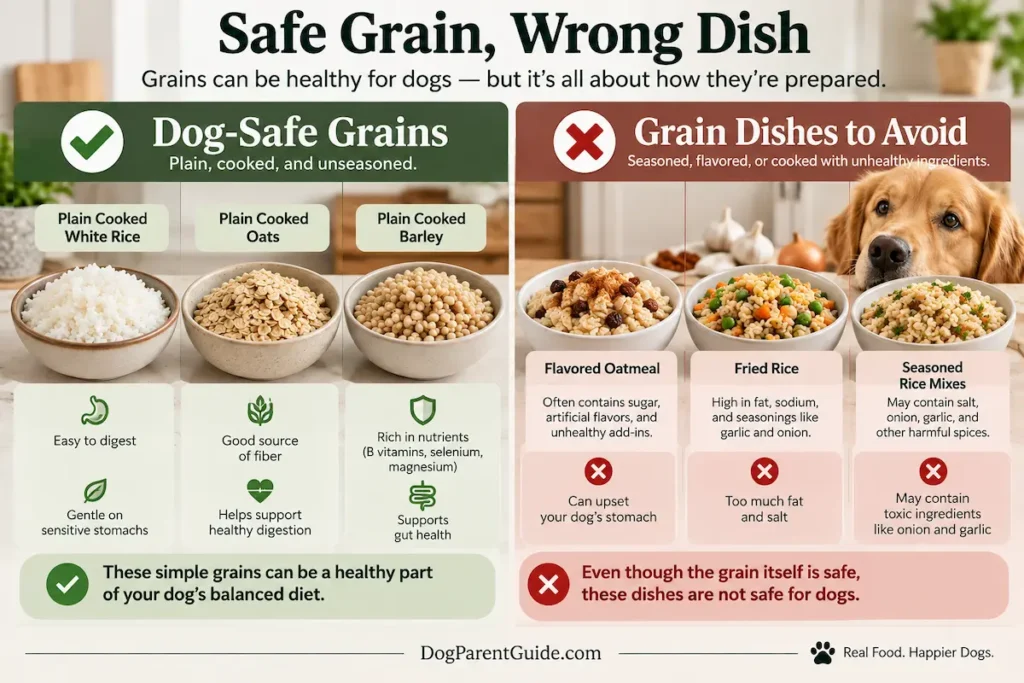
Watch out for:
- 🚫 Flavored oatmeal containing sugar, raisins, chocolate, or artificial sweeteners
- 🚫 Fried rice made with oil, salt, sauces, onion, or garlic
- 🚫 Seasoned rice mixes containing onion or garlic powder
- 🚫 Sugary breakfast cereals
- 🚫 Grain dishes covered in rich sauces or gravy
- 🚫 Raw or seriously undercooked grains
- 🚫 Moldy or spoiled grains
Always judge the entire dish, not just the grain listed in its name.
How Much Grain Should Be in Homemade Dog Food?
There is no universal rule saying that every homemade dog meal should contain 20%, 30%, or 50% grain.
And this is where many homemade diets go wrong.
A formula such as:
meat + grain + vegetables = balanced dog food
looks sensible, but it does not guarantee nutritional adequacy.
Dogs need specific amounts of:
- Protein and amino acids
- Fat and essential fatty acids
- Calcium and phosphorus
- Vitamins
- Trace minerals
- Calories
Grain can contribute useful energy, fiber, and nutrients, but it is still only one part of the complete formula.
If you are adding a small amount of homemade food as a topper, that is very different from feeding homemade food as the dog’s full daily diet.
For long-term feeding, the entire recipe needs to be balanced rather than built around arbitrary percentages.
4 Easy Ways to Use Grains in Homemade Dog Meals
These safe grains for dogs can fit into very different kinds of homemade meals depending on the texture and nutrition profile you want.
🍚 Turkey + White Rice + Vegetables
Soft, simple, and easy to portion.
White rice keeps the texture gentle while turkey provides the main protein.
🥣 Beef + Oats + Pumpkin
A soft, fiber-rich combination with a creamy texture.
Oats and pumpkin both add body to the meal, making this a very different bowl from the classic beef-and-rice combination.
🌾 Chicken + Barley + Carrots
A heartier meal with more chew.
Barley holds its texture well and works especially well in slow-cooker recipes or larger meal-prep batches.
🌱 Fish + Quinoa + Green Beans
A lighter combination that gives you a completely different ingredient profile from rice-based meals.
These are meal combinations, not complete nutritional formulas on their own.
If you want one of them to provide all of your dog’s daily nutrition, the entire recipe needs to be properly formulated.
So, Which Grain Should You Choose?
The best safe grains for dogs are not necessarily the ones with the longest nutrient list.
They are the ones that fit the dog and the meal.
- Choose white rice when easy digestion and soft texture matter most.
- Choose brown rice when you want more fiber and a firmer grain.
- Choose oats when you want a soft, fiber-rich alternative.
- Choose barley when you want a hearty grain for batch meals.
- Choose quinoa, millet, or buckwheat when you want more variety.
There is no reason to fear grains simply because grain-free diets became popular, and there is no reason to force grains into every meal either.
The smartest choice depends on what your dog tolerates well, what the rest of the recipe needs, and what that grain actually contributes to the bowl.