If a dog is constantly scratching their ears, licking their paws, or rubbing their face on every available surface, yeast overgrowth is one of the first things worth investigating.
It’s one of the most common — and most frustrating — chronic health issues in dogs, and diet plays a significantly larger role in managing it than most dog parents realize.
The connection is direct: yeast feeds on sugar and simple carbohydrates. Commercial dog food — even premium kibble — is often loaded with both.
Anti-yeast dog food recipes work by removing the dietary fuel that yeast thrives on and replacing it with proteins, low-glycemic vegetables, and antioxidant-rich ingredients that support the immune system instead of undermining it.
FYI, a vet diagnosis before changing the diet is always the right first step — but once yeast overgrowth is confirmed, diet is one of the most powerful tools available. 🙂
Here are the recipes first, then everything worth knowing about yeast, diet, and how the two connect.
8 Anti-Yeast Dog Food Recipes

1. Turkey & Leafy Green Anti-Yeast Base Recipe
The foundation recipe for anti-yeast feeding — lean protein, low-glycemic vegetables, and zero sugar or starchy carbohydrates.
This is the recipe to start with when transitioning a yeast-prone dog to an anti-yeast diet.
Turkey & Leafy Green Anti-Yeast Base Recipe
Lean turkey with low-glycemic vegetables and coconut oil — designed to starve yeast while supporting detox
Ingredients
2 lbs ground turkey
1 cup chopped zucchini
1 cup chopped broccoli
1 cup chopped spinach
½ cup grated carrot (moderate use — slightly higher glycemic)
1 cup chopped green beans
2 tablespoons coconut oil
4 cups water
Instructions
Sauté ground turkey in a large pot over medium heat until fully cooked through.
Add zucchini, broccoli, carrot, green beans, and water. Bring to a boil.
Reduce to a simmer, cover, and cook for 15 minutes.
Add spinach for the final 3 minutes until wilted.
Stir in coconut oil, mix well, and cool completely before serving.
💡 Coconut oil tip: Contains caprylic acid — a natural antifungal that inhibits yeast growth. Add after cooking to preserve its beneficial properties.
2. Salmon & Asparagus Anti-Inflammatory Meal
Salmon’s omega-3 fatty acids reduce the systemic inflammation that allows yeast to establish and spread — making this recipe one of the most therapeutically valuable on the list.
Asparagus is a natural prebiotic that feeds beneficial gut bacteria rather than yeast.
Salmon & Asparagus Anti-Inflammatory Meal
Omega-3 rich salmon with prebiotic asparagus and apple cider vinegar — targets inflammation and yeast overgrowth
Ingredients
2 lbs boneless salmon fillets, skin removed
1 cup chopped asparagus
1 cup chopped zucchini
1 cup chopped broccoli
½ cup chopped spinach
1 tablespoon apple cider vinegar (raw, unfiltered)
3 cups water
Instructions
Add asparagus, zucchini, broccoli, and water to a large pot. Bring to a boil.
Cook for 8 minutes until vegetables begin to soften.
Place salmon fillets on top of the vegetables.
Cover and steam over low heat for 8–10 minutes until salmon flakes easily.
Flake salmon thoroughly and check carefully for any remaining bones.
Stir in spinach and apple cider vinegar off the heat.
Mix well and cool completely before serving.
💡 Omega-3 boost: Salmon’s EPA and DHA reduce inflammation that yeast thrives in. Feed salmon 2–3 times per week for best results. Apple cider vinegar supports healthy gut acidity where yeast struggles to grow.
3. Chicken & Cruciferous Vegetable Detox Meal
Cruciferous vegetables — broccoli, cauliflower, Brussels sprouts — contain compounds that support liver detoxification pathways.
When yeast dies off in response to dietary changes, the liver processes the released toxins. Supporting those pathways with the right vegetables makes the transition smoother and reduces die-off symptoms.
Chicken & Cruciferous Vegetable Detox Meal
Lean chicken with detoxifying cruciferous vegetables — supports liver function and yeast elimination
Ingredients
2 lbs boneless chicken breast
1 cup chopped broccoli
1 cup chopped cauliflower
½ cup shredded Brussels sprouts
1 cup chopped green beans
½ cup chopped parsley (supports kidney function)
2 tablespoons olive oil
4 cups low-sodium chicken broth (no onion, no garlic)
Instructions
Add chicken and broth to a large pot. Bring to a boil.
Reduce to a simmer, cover, and cook for 18 minutes.
Remove chicken and shred finely. Return to the pot.
Add broccoli, cauliflower, Brussels sprouts, and green beans.
Simmer for a further 8 minutes until vegetables are tender.
Stir in parsley and olive oil off the heat. Cool completely before serving.
💡 Detox support: Cruciferous vegetables activate liver enzymes that help eliminate yeast byproducts. Brussels sprouts can cause gas — introduce gradually and reduce quantity if needed.
4. Venison & Pumpkin Seed Anti-Yeast Meal
Venison is a novel protein that most yeast-prone dogs haven’t developed sensitivities to — important because food sensitivities and yeast overgrowth often co-occur, and protein sensitivities can worsen inflammation that allows yeast to thrive.
Pumpkin seeds are a genuinely impressive addition: they contain cucurbitin, a compound with antiparasitic and antifungal properties.
Venison & Pumpkin Seed Anti-Yeast Meal
Novel protein venison with raw pumpkin seeds and coconut oil — dual antifungal support with immune-boosting minerals
Ingredients
2 lbs ground venison
2 tablespoons raw pumpkin seeds, ground (not roasted, not salted)
1 cup chopped zucchini
1 cup chopped broccoli
1 cup chopped green beans
½ cup chopped spinach
2 tablespoons coconut oil
4 cups water
Instructions
Brown venison in a large pot over medium heat. Drain any excess liquid.
Add zucchini, broccoli, green beans, and water. Bring to a boil.
Reduce to a simmer, cover, and cook for 15 minutes.
Add spinach for the final 3 minutes.
Remove from heat and stir in ground pumpkin seeds and coconut oil.
Mix well and cool completely before serving.
💡 Pumpkin seed power: Use raw, unsalted seeds only — grind immediately before adding to preserve nutrients. Combined with coconut oil’s caprylic acid for dual antifungal effect.
5. Lamb & Low-Glycemic Vegetable Bowl
Lamb is another excellent novel protein for yeast-prone dogs that have common sensitivities to chicken or beef.
This recipe pairs lamb with a carefully selected set of low-glycemic vegetables — every ingredient has been chosen specifically for its low sugar content and antifungal or anti-inflammatory properties.
Lamb & Low-Glycemic Vegetable Bowl
Lean lamb with ultra-low glycemic vegetables — zero yeast fuel with diuretic support for detox
Ingredients
2 lbs ground lamb, fat trimmed
1 cup chopped zucchini
1 cup chopped asparagus
1 cup chopped green beans
½ cup chopped kale (stems removed)
½ cup chopped celery
1 tablespoon coconut oil
4 cups water
Instructions
Brown lamb in a large pot over medium heat. Drain excess fat thoroughly — important for yeast-prone dogs.
Add zucchini, asparagus, green beans, celery, and water. Bring to a boil.
Reduce to a simmer, cover, and cook for 15 minutes.
Add kale for the final 4 minutes until wilted.
Stir in coconut oil off the heat. Cool completely before serving.
💡 Fat matters: Trim lamb fat carefully — high fat can stress the liver and worsen yeast in some dogs. Every vegetable here has ultra-low glycemic index to starve yeast completely.
6. Beef & Herb Anti-Yeast Meal
Certain herbs are among the most potent natural antifungal agents available — and several are completely safe for dogs in appropriate amounts.
This recipe incorporates oregano and thyme, both of which contain compounds with demonstrated antifungal activity against Candida and Malassezia species.
Beef & Herb Anti-Yeast Meal
Lean beef with antifungal oregano and thyme — culinary herbs that fight yeast naturally
Ingredients
2 lbs lean ground beef (90/10)
½ teaspoon dried oregano (safe for dogs — antifungal)
½ teaspoon dried thyme (safe for dogs — antifungal)
1 cup chopped broccoli
1 cup chopped zucchini
1 cup chopped green beans
½ cup chopped spinach
2 tablespoons olive oil
4 cups water
Instructions
Brown ground beef in a large pot. Drain excess fat thoroughly.
Add broccoli, zucchini, green beans, and water. Bring to a boil.
Reduce to a simmer, cover, and cook for 15 minutes.
Add spinach for the final 3 minutes.
Remove from heat and stir in oregano, thyme, and olive oil.
Mix well and cool completely before serving.
💡 Herb safety: Use dried culinary herbs only at these quantities — safe and therapeutic. Never use essential oils or concentrated extracts. Add herbs after cooking to preserve antifungal compounds.
7. Duck & Coconut Oil Recovery Meal
Duck is one of the richest protein sources in terms of iron, B vitamins, and zinc — all nutrients that support immune function and skin health in yeast-affected dogs.
The higher fat content is balanced here by careful trimming and the inclusion of coconut oil’s antifungal caprylic acid.
Duck & Coconut Oil Recovery Meal
Zinc-rich duck with coconut oil — supports skin barrier integrity and immune function against yeast
Ingredients
2 lbs duck breast, fat trimmed aggressively
2 tablespoons coconut oil
1 cup chopped zucchini
1 cup chopped broccoli
½ cup chopped asparagus
½ cup chopped green beans
½ cup chopped spinach
3 cups water
Instructions
Sear duck breast in a large pot over medium heat. Drain all rendered fat.
Add zucchini, broccoli, asparagus, green beans, and water. Bring to a boil.
Reduce to a simmer, cover, and cook for 18 minutes.
Remove duck, shred or slice into small pieces, and return to the pot.
Add spinach for the final 3 minutes.
Stir in coconut oil off the heat. Cool completely before serving.
💡 Zinc for skin: Duck’s high zinc content supports skin barrier integrity — critical for fighting yeast. Trim fat aggressively (remove skin and visible fat) — the lean meat is the therapeutic component.
8. White Fish & Probiotic Gut Reset Meal
The gut is ground zero for yeast overgrowth — approximately 70% of the immune system lives in the gut, and yeast management starts with restoring a healthy microbial balance there.
This recipe combines lean white fish with probiotic-rich plain kefir and prebiotic vegetables to actively rebuild beneficial gut bacteria.
White Fish & Probiotic Gut Reset Meal
Ultra-lean white fish with kefir probiotics and prebiotic vegetables — resets gut flora to crowd out yeast
Ingredients
2 lbs boneless cod or tilapia
¼ cup plain, unsweetened kefir (no added sugar or flavoring)
1 cup chopped asparagus
1 cup chopped zucchini
1 cup chopped broccoli
½ cup chopped green beans
3 cups water
Instructions
Add asparagus, zucchini, broccoli, green beans, and water to a large pot. Bring to a boil.
Cook for 8 minutes until vegetables begin to soften.
Place fish fillets on top of the vegetable mixture.
Cover and steam over low heat for 7–8 minutes until fish flakes easily.
Flake fish thoroughly and check carefully for any bones.
Remove from heat and allow to cool to room temperature.
Stir in kefir once fully cooled — heat destroys probiotic cultures.
Mix well and serve immediately or refrigerate.
💡 Probiotic power: Use plain, unsweetened kefir only — flavored versions contain yeast-feeding sugar. Start with 1–2 teaspoons for dogs new to kefir, build up over a week. Add only after cooling to preserve live cultures.
Quick Reference Guide: All 8 Recipes
| # | Recipe | Protein | Key Antifungal Ingredient | Best For |
| 1 | Turkey & Leafy Greens | Turkey | Coconut oil | Anti-yeast base recipe |
| 2 | Salmon & Asparagus | Salmon | Apple cider vinegar | Inflammation, coat health |
| 3 | Chicken & Cruciferous Veg | Chicken | Cruciferous detox compounds | Liver support, die-off |
| 4 | Venison & Pumpkin Seed | Venison | Pumpkin seeds + coconut oil | Novel protein, dual antifungal |
| 5 | Lamb & Low-GI Vegetables | Lamb | Coconut oil | Sensitive dogs, low glycemic |
| 6 | Beef & Herb Meal | Beef | Oregano + thyme | Herbal antifungal support |
| 7 | Duck & Coconut Oil | Duck | Coconut oil | Zinc, skin barrier support |
| 8 | White Fish & Kefir | White Fish | Kefir (probiotic) | Gut reset, microbiome rebuild |
💡 Related Articles:
- Natural Allergy Remedies for Dogs: Stop Itching & Skin Issues Fast
- Homemade Dog Food for Dogs with Allergies (+ Maltese-Specific Recipe!)
- 12 Best Homemade Dog Food for Allergies Recipes Will Have Them Feeling Like a Million Bucks
- 10 Simple Homemade Dog Food Recipes for Sensitive Stomachs (Vet-Approved)
- Homemade Raw Dog Food Recipes: 10 Vet-Approved Meals for a Healthier Dog
What Is Yeast Overgrowth in Dogs?
Yeast overgrowth — most commonly caused by Malassezia pachydermatis (skin yeast) or Candida species (gut yeast) — occurs when the normal balance of microorganisms in a dog’s body tips in favor of yeast at the expense of beneficial bacteria.
Yeast lives on virtually every dog naturally and causes no problems when kept in check by a healthy immune system and balanced gut microbiome.
The issues begin when something disrupts that balance — and diet is one of the most significant contributing factors.
Common signs of yeast overgrowth in dogs:
- Persistent ear infections with dark, waxy discharge and a characteristic musty odor
- Chronic paw licking, chewing between the toes, or rust-colored staining on the paws
- Greasy, flaky skin or a distinctive “corn chip” or musty smell to the coat
- Red, irritated skin in skin folds — particularly around the face, armpits, and groin
- Recurring skin infections or hot spots
- Digestive issues — gas, loose stools, or inconsistent digestion
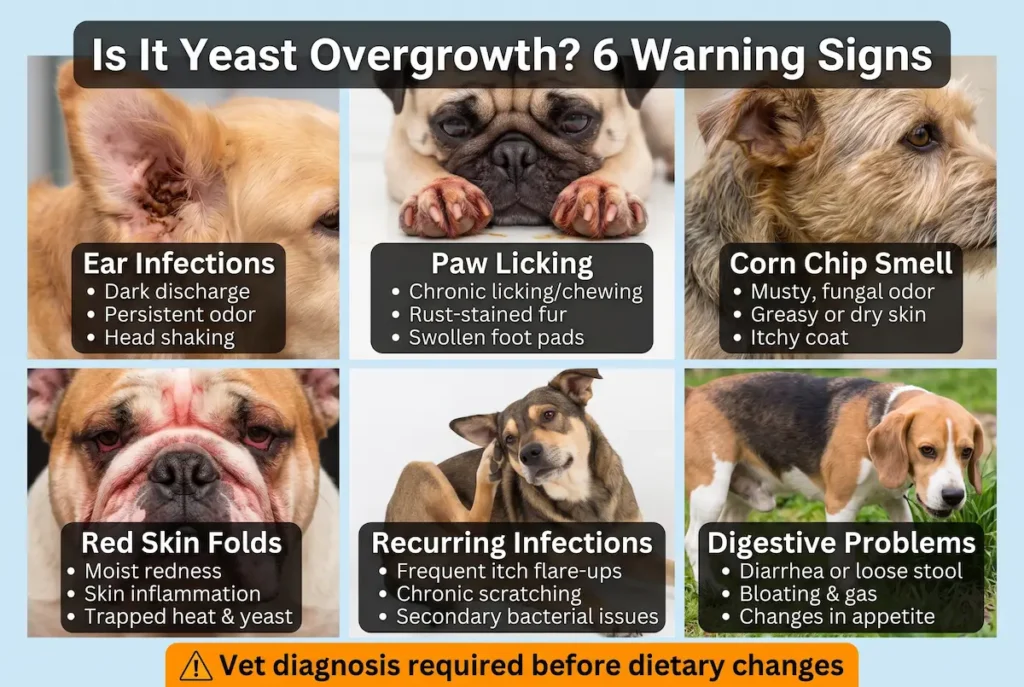
Not all of these signs indicate yeast — several overlap with allergies, bacterial infections, or other conditions. A vet diagnosis is essential before assuming yeast and changing the diet accordingly.
IMO, the vet visit is non-negotiable here — treating the wrong problem with dietary changes wastes time and leaves the actual issue unaddressed.
The Diet-Yeast Connection
Yeast — like all living organisms — requires food to grow and reproduce. In a dog’s gut and on their skin, the primary yeast fuel sources are simple sugars and rapidly digestible carbohydrates.
Every time a dog eats a high-carbohydrate meal, blood glucose rises, and yeast in the gut and tissues gets a feeding opportunity.
Commercial kibble — even grain-free varieties — typically contains 30–60% carbohydrates by dry matter weight.
Grain-free kibble often replaces grains with potato, tapioca, or legumes that have comparable or higher glycemic indexes than the grains they replaced.
FYI, “grain-free” does not mean “yeast-friendly” — this is one of the most common misconceptions in managing yeast through diet.
Anti-yeast dog food recipes work by:
- ✅ Removing high-glycemic carbohydrates that feed yeast
- ✅ Providing protein as the primary energy source
- ✅ Including specific antifungal ingredients (coconut oil, apple cider vinegar, oregano, pumpkin seeds)
- ✅ Supporting the gut microbiome with prebiotic vegetables and probiotic additions
- ✅ Reducing systemic inflammation through omega-3-rich proteins and antioxidant vegetables
Foods That Feed Yeast: What to Remove
The anti-yeast diet is as much about what’s removed as what’s added. These foods actively contribute to yeast overgrowth and should be eliminated or minimized:
- Grains — wheat, corn, rice, oats; all break down rapidly to glucose
- Starchy vegetables — white potato, sweet potato, peas, corn; high glycemic index
- Fruit — naturally high in fructose; even dog-safe fruits feed yeast in yeast-prone dogs
- Commercial treats — almost universally high in carbohydrates and sugar
- Honey and maple syrup — sometimes added to homemade treats; pure sugar from a yeast perspective
- Dairy (except plain kefir and plain yogurt) — contains lactose, which yeast ferments readily
⚠️ The hardest one: Sweet potato appears in virtually every homemade dog food recipe and is often considered a health food for dogs — and it is, for dogs without yeast issues. For yeast-prone dogs, sweet potato’s relatively high glycemic index makes it one of the first ingredients to remove when managing active yeast overgrowth.
Foods That Fight Yeast: What to Add
- Coconut oil — caprylic acid directly disrupts yeast cell membranes
- Apple cider vinegar (raw, unfiltered) — creates an acidic environment hostile to yeast
- Oregano (dried, culinary) — carvacrol and thymol with antifungal activity
- Thyme (dried, culinary) — thymol with antifungal properties
- Raw pumpkin seeds (ground) — cucurbitin with antifungal and antiparasitic properties
- Kefir (plain, unsweetened) — diverse probiotic strains that compete with yeast
- Salmon, sardines, and other oily fish — omega-3 EPA and DHA
- Novel proteins (venison, duck, lamb, rabbit) — less likely to trigger concurrent food sensitivities
- Zucchini, broccoli, cauliflower, asparagus, green beans, spinach, kale, celery, cucumber
Supplements Worth Discussing With a Vet
Diet is the foundation — but these supplements add meaningful support for yeast-prone dogs:
- Probiotics (canine-specific) — Lactobacillus acidophilus and Bifidobacterium strains specifically shown to inhibit Candida; different from human probiotic formulations
- Omega-3 fish oil — systemic anti-inflammatory support
- Digestive enzymes — support protein and fat digestion; may reduce fermentable substrate available for yeast
- Colostrum — supports gut barrier integrity and immune function
- Caprylic acid supplement — the active antifungal compound in coconut oil in more concentrated form; discuss dosing with a vet
What to Expect: The Yeast Die-Off Period
When yeast levels drop in response to dietary changes, dying yeast cells release toxins as they break down. This is called the Herxheimer reaction or die-off, and it temporarily makes symptoms look worse before they improve.
Dog parents who don’t know to expect this sometimes abandon the dietary change right when it’s starting to work.
✔️ Common die-off symptoms:
- Increased itching or skin irritation for the first 1–2 weeks
- Temporary increase in discharge from ears or skin folds
- Lethargy or mild digestive upset
- Increased thirst
These symptoms are normal and typically resolve within 2–3 weeks as yeast levels drop to manageable levels.
If symptoms are severe or persist beyond 3 weeks, a vet check is warranted — this could indicate a more complex infection requiring medical treatment alongside dietary management.
Portion & Feeding Guide
| Dog Size | Weight | Per Meal | Meals Per Day |
|---|---|---|---|
| Extra Small | Under 10 lbs | ¼–⅓ cup | 2–3 |
| Small | 10–20 lbs | ½–¾ cup | 2 |
| Medium | 20–50 lbs | 1–1½ cups | 2 |
| Large | 50–90 lbs | 2–3 cups | 2 |
| Extra Large | 90+ lbs | 3–4 cups | 2 |
Storage Guide
- Refrigerator — airtight containers for up to 4 days; fish-based recipes for up to 3 days
- Freezer — portioned servings for up to 3 months; thaw overnight in the fridge
- Kefir-containing meals (Recipe 8) — add kefir fresh at serving time rather than storing with the meal; heat and age both reduce probiotic viability
- Coconut oil — add to each serving rather than storing in the batch if the batch will be frozen — coconut oil separates during freezing and thawing
Final Thoughts
Anti-yeast dog food recipes are one of the most powerful tools available for managing chronic yeast overgrowth — and the results, when the diet is done correctly and consistently, are genuinely impressive.
Less scratching, cleaner ears, reduced paw licking, improved coat quality, and a dog that’s clearly more comfortable in their own skin.
The dietary change takes commitment — removing sweet potato, fruit, and grains from a homemade diet requires adjusting established habits.
But for dogs that have been dealing with chronic yeast issues, that commitment pays off in visible, tangible improvements within weeks.
Start with Recipe 1 as the foundation. Add Recipe 2 twice a week for omega-3 support. Rotate through the remaining recipes for protein variety and broad antifungal coverage. Be patient through the die-off period. Work with a vet throughout.
A dog free from chronic yeast discomfort is a completely different dog — more relaxed, more comfortable, and significantly less interested in licking everything within reach. That outcome is absolutely worth the effort. 🙂