
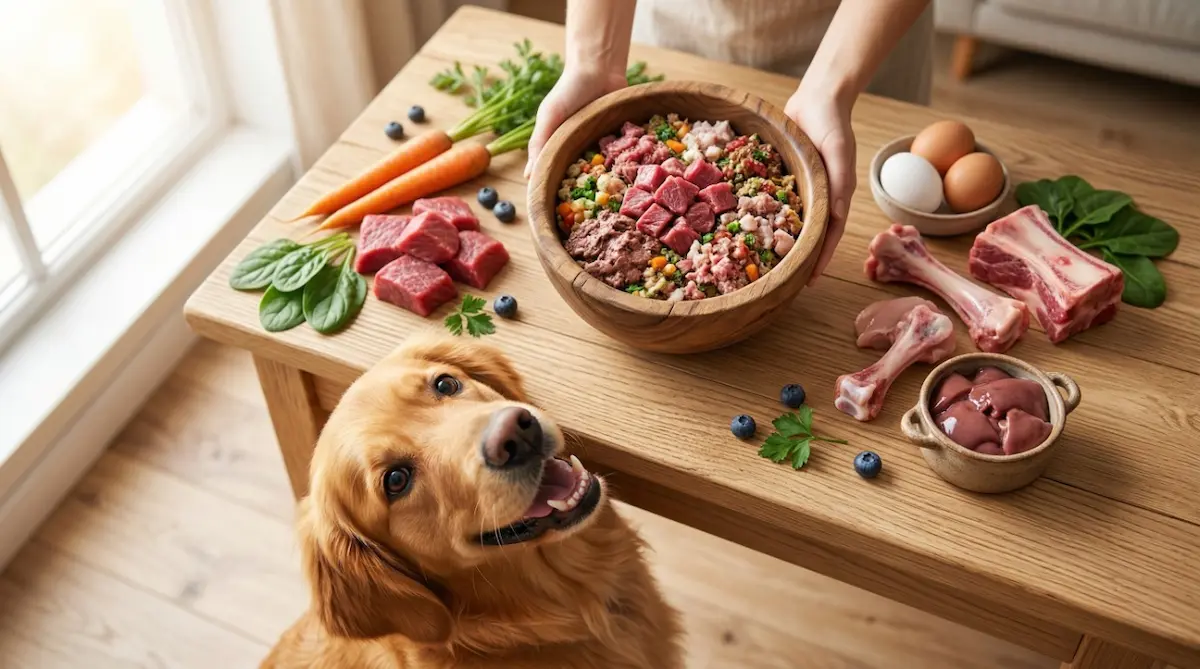
Raw feeding divides the dog owner world like almost nothing else. Vets who swear by it, vets who warn against it, and dog owners caught somewhere in the middle trying to figure out who to believe. The truth sits somewhere more nuanced than either camp typically admits.
Done carelessly, raw feeding creates genuine nutritional gaps and real bacterial risks. Done correctly — with balanced ratios, proper sourcing, safe handling, and appropriate supplementation — it’s one of the most species-appropriate diets available for dogs. This article covers how to do it correctly.
Here are 10 complete and balanced homemade raw dog food recipes, followed by everything needed to understand the framework behind them.
⚠️ Critical disclaimer: Raw feeding carries genuine risks including bacterial contamination and nutritional imbalance.
Always consult a veterinarian or veterinary nutritionist before starting a raw diet — particularly for puppies, senior dogs, immunocompromised dogs, or households with young children or immunocompromised humans.
The recipes below follow established raw feeding guidelines but are not a substitute for professional nutritional advice.
10 Complete & Balanced Raw Dog Food Recipes
Recipe 1: Beef and Bone Raw Meal
The foundation recipe for anyone starting raw feeding.
Ground beef with raw meaty bones covers the protein, fat, calcium, and phosphorus bases that form the structural core of any balanced raw diet. Everything else builds from here.
Beef & Bone Raw Meal
Classic BARF-style foundation — muscle meat, raw bone, organ, and veggie matter in proper ratio
Ingredients — approx. 2 days for a 50 lb dog
1.5 lbs lean ground beef (80/20)
✦ Higher fat than cooked recipes — appropriate for raw feeding
½ lb raw meaty bone — chicken necks or wings
✦ Beginner-friendly; soft enough to chew and fully digestible raw
⚠ Size bones appropriately — never small enough to swallow whole
¼ lb beef liver
primary secreting organ — dense in vitamin A, B12, iron
¼ lb beef kidney
secondary secreting organ — counts toward the 10% organ target
1 cup leafy greens (spinach or kale), finely chopped or blended
✦ Blend or chop finely — dogs don’t digest plant cell walls efficiently
½ cup carrots, grated
grate fine for better digestibility
1 tbsp fish oil
✦ Add per serving after portioning — do not mix into the whole batch
Raw Ratio (BARF)
Instructions
Source ingredients from a reputable butcher or raw pet food supplier. Quality sourcing matters more in raw feeding than cooked.
Keep everything refrigerated until prep time — work quickly and wash hands and surfaces thoroughly before and after.
Combine ground beef with finely chopped liver and kidney. Mix well.
Fold in blended or finely chopped greens and grated carrot.
Serve the raw meaty bone alongside the ground mixture — or grind it in if using a grinder.
Add fish oil and any supplements per individual serving, not into the full batch.
Portion into daily servings, refrigerate for up to 2 days or freeze the rest.
🦴 Storage tip: Freeze portioned meals flat in zip-lock bags — thaw in the fridge overnight, never at room temperature. Discard any uneaten raw food after 30 minutes in the bowl. New to raw feeding? Transition gradually over 7–10 days to avoid digestive upset.
Why it works: Ground beef provides complete essential amino acids, raw bone delivers bioavailable calcium and phosphorus in appropriate ratio, organ meat supplies the micronutrient density muscle meat alone cannot match.
Recipe 2: Chicken Raw Meal
Chicken is the most accessible raw protein — affordable, widely available, and accepted enthusiastically by virtually every dog.
Chicken frames are an excellent beginner bone source because they’re soft enough for most dogs to consume safely.
Chicken Raw Meal
Leaner single-protein raw meal — beginner-friendly with soft frames and easy-to-source cuts
Ingredients — approx. 2 days for a 50 lb dog
1.5 lbs ground chicken or boneless chicken thighs, finely chopped
thighs preferred over breast — higher fat content suits raw feeding better
½ lb chicken frame or chicken necks (raw only)
✦ Soft, pliable bones — one of the safest raw bones for beginners
⚠ Never cooked — cooked poultry bones splinter and are dangerous
¼ lb chicken liver
primary secreting organ — rich in vitamin A, B12, and folate
¼ lb chicken gizzards
✦ Classified as muscle meat in raw feeding — counts toward the 70%, not the 10% organ allocation
1 cup spinach, blended
blend well — dogs digest blended greens far more efficiently than chopped
½ cup zucchini, grated
hydrating and low-calorie — grate fine for easy mixing
1 tbsp fish oil
✦ Add per serving after portioning — do not mix into the whole batch
Raw Ratio (BARF)
Instructions
Keep all chicken refrigerated at below 40°F until preparation. Work quickly and sanitize all surfaces before and after.
Combine ground chicken (or finely chopped thighs) with chopped liver and gizzards. Mix well.
Blend spinach until smooth, then mix with grated zucchini.
Combine meat mixture with vegetable mixture and mix thoroughly.
Serve raw bone alongside the mix — or use ground chicken frames incorporated directly if available.
Add fish oil and any supplements per individual serving, not into the full batch.
Portion into daily servings, refrigerate for up to 2 days or freeze the rest.
🍗 Single-protein advantage: An all-chicken meal is ideal for dogs starting an elimination diet or being introduced to raw for the first time — easy to monitor for sensitivities. If your dog is new to raw, introduce gizzards gradually; the texture and density differ significantly from ground muscle meat.
Why it works: Chicken’s complete amino acid profile supports muscle maintenance, chicken liver delivers exceptional Vitamin A and B12 levels, gizzards add texture variety and additional muscle protein.
Recipe 3: Turkey Raw Meal
Turkey raw meals are particularly well-suited for dogs with sensitivities to chicken — a more common sensitivity than most owners realize, given how heavily chicken features in commercial dog food.
Turkey delivers a near-identical nutritional profile to chicken with enough protein difference to avoid triggering chicken-specific reactions.
Turkey Raw Meal
Leaner poultry alternative with turkey heart muscle meat and pumpkin for digestive support
Ingredients — approx. 2 days for a 50 lb dog
1.5 lbs ground turkey (80/20)
✦ Use fattier grind for raw — leaner than beef but still needs adequate fat for raw feeding
½ lb turkey neck, chopped into appropriate pieces (or ground turkey frames)
✦ Turkey necks are denser than chicken necks — size pieces to the dog’s weight
⚠ Never cooked — raw only; cooked poultry bones splinter and are dangerous
¼ lb turkey liver
primary secreting organ — do not exceed 10% of total meal weight
¼ lb turkey heart
✦ Heart is muscle meat in raw feeding — combine with ground turkey, not the organ portion
1 cup kale, very finely blended
✦ Blend until almost liquid — cell wall disruption is essential for dogs to absorb nutrients from raw leafy greens
½ cup pumpkin puree, plain
supports gut motility — soluble fiber helps dogs transitioning to raw
⚠ Plain puree only — pumpkin pie filling contains xylitol and spices toxic to dogs
1 tbsp fish oil
✦ Add per serving after portioning — do not mix into the whole batch
Raw Ratio (BARF)
Instructions
Source turkey components from a butcher or raw pet food supplier. Keep refrigerated at below 40°F until prep.
Combine ground turkey with finely chopped turkey heart — both count as muscle meat.
Finely chop turkey liver and mix into the meat base.
Blend kale until almost liquid — this step is non-negotiable for nutrient absorption.
Mix blended kale and pumpkin puree into the meat mixture until fully combined.
Serve turkey neck pieces sized appropriately alongside the mix — or use ground frames incorporated directly.
Add fish oil and any supplements per individual serving, not into the full batch.
🎃 Pumpkin for raw transitions: Plain pumpkin puree is especially useful for dogs switching to raw — the soluble fiber acts as a buffer during the digestive adjustment period, helping firm up loose stools that sometimes appear in the first 1–2 weeks. Turkey is also one of the most hypoallergenic proteins available, making this a solid choice for dogs with suspected poultry sensitivities to chicken.
Why it works: Turkey heart is one of the richest natural sources of taurine available — a critical amino acid for heart health that some homemade diets fall short on. Pumpkin adds digestive fiber that supports gut motility alongside raw food.
Recipe 4: Lamb Raw Meal
Lamb is the gold standard novel protein for raw elimination diets — most dogs have had minimal prior exposure, making immune-triggered reactions significantly less likely.
This recipe is particularly valuable for dogs undergoing food sensitivity diagnostics.
Lamb Raw Meal
Rich novel protein for rotation or elimination diets — higher omega-6 offset with double fish oil dose
Ingredients — approx. 2 days for a 50 lb dog
1.5 lbs ground lamb
✦ Less commonly pre-ground than beef or chicken — source from a butcher or raw pet food supplier
½ lb lamb ribs or lamb neck pieces, raw
✦ Denser than poultry bones — size pieces carefully to the dog’s weight and jaw strength
⚠ Raw only — never cooked; always size appropriately to prevent choking
¼ lb lamb liver
primary secreting organ — do not exceed 10% of total meal weight
¼ lb lamb kidney
secondary secreting organ — counts toward the 10% other organ target
1 cup spinach, blended
✦ Blend until smooth — cell wall disruption required for dogs to absorb nutrients from raw greens
½ cup butternut squash, grated raw or steamed and cooled
either form works — steamed is softer and easier to mix; raw grated adds texture
2 tbsp fish oil
✦ Double the standard dose — lamb’s higher omega-6 content requires additional omega-3 to maintain balance
Raw Ratio (BARF)
Instructions
Source lamb components from a butcher or raw pet food supplier — lamb is less commonly pre-ground and may need to be ordered ahead.
Combine ground lamb with finely chopped liver and kidney. Mix well.
Blend spinach until smooth, then combine with grated or steamed butternut squash.
Mix meat and vegetable components together until evenly combined.
Serve lamb bone pieces alongside the ground mix, sized appropriately for the dog.
Add 2 tbsp fish oil per serving — the higher dose is intentional to offset lamb’s omega-6 profile.
Add any additional supplements per serving, then portion and refrigerate or freeze.
🐑 Novel protein note: Lamb is one of the most common novel proteins used in elimination diets for dogs with suspected food sensitivities — if this is the goal, ensure all other meal components (bone, organ, vegetables) are also new to the dog. Rotate lamb with other proteins rather than feeding exclusively long-term; its higher fat content makes it energy-dense and less suited as a sole protein source.
Why it works: Novel protein reduces immunological reactions in sensitive dogs, lamb’s L-carnitine supports fat metabolism, double fish oil dose corrects the omega-3 to omega-6 ratio that raw lamb naturally skews.
Recipe 5: Pork Raw Meal
Pork is one of the most underused proteins in raw feeding despite being nutritionally excellent, highly affordable, and exceptionally rich in B vitamins.
The main precaution is sourcing — pork must be frozen for at least 3 weeks before feeding raw to eliminate the risk of Trichinella parasites.
Pork Raw Meal
Underused raw protein — safe when properly freeze-treated; plain, unseasoned pork only
⚠️ Freeze pork for a minimum of 3 weeks before use. This step eliminates Trichinella risk — a parasite present in some raw pork. Thaw fully in the fridge before preparation. Do not skip this step.
Ingredients — approx. 2 days for a 50 lb dog
1.5 lbs ground pork, plain and unseasoned
⚠ Plain ground pork only — never seasoned, marinated, or pre-flavored
½ lb pork ribs, raw and appropriately sized
✦ Denser than poultry bones — supervise chewing and size to the dog’s jaw
⚠ Raw only — never cooked; always freeze-treated for minimum 3 weeks first
¼ lb pork liver
primary secreting organ — do not exceed 10% of total meal weight
¼ lb pork kidney
secondary secreting organ — counts toward the 10% other organ target
1 cup leafy greens (spinach or kale), blended
✦ Blend until smooth — essential for dogs to access nutrients from raw plant matter
½ cup carrots, grated
grate fine for better digestibility and easier mixing
1 tbsp fish oil
✦ Add per serving after portioning — do not mix into the whole batch
Raw Ratio (BARF)
Instructions
Freeze all pork components for a minimum of 3 weeks before use. Thaw fully in the fridge overnight — never at room temperature.
Combine ground pork with finely chopped liver and kidney. Mix well.
Blend leafy greens until smooth, then mix with grated carrots.
Combine meat and vegetable components until evenly mixed.
Serve alongside appropriately sized raw pork rib pieces — supervise chewing.
Add fish oil and any supplements per individual serving, not into the full batch.
🐷 Never use: Seasoned pork products, ham, bacon, sausage, or any pork containing salt, spices, onion, garlic, or additives. These are toxic or harmful to dogs — plain, single-ingredient pork only. Pork is an underused raw protein with a solid amino acid profile; when freeze-treated correctly, it is as safe as any other raw meat.
Why it works: Pork is exceptionally rich in thiamine (Vitamin B1) and B vitamins broadly, providing micronutrients that beef and chicken deliver in lower quantities. Rotating pork into a raw feeding schedule adds genuine nutritional diversity.
Recipe 6: Rabbit Raw Meal
Rabbit is the ultimate novel protein — genuinely rare in commercial dog food, making it the most reliable choice for dogs with multiple protein sensitivities. It’s also nutritionally exceptional: lean, complete, and naturally balanced in a way few proteins match.
Rabbit Raw Meal
Novel protein, naturally bone-in ground — a standout choice for allergy-prone dogs
Ingredients
2 lbs whole ground rabbit (bone-in)
✦ Source from raw pet food suppliers — naturally delivers balanced Ca:P ratio; confirm bone % with supplier
¼ lb rabbit liver
add only if not already included in the whole grind — do not exceed 10% of total meal
1 cup spinach, blended
✦ Blend until smooth — dogs cannot break down raw plant cell walls on their own
½ cup zucchini, grated
grate fine for easy mixing and digestion
1 tbsp fish oil
✦ Add per serving after portioning — do not mix into the whole batch
Raw Ratio (BARF — bone already in grind)
Instructions
Source whole ground rabbit from a raw pet food supplier — this is the most practical form for home prep. Confirm bone content % with the supplier.
Add rabbit liver only if not already included in the grind. Chop finely before mixing in.
Blend spinach until smooth. Grate zucchini fine. Mix both into the rabbit mixture.
Portion into daily servings. Add fish oil and any supplements per serving before feeding — not into the full batch.
🐰 Novel protein advantage: Rabbit is one of the cleanest novel proteins for dogs with food sensitivities or allergies — low in fat, highly digestible, and rarely found in commercial kibble. Because bone is naturally incorporated in the grind, no additional raw bone is needed, making this one of the more beginner-friendly raw meals to assemble. Store in the fridge for up to 3 days, or freeze in daily portions.
Why it works: Whole ground rabbit provides a naturally complete calcium-to-phosphorus ratio without separate bone sourcing, exceptional lean protein profile, and the most genuinely novel protein available for multi-sensitivity dogs.
Recipe 7: Beef Heart and Organ Power Meal
Heart is classified as muscle meat in raw feeding — not organ meat — which is important to understand for ratio calculations. Beef heart is one of the single richest natural sources of CoQ10, taurine, and B vitamins available in any animal protein.
Beef Heart & Organ Power Meal
Muscle meat, organ trio, and raw bone — a nutrient-dense build for active dogs
Ingredients
1 lb beef heart, finely chopped or ground
✦ Muscle meat, not organ — counts toward the 70% muscle meat portion; dense texture benefits from finer cuts
½ lb lean ground beef
plain, unseasoned — rounds out the muscle meat base
½ lb raw meaty bones (chicken necks)
✦ Raw only — never cooked; chicken necks are a practical size for most dogs; supervise chewing
¼ lb beef liver
primary secreting organ — do not exceed 10% of total meal weight
¼ lb beef spleen
secondary secreting organ — counts toward the 10% other organ allocation
1 cup kale, blended
✦ Blend until liquid — kale is tougher than spinach; blending is essential for nutrient release
1 tbsp fish oil
✦ Add per serving after portioning — do not mix into the whole batch
Raw Ratio (BARF)
Instructions
Finely chop or grind beef heart — its dense texture mixes better in smaller pieces.
Combine beef heart, ground beef, finely chopped liver, and spleen. Mix well.
Blend kale until liquid and mix into the meat base.
Serve raw meaty bones (chicken necks) alongside — raw only, never cooked. Supervise chewing.
Add fish oil and any supplements per serving before feeding — not into the full batch.
❤️ Heart is muscle, not organ: Beef heart is technically muscle meat and counts toward the 70% muscle portion — not the organ allocation. It’s one of the most nutrient-dense muscle meats available: high in CoQ10, taurine, and B vitamins. Combined with liver and spleen, this meal delivers a particularly complete micronutrient profile. Store in the fridge for up to 3 days, or freeze in daily portions.
Why it works: CoQ10 and taurine from beef heart support cardiovascular health at levels that make this one of the most heart-protective raw meals available. Spleen adds iron and Vitamin C in forms that are highly bioavailable for dogs.
Recipe 8: Mixed Fish Raw Meal
Raw fish feeding requires more precautions than other raw proteins — but the omega-3 payoff makes it genuinely worthwhile as a rotation component.
This recipe uses mackerel and sardines as the primary proteins because they’re smaller fish with lower heavy metal accumulation risk than larger species like tuna.
Mixed Fish Raw Meal
Omega-3 rich, no added fish oil needed — use mackerel, sardines, or herring only
⚠️ Never feed raw salmon or trout. Both carry Neorickettsia helminthoeca — the parasite responsible for salmon poisoning disease, which is fatal to dogs if untreated. Safe fish for raw feeding: mackerel, sardines, herring, anchovies. Cook salmon and trout to an internal temperature of 145°F (63°C) if using.
Ingredients
1 lb fresh mackerel — whole small fish or fillets
✦ Primary fish base; small whole mackerel include soft edible bones — remove large spines if present
1 can sardines in water, no salt added (optional backup)
use if fresh mackerel is unavailable — check label for water-packed, no salt, no flavorings
½ lb ground chicken or turkey, plain
supplements the protein base — plain, unseasoned only
¼ lb chicken liver
primary secreting organ — do not exceed 10% of total meal weight
1 cup spinach, blended
✦ Blend until smooth for nutrient access
½ cup plain pumpkin puree
⚠ Plain pumpkin only — never pumpkin pie filling (contains xylitol and spices)
Raw Ratio (BARF)
✅ Safe for Raw
🐟 Mackerel (small, whole)
🐟 Sardines (fresh or water-packed)
🐟 Herring
🐟 Anchovies
❌ Never Feed Raw
🚫 Salmon — salmon poisoning disease
🚫 Trout — same parasite risk
🚫 Tuna / Swordfish — heavy metals
Instructions
Use fresh mackerel as the primary fish base. If unavailable, substitute with water-packed, no-salt sardines.
Combine fish with ground poultry and finely chopped chicken liver. Mix well.
Blend spinach until smooth. Mix with pumpkin puree, then fold into the protein base.
Portion into daily servings. Add any supplements per serving — no additional fish oil needed; this meal is already omega-3 rich.
🐟 Fish oil not needed here: Mackerel and sardines naturally deliver high levels of EPA and DHA — adding fish oil on top would over-supplement. This meal is an excellent omega-3 rotation, particularly beneficial for dogs with skin, coat, or joint concerns. Store in the fridge for up to 2 days (fish spoils faster than red meat), or freeze in daily portions.
Why it works: Mackerel and sardines deliver the highest omega-3 density of any raw protein source, naturally balanced calcium from small fish bones, exceptional Vitamin D content supports bone health and immune function.
Recipe 9: Venison Raw Meal
Venison is a genuinely wild novel protein — one of the most species-appropriate raw proteins available given that prey animals are the evolutionary basis of canine nutrition.
It’s exceptionally lean, rich in iron and zinc, and almost never appears in commercial dog food.
Venison Raw Meal
Lean, hypoallergenic wild protein — ideal for dogs with sensitivities to common meats
🦌 Bone note: Venison bones are too dense for most dogs. Use raw chicken necks as the bone component instead — they’re safer, appropriately sized, and easy to source.
Ingredients — approx. 2 days for a 50 lb dog
1.5 lbs ground venison
source from butcher, game processor, or raw pet food supplier
½ lb raw chicken necks
✦ Used in place of venison bones — safer and appropriately sized
⚠ Raw only — never cooked
¼ lb venison liver (or beef liver)
primary secreting organ — do not exceed 10% of total meal weight
¼ lb venison heart
counts as muscle meat — rich in taurine and CoQ10
1 cup leafy greens, blended
✦ Blend until smooth for proper nutrient absorption
½ cup blueberries, mashed
antioxidant boost — mash well before mixing in
1 tbsp fish oil
✦ Add per serving after portioning — not into the full batch
Raw Ratio (BARF)
Instructions
Combine ground venison with finely chopped liver and heart. Mix well.
Blend leafy greens until smooth. Mash blueberries separately, then combine with greens.
Mix meat and plant components together until evenly distributed.
Serve raw chicken necks alongside as the bone component — do not substitute with venison bones.
Add fish oil and any supplements per individual serving before serving.
🦌 Sourcing tip: Venison can be harder to find than conventional meats. Check local butchers, game processors, or raw pet food suppliers. Frozen ground venison from specialty retailers works well — just thaw fully in the fridge overnight before use.
Why it works: Venison’s exceptional iron and zinc content supports immune function and red blood cell production, blueberries add antioxidants that complement venison’s naturally wild nutritional profile, lean protein supports lean muscle maintenance without excess fat.
Recipe 10: Rotating Multi-Protein Raw Meal
The recipe that most closely mirrors what a dog’s nutritional needs actually look like over time.
No single protein provides every nutrient in optimal quantities — rotation across multiple proteins over a week delivers the most complete nutritional picture possible.
This isn’t a single batch recipe — it’s a weekly rotation framework:
Rotating Multi-Protein Raw Meal
Not a single recipe — a 7-day rotation system built from Recipes 1–9
Why Rotate?
🔄 No single protein provides everything your dog needs. Rotating across multiple meat sources each week fills nutritional gaps, reduces the risk of food sensitivities, and keeps meals interesting — without requiring a new recipe every day.
Weekly Rotation Schedule
Beef & Bone Raw Meal
Recipe #1 — foundational protein, rich in iron & zinc
Chicken Raw Meal
Recipe #2 — lean, easy to digest, great for gut rest
Turkey Raw Meal
Recipe #3 — high-protein, low-fat alternative to chicken
Beef Heart & Organ Power Meal
Recipe #7 — organ-dense, taurine & B-vitamin boost
Mixed Fish Raw Meal
Recipe #8 — omega-3 rich, supports coat & joint health
Lamb or Venison Raw Meal
Recipe #4 or #9 — novel proteins, ideal for sensitive dogs
Benefits of Rotating
💡 New to rotating? Don’t switch proteins abruptly. Start by introducing one new protein per week alongside the current one — let your dog’s digestive system adjust gradually before committing to a full weekly cycle.
Why rotation works: Each protein delivers a distinct micronutrient profile.
- Beef excels in iron and zinc.
- Chicken and turkey deliver taurine.
- Fish provides omega-3s and Vitamin D.
- Organ meat from multiple species covers the full B vitamin and fat-soluble vitamin spectrum.
No supplementation program compensates as effectively for micronutrient gaps as genuine protein rotation does.
Quick Reference: All 10 Recipes
| Recipe | Protein | Novel Protein | Best For | Key Nutrient |
| Beef & Bone | Beef | No | Beginners, all dogs | Iron, zinc, complete amino acids |
| Chicken | Chicken | No | All dogs, affordable | Taurine, B vitamins |
| Turkey | Turkey | Partial | Chicken-sensitive dogs | Taurine, heart health |
| Lamb | Lamb | Yes | Allergy management | L-carnitine, novel protein |
| Pork | Pork | Yes | Nutritional diversity | B vitamins, thiamine |
| Rabbit | Rabbit | Yes | Multi-sensitivity dogs | Lean complete protein |
| Beef Heart & Organ | Beef | No | Cardiovascular support | CoQ10, taurine |
| Mixed Fish | Fish | Partial | Omega-3, inflammation | DHA, EPA, Vitamin D |
| Venison | Venison | Yes | Wild protein, immune | Iron, zinc, lean protein |
| Multi-Protein Rotation | Multiple | Varies | Long-term balance | Full nutritional spectrum |
The Raw Feeding Framework: What Every Owner Needs to Know
Understanding the ratios and principles behind these recipes matters as much as the recipes themselves. Raw feeding done wrong is genuinely risky — raw feeding done right is genuinely excellent.
The 80/10/10 Rule — And Why It’s Actually 70/10/10/10
✔️ The most commonly cited raw feeding ratio is 80/10/10:
- 80% muscle meat
- 10% raw edible bone
- 10% organ meat (liver only in some frameworks)
✔️ The more complete version that veterinary nutritionists recommend is 70/10/10/10:
- 70% muscle meat (includes heart, gizzards — not just skeletal muscle)
- 10% raw edible bone
- 10% liver (from any species)
- 10% other secreting organ (kidney, spleen, pancreas, testicles)
✔️ The distinction matters. Liver alone as the only organ source creates a Vitamin A-heavy diet.
Diversifying across secreting organs — kidney, spleen, pancreas — delivers a broader micronutrient spectrum without over-relying on any single organ’s nutritional profile.
Raw Bone Safety — The Most Important Section
Raw bones are safe. Cooked bones are not. This distinction is absolute and non-negotiable.
Cooking changes bone structure — it dries them out, makes them brittle, and causes them to splinter into sharp fragments that cause internal lacerations. Raw bones flex rather than splinter, making them digestible and safe when appropriately sized.
Safe raw bones
- ✅ Chicken necks — appropriate for most medium to large dogs
- ✅ Chicken wings — appropriate for medium dogs
- ✅ Chicken frames — larger dogs
- ✅ Turkey necks — large dogs
- ✅ Lamb ribs — medium to large dogs
- ✅ Beef ribs (recreational, not consumed fully) — large breeds
Bones to always avoid
- ❌ Any cooked bone — all species, all sizes
- ❌ Weight-bearing bones of large animals (femurs, knuckles from beef) — too hard, risk tooth fracture
- ❌ Bones smaller than the dog’s mouth — choking and swallowing risk
- ❌ Smoked or processed bones of any kind
Always supervise a dog with raw bones — particularly during the first few feeding experiences. Some dogs gulp rather than chew, which changes the appropriate bone format entirely.
Safe Handling Protocols
Raw meat carries bacterial risks — primarily Salmonella and E. coli — that require consistent handling protocols to manage safely:
- Thaw in the fridge — never at room temperature
- Prepare on non-porous surfaces — glass or stainless steel cutting boards
- Wash hands thoroughly before and after handling
- Clean all surfaces and utensils with hot soapy water after each preparation session
- Remove uneaten food within 20 minutes — raw food sitting at room temperature is a bacterial growth environment
- Freeze portions immediately — only keep 2 to 3 days’ supply in the fridge at any time
- Keep away from children during preparation and feeding
Households with young children, elderly individuals, or immunocompromised people face elevated risk from raw feeding and should discuss this specifically with a healthcare provider before starting.
Vegetables in Raw Feeding
Dogs lack the enzyme (cellulase) needed to break down plant cell walls effectively. Raw vegetables fed whole or roughly chopped pass through largely undigested.
For vegetables to contribute nutritional value in a raw diet, they need to be:
- Blended or juiced — breaks cell walls mechanically
- Lightly steamed — partially breaks down cell walls while preserving most nutrients
- Fermented — traditional raw feeding approach that maximizes digestibility
Keep vegetables at no more than 10 to 15% of total diet volume. Dogs are primarily carnivores — vegetables play a supporting nutritional role, not a primary one.
Supplementation for Raw Fed Dogs
Well-designed raw diets with genuine protein rotation and organ meat need fewer supplements than cooked homemade diets.
That said, a few additions consistently improve nutritional completeness:
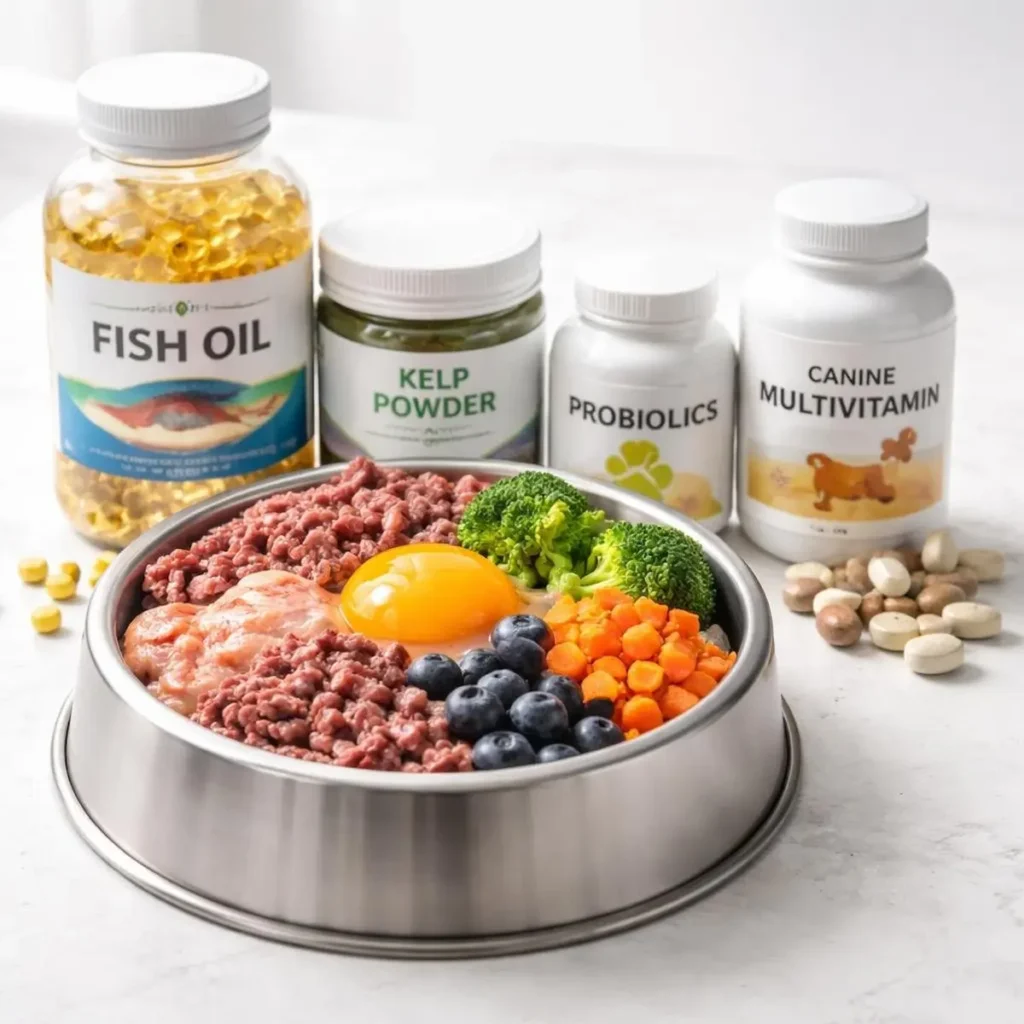
- Fish oil — unless feeding fish-based meals 3+ times per week, omega-3 supplementation remains valuable
- Vitamin E — antioxidant protection, particularly important when fish oil is used regularly
- Kelp or iodine source — iodine is consistently low in raw diets without seafood
- Probiotics — support microbiome health during transition and ongoing
- Canine multivitamin — recommended during the first 6 months while learning to balance raw feeding properly
Is Raw Feeding Right for Every Dog?
IMO the honest answer is: not always. Raw feeding works exceptionally well for many dogs — but certain situations warrant extra caution or outright avoidance:
✅ Raw feeding works well for:
- Healthy adult dogs with no underlying conditions
- Dogs with food sensitivities or allergies (novel protein raw diets)
- Highly active or working dogs with higher protein and fat requirements
- Dogs with chronic skin or coat issues that haven’t responded to commercial food changes
⚠️ Extra caution or veterinary guidance required:
- Puppies — higher calcium-to-phosphorus ratio requirements during bone development
- Senior dogs — reduced immune function affects bacterial risk tolerance
- Dogs with pancreatitis — higher fat content of raw diets can be problematic
- Dogs with compromised immune systems — bacterial risk is elevated
❌ Not recommended without specialist guidance:
- Dogs undergoing chemotherapy
- Dogs with diagnosed kidney or liver disease
- Dogs recovering from surgery or serious illness
Storage and Batch Preparation
- Fridge: Prepared raw meals keep for 2 to 3 days maximum — shorter than cooked homemade food due to bacterial multiplication rates in raw meat
- Freezer: Portioned and frozen immediately after preparation for up to 3 months
- Thawing: Always in the fridge overnight — never microwave or use warm water
- Portion before freezing: Freeze individual meal portions rather than large blocks — thawing only what’s needed minimizes bacterial exposure time
Final Thoughts
Raw feeding done right is genuinely one of the most nutritionally complete approaches to homemade dog food available.
Correct ratios, protein rotation, organ meat inclusion, safe handling, and appropriate supplementation are what separate a raw diet that helps dogs thrive from one that creates problems over time.
The 10 recipes above follow established raw feeding principles and cover the full protein rotation that a genuinely balanced raw diet requires.
Start with Recipe 1 or Recipe 2, get comfortable with the handling protocols, and build the rotation gradually over several weeks.
And please — talk to a vet who has genuine experience with raw feeding before starting. The difference between a vet who understands raw nutrition and one who reflexively dismisses it is enormous, and finding the right one makes the whole journey significantly easier 🙂