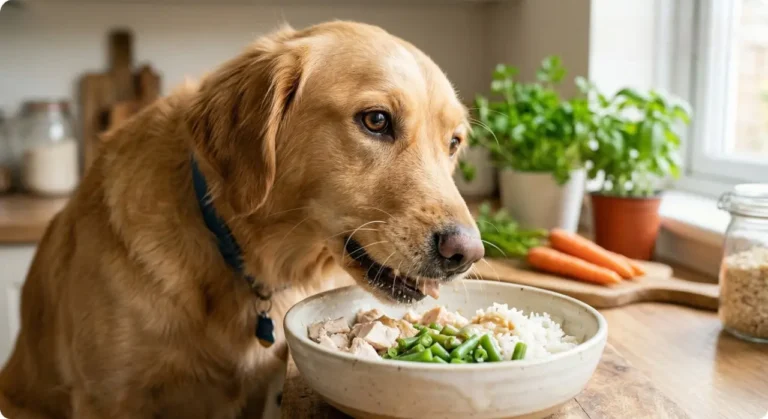

When Pepper was diagnosed with kidney disease at 10 years old, the prescription diet made him turn away from his bowl. Watching him lose weight over just a few days pushed me to find something he’d actually eat.
These recipes brought his appetite back. They’re built around the nutritional principles vets recommend for CKD dogs: controlled phosphorus, quality protein, low sodium, omega-3 support, and lots of moisture.
⚠️ Important Medical Disclaimer: These kidney friendly dog food recipes are designed for dogs already diagnosed with CKD under veterinary care. They complement, never replace, professional medical management.
If your dog hasn’t been diagnosed with kidney disease, general senior nutrition is more appropriate.
Before you start, talk with your vet about which recipes fit your dog’s specific CKD stage and bloodwork. Every dog’s kidney disease looks a little different.
Quick Guide: Which Recipe Is Right for My Dog?
Not sure which recipe to try first? This quick guide matches recipes to your dog’s CKD stage and specific needs.
| Recipe | Protein | Phosphorus Level | Best For | Prep Time |
|---|---|---|---|---|
| #1 Egg White & Rice | Egg whites | Very Low | All CKD stages | 25 min |
| #2 Chicken & White Rice | Chicken breast | Low-Moderate | Early-moderate CKD | 30 min |
| #3 White Fish & Zucchini | Cod/Tilapia | Low | Moderate CKD | 20 min |
| #4 Rabbit & White Rice | Rabbit | Low | All stages (novel protein) | 35 min |
| #5 Chicken & Cabbage | Chicken breast | Low-Moderate | All stages (hydration focus) | 30 min |
| #6 Egg White & Vegetable | Egg whites | Very Low | Advanced CKD | 20 min |
| #7 Salmon & Cauliflower | Salmon | Moderate | Early CKD (omega-3 focus) | 25 min |
| #8 Turkey & Rice | Turkey breast | Low-Moderate | All stages | 30 min |
| #9 Chicken & Apple | Chicken breast | Low-Moderate | Appetite support | 30 min |
| #10 Egg White & Chicken | Both | Low | All stages (variety) | 30 min |
10 Best Kidney Friendly Dog Food Recipes (Vet-Informed)
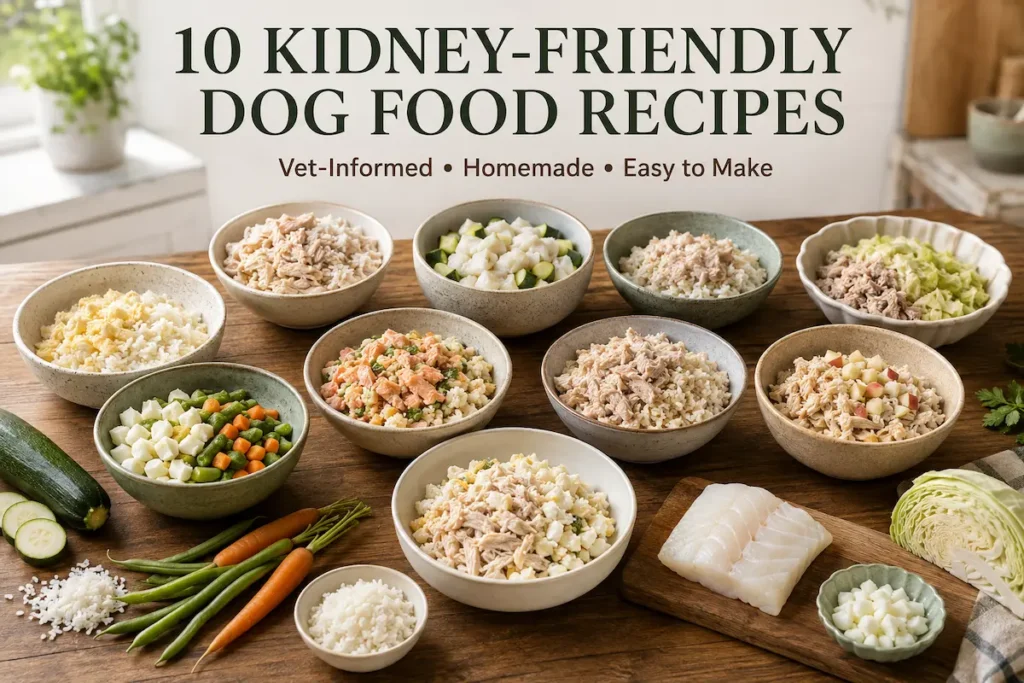
1. Egg White & Rice Bowl: Lowest Phosphorus Recipe for CKD Dogs
Egg whites provide highly digestible complete protein while remaining one of the lowest-phosphorus animal protein sources available.
Since nearly all the phosphorus is found in the yolk, using only the whites makes this recipe a great choice for dogs that need strict phosphorus restriction.
🥘 Ingredients
- 6 large egg whites (yolks removed)
- 1 cup dry white rice
- 1 cup chopped zucchini
- 1 cup chopped green beans
- ½ cup grated carrot
- 3 cups water
- 1 tablespoon fish oil (add after cooking)
📝 Instructions
- Cook the white rice in water for about 18 minutes until very soft.
- Add the zucchini, green beans, and carrot. Simmer for 5 minutes.
- Reduce the heat to low.
- Lightly beat the egg whites and slowly stir them into the hot rice mixture.
- Stir for 2 to 3 minutes until fully cooked.
- Let cool completely, then stir in the fish oil just before serving.
❄️ Storage: Refrigerate for up to 3 days or freeze individual portions for up to 2 months. Add fish oil fresh before serving, not before freezing.
💡 Why This Works: Egg whites deliver high-quality protein with very little phosphorus, while white rice helps keep the overall phosphorus content lower than brown rice. Together, they create a simple, kidney-friendly meal that’s gentle on dogs with CKD.
💾 Save This Recipe: A great homemade option for dogs with advanced kidney disease or those following a phosphorus-controlled diet.
2. Chicken Breast & White Rice: Classic Everyday Renal Meal
Chicken breast offers a practical, budget-friendly protein that’s lower in phosphorus than dark meat or organ meats. Most dogs accept it readily, making this recipe an easy everyday option for managing kidney disease at home.
🥘 Ingredients:
- 2 lbs boneless, skinless chicken breast
- 1 cup dry white rice
- 1 cup chopped green beans
- ½ cup chopped zucchini
- ½ cup grated carrot
- 4 cups water (not broth)
- 1 tablespoon fish oil (add after cooking)
📝 Instructions:
- Add the chicken, rice, carrot, and water to a large pot. Bring to a boil.
- Reduce to a simmer, cover, and cook for about 20 minutes until the rice is very soft.
- Remove the chicken and shred it finely for easier digestion.
- Return the chicken to the pot. Add the green beans and zucchini for the final 5 minutes.
- Let cool completely before serving.
- Add fish oil to each individual serving just before feeding.
❄️ Storage: Refrigerate for 3 to 4 days or freeze individual portions for up to 2 months. Add fish oil fresh before serving, not before freezing.
💡 Why This Works: Using water instead of broth helps control sodium intake, since even low-sodium broths add up over daily feedings. The chicken provides complete protein while keeping phosphorus at a moderate level that works for most CKD stages.
💾 Save This Recipe: Best everyday recipe for early to moderate CKD. Simple, affordable, and appropriate for most kidney disease stages.
3. White Fish & Zucchini Low-Phosphorus Bowl
White fish like cod and tilapia rank among the lowest-phosphorus proteins you can use. This makes them a solid choice when your dog needs stricter phosphorus control as kidney disease progresses.
🥘 Ingredients:
- 2 lbs boneless cod or tilapia
- 1 cup chopped zucchini
- 1 cup chopped green beans
- ½ cup grated carrot
- ½ cup chopped cauliflower
- 3 cups water
- 1 tablespoon fish oil (add after cooking)
📝 Instructions:
- Add the zucchini, green beans, carrot, cauliflower, and water to a large pot. Bring to a boil.
- Cook for about 8 minutes until the vegetables begin to soften.
- Place the fish fillets on top of the vegetable mixture.
- Cover and steam over low heat for 7 to 8 minutes until the fish flakes easily.
- Flake the fish and check very carefully for any small bones.
- Mix gently with the vegetables. Let cool completely.
- Add fish oil to each individual serving just before feeding.
❄️ Storage: Because fish spoils faster than meat, refrigerate for no more than 3 days. Freeze individual portions for up to 2 months. Add fish oil fresh before serving, not before freezing.
⚠️ Note: Check fish extremely carefully for small bones before serving. Run your fingers through the flaked fish and visually inspect it.
💡 Why This Works: Cauliflower adds filling bulk with very little phosphorus, making it useful when you want to reduce grain content while keeping phosphorus low.
💾 Save This Recipe: Perfect for moderate to advanced CKD requiring strict phosphorus restriction. One of the lowest-phosphorus proteins you can make at home.
4. Rabbit & White Rice: Novel Protein Low-Phosphorus Meal
Rabbit offers exceptionally low phosphorus relative to its protein content, putting it on par with egg whites and white fish. As a novel protein, it’s also helpful for dogs dealing with both kidney disease and food sensitivities at the same time.
🥘 Ingredients:
- 1.5 lbs boneless rabbit meat
- 1 cup dry white rice
- 1 cup chopped green beans
- ½ cup grated carrot
- ½ cup chopped zucchini
- 4 cups water
- 1 tablespoon fish oil (add after cooking)
📝 Instructions:
- Add the rabbit, rice, carrot, and water to a large pot. Bring to a boil.
- Skim any foam from the surface (this is normal with rabbit).
- Reduce to a simmer, cover, and cook for about 25 minutes.
- Remove the rabbit and shred it finely. Return to the pot.
- Add the green beans and zucchini for the final 5 minutes.
- Let cool completely. Add fish oil to each individual serving just before feeding.
❄️ Storage: Refrigerate for 3 to 4 days or freeze individual portions for up to 2 months. Add fish oil fresh before serving, not before freezing.
⚠️ Note: Look for rabbit at specialty butchers, ethnic grocery stores (particularly Asian or European markets), or online meat suppliers. It’s worth the effort for the phosphorus-to-protein ratio.
💡 Why This Works: Rabbit delivers protein quality similar to chicken but with phosphorus levels closer to egg whites. As a novel protein, it’s particularly valuable for dogs managing both kidney disease and food sensitivities.
💾 Save This Recipe: Best for dogs with both CKD and food sensitivities. Novel protein with exceptional phosphorus control, suitable for all kidney disease stages.
5. Chicken & Cabbage High-Moisture Hydration Meal
Cabbage brings exceptional water content to this recipe—around 92% moisture. Combined with the cooking liquid, this creates one of the highest-moisture meals in the guide, which may help support dogs whose kidneys can’t concentrate urine efficiently.
🥘 Ingredients:
- 2 lbs boneless chicken breast
- 2 cups finely chopped green cabbage
- 1 cup chopped green beans
- ½ cup grated carrot
- ½ cup chopped zucchini
- 4 cups water
- 1 tablespoon fish oil (add after cooking)
📝 Instructions:
- Add the chicken, cabbage, carrot, and water to a large pot. Bring to a boil.
- Reduce to a simmer, cover, and cook for about 20 minutes.
- Remove the chicken and shred it finely. Return to the pot.
- Add the green beans and zucchini for the final 5 minutes.
- Let cool completely. Add fish oil to each individual serving just before feeding.
❄️ Storage: Refrigerate for 3 to 4 days or freeze individual portions for up to 2 months. Add fish oil fresh before serving, not before freezing.
⚠️ Note: Introduce cabbage gradually if your dog isn’t used to it. Start with half the cabbage amount for the first week to allow digestive adjustment, then increase to the full amount if tolerated well. Some initial gas is normal.
💡 Why This Works: The high cabbage content pushes moisture levels even higher than typical homemade food, which may help dogs who struggle to drink enough water or are losing extra fluids through increased urination.
💾 Save This Recipe: Excellent for dogs struggling with hydration or not drinking enough water. High-moisture content supports kidney function across all CKD stages.
6. Egg White & Vegetable Bowl: Strictest Phosphorus Restriction
This grain-free recipe removes both egg yolks and grains to create the absolute lowest phosphorus option in this guide. It’s designed for situations where bloodwork shows high phosphorus levels that need the strictest dietary control.
🥘 Ingredients:
- 8 large egg whites
- 1 cup chopped zucchini
- 1 cup chopped green beans
- ½ cup grated carrot
- ½ cup chopped cauliflower
- ½ cup chopped cabbage
- 2 cups water
- 1 tablespoon fish oil (add after cooking)
📝 Instructions:
- Add all the vegetables and water to a large pot. Bring to a boil.
- Cook for about 8 minutes until all the vegetables are completely soft.
- Reduce the heat to very low.
- Lightly beat the egg whites and slowly stir them into the hot vegetable mixture.
- Stir continuously for about 3 minutes until the egg whites are fully set.
- Let cool completely. Add fish oil to each individual serving just before feeding.
❄️ Storage: Egg white-based meals are best used within 3 days for optimal freshness. Freeze individual portions for up to 2 months. Add fish oil fresh before serving, not before freezing.
💡 Why This Works: Removing both grains and egg yolks creates the lowest possible phosphorus load while still providing complete protein. The vegetable base adds fiber and nutrients without adding significant phosphorus.
💾 Save This Recipe: The strictest phosphorus-restricted recipe in this guide. Grain-free and yolk-free, designed for advanced kidney disease requiring maximum dietary phosphorus control.
7. Salmon & Cauliflower Omega-3 Support Meal
Salmon provides direct EPA and DHA omega-3 fatty acids. Some research suggests these may have anti-inflammatory properties that could support kidney health, which is why many vets include omega-3-rich foods in CKD management plans.
🥘 Ingredients:
- 1.5 lbs boneless salmon fillets, skin removed
- 1 cup chopped cauliflower
- 1 cup chopped green beans
- ½ cup grated carrot
- ½ cup chopped zucchini
- 3 cups water
- 2 tablespoons fish oil (add after cooking)
📝 Instructions:
- Add the cauliflower, green beans, carrot, zucchini, and water to a large pot. Bring to a boil.
- Cook for about 8 minutes until the vegetables soften.
- Place the salmon on top of the vegetable mixture.
- Cover and steam over low heat for about 8 minutes until the salmon flakes easily.
- Flake the salmon and check very carefully for any small bones.
- Mix gently with the vegetables. Let cool completely.
- Add fish oil to each individual serving just before feeding (double dose for extra omega-3 support).
❄️ Storage: Because fish spoils faster than meat, refrigerate for no more than 3 days. Freeze individual portions for up to 2 months. Add fish oil fresh before serving, not before freezing.
💡 Why This Works: Salmon contains more phosphorus than white fish or chicken, but provides omega-3s that some studies suggest may benefit kidney health. For early to moderate CKD, the potential omega-3 benefits may make this an appropriate occasional rotation.
💾 Save This Recipe: Best for early to moderate CKD where omega-3 anti-inflammatory support is a priority. Use as occasional rotation rather than daily staple for advanced disease.
8. Turkey Breast & Rice Gentle Renal Batch
Turkey breast offers a lean protein option with phosphorus levels similar to chicken breast. It’s a practical way to add variety to your rotation while keeping phosphorus in the low-moderate range.
🥘 Ingredients:
- 2 lbs boneless, skinless turkey breast
- 1 cup dry white rice
- 1 cup chopped green beans
- ½ cup chopped zucchini
- ½ cup grated carrot
- 4 cups water
- 1 tablespoon fish oil (add after cooking)
📝 Instructions:
- Add the turkey, rice, carrot, and water to a large pot. Bring to a boil.
- Reduce to a simmer, cover, and cook for about 22 minutes until the turkey is fully cooked.
- Remove the turkey and shred it very finely. Return to the pot.
- Add the green beans and zucchini for the final 5 minutes.
- Let cool completely. Add fish oil to each individual serving just before feeding.
❄️ Storage: Refrigerate for 3 to 4 days or freeze individual portions for up to 2 months. Add fish oil fresh before serving, not before freezing.
⚠️ Note: Use whole turkey breast specifically, not ground turkey. Ground turkey contains a higher proportion of dark meat and consequently more phosphorus.
💡 Why This Works: Turkey breast keeps phosphorus at levels comparable to chicken breast while providing variety. Rotating proteins helps prevent food boredom and provides a broader range of amino acids over time.
💾 Save This Recipe: Perfect protein rotation alongside chicken for variety. Same low-moderate phosphorus profile, suitable for all CKD stages.
9. Chicken & Apple Palatability Boost Bowl
Many CKD dogs experience reduced appetite due to nausea and general malaise. This recipe uses apple’s natural sweetness to help make food more appealing when appetite starts to decline.
🥘 Ingredients:
- 2 lbs boneless chicken breast
- 1 medium apple, peeled, cored, and diced small (no seeds)
- 1 cup white rice
- ½ cup chopped green beans
- ½ cup grated carrot
- 4 cups water
- 1 tablespoon fish oil (add after cooking)
📝 Instructions:
- Add the chicken, rice, carrot, and water to a large pot. Bring to a boil.
- Reduce to a simmer, cover, and cook for about 18 minutes.
- Remove the chicken and shred it very finely. Return to the pot.
- Add the green beans and apple for the final 5 minutes. The apple will soften but retain some texture.
- Let cool completely. Add fish oil to each individual serving.
- Serve slightly warmed (lukewarm, not hot) to increase aroma and appeal.
❄️ Storage: Refrigerate for 3 to 4 days or freeze individual portions for up to 2 months. Add fish oil fresh before serving, not before freezing.
💡 Why This Works: Warming food to slightly above room temperature releases more aroma, which may help stimulate interest in dogs with suppressed appetite. Test temperature against your wrist before serving.
⚠️ Note: If your dog refuses food for more than 24 hours or is losing significant weight, contact your vet.
💾 Save This Recipe: Designed for picky eaters and dogs with CKD-related appetite suppression. Natural sweetness helps boost interest in food.
10. Egg White & Chicken Breast Mixed Protein Bowl
Combining egg whites and chicken breast creates a recipe that offers protein variety while keeping phosphorus content lower than chicken alone. The mix may also help improve palatability for dogs experiencing appetite changes.
🥘 Ingredients:
- 1.5 lbs boneless chicken breast
- 4 large egg whites
- 1 cup white rice
- 1 cup chopped green beans
- ½ cup grated carrot
- ½ cup chopped zucchini
- 4 cups water
- 1 tablespoon fish oil (add after cooking)
📝 Instructions:
- Add the chicken, rice, carrot, and water to a large pot. Bring to a boil.
- Reduce to a simmer, cover, and cook for about 20 minutes.
- Remove the chicken and shred it very finely. Return to the pot.
- Add the green beans and zucchini. Simmer for 5 minutes.
- Reduce the heat to very low. Lightly beat the egg whites and slowly stir them into the mixture.
- Stir for 2 to 3 minutes until the egg whites are fully set.
- Let cool completely. Add fish oil to each individual serving just before feeding.
❄️ Storage: Because this contains egg whites, refrigerate for up to 3 days rather than 4. Freeze individual portions for up to 2 months. Add fish oil fresh before serving, not before freezing.
💡 Why This Works: The egg white addition keeps overall phosphorus lower than using chicken alone, while providing protein variety that can be helpful for dogs experiencing appetite changes or needing broader amino acid coverage.
💾 Save This Recipe: Versatile mixed-protein option suitable for all CKD stages. Lower phosphorus than chicken-only recipes with added variety for picky eaters.
How These Recipes Support Kidney Health
Every recipe in this guide follows the same nutritional principles commonly recommended for dogs with chronic kidney disease.
While each recipe uses different ingredients, they all aim to support kidney function by managing phosphorus, providing high-quality protein, limiting sodium, increasing moisture, and including omega-3 fatty acids.
1. Phosphorus Restriction
Managing phosphorus is one of the most important nutritional goals for dogs with CKD because damaged kidneys cannot remove excess phosphorus efficiently.
That’s why these recipes focus on naturally lower-phosphorus ingredients such as:
- Egg whites
- White fish (cod, tilapia)
- Chicken breast
- Rabbit
They also avoid or limit higher-phosphorus foods like organ meats, dairy products, legumes, and large amounts of whole eggs.
Remember: The ideal phosphorus level depends on your dog’s CKD stage and bloodwork, so always follow your veterinarian’s recommendations.
2. High-Quality Protein
Modern veterinary nutrition focuses on feeding enough highly digestible protein while controlling phosphorus, rather than simply feeding less protein.
That’s why these recipes use proteins such as egg whites, lean poultry, rabbit, and white fish to help maintain muscle while being easier on the kidneys.
3. Lower Sodium
All recipes are made without added salt or regular commercial broth, helping keep sodium intake lower than many homemade meals.
4. Omega-3 Support
Fish oil is included throughout this guide because EPA and DHA may help support kidney health and are commonly recommended as part of CKD nutritional management.
5. High Moisture
Homemade food naturally contains much more moisture than dry kibble, helping many CKD dogs increase their daily water intake through meals.
Protein Guide & Supplements for CKD Dogs
Nutrition plays a major role in managing chronic kidney disease. Along with choosing the right protein, the vegetables and supplements you use can also make a difference.
🥩 Best Protein Choices
The table below compares common protein sources based on their phosphorus levels and when they’re typically recommended for dogs with CKD.
| Protein Source | Phosphorus Level | Commonly Recommended For |
|---|---|---|
| Egg whites | Very Low | All CKD stages |
| Rabbit | Very Low | All CKD stages |
| White fish (cod, tilapia) | Low | All CKD stages |
| Chicken breast | Low-Moderate | Early to moderate CKD |
| Turkey breast | Low-Moderate | Early to moderate CKD |
| Salmon | Moderate | Early CKD (omega-3 support) |
| Ground beef | Moderate-High | Discuss with your vet |
| Organ meats | Very High | Generally avoided |
| Whole eggs | Moderate-High | Limited use |
🥦 Best Vegetables for CKD Dogs
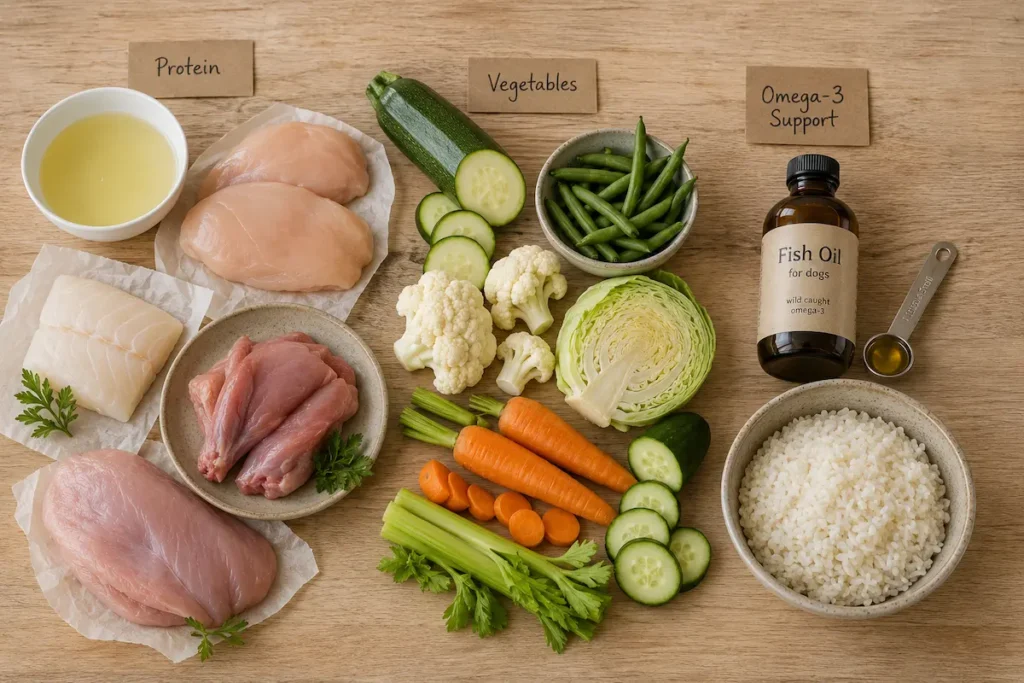
Most vegetables are naturally low in phosphorus while providing fiber, vitamins, antioxidants, and extra moisture.
- Zucchini
- Green beans
- Cabbage
- Cauliflower
- Carrots
- Cucumber
- Celery
- Bell peppers
- Broccoli
- Asparagus
- Sweet potato
- Spinach
- Kale
- Legumes
- Tomatoes (especially for some dogs with advanced CKD)
Always discuss ingredient choices with your veterinarian, particularly if your dog has advanced kidney disease or other medical conditions.
🐾 Common Supplements
These supplements are commonly recommended or discussed by veterinarians as part of CKD management. Always check with your veterinarian before adding supplements to your dog’s diet.
- Fish Oil (EPA/DHA): May help support kidney health and provide anti-inflammatory omega-3 fatty acids.
- B Vitamins: May help replace water-soluble vitamins lost through increased urination.
- Phosphorus Binders: Sometimes prescribed when diet alone cannot adequately control blood phosphorus levels.
- Potassium: Supplemented only if bloodwork shows low potassium levels.
- Probiotics: May support digestive health in some dogs with CKD.
How to Feed a Dog with Kidney Disease
Portion Guidelines
| Dog Size | Per Meal | Meals Per Day | Hydration |
|---|---|---|---|
| Under 10 lbs | ¼ to ⅓ cup | 2 to 3 | Fresh water always available |
| 10 to 20 lbs | ⅓ to ½ cup | 2 to 3 | Fresh water always available |
| 20 to 50 lbs | ¾ to 1 cup | 2 to 3 | Fresh water always available |
| 50 to 80 lbs | 1 to 1½ cups | 2 to 3 | Fresh water always available |
| 80+ lbs | 1½ to 2 cups | 2 to 3 | Fresh water always available |
These are starting guidelines only. Your veterinarian should adjust portions based on your dog’s weight, body condition, activity level, and bloodwork.
For more detailed guidance on portioning homemade food, see How Much Homemade Dog Food to Feed Your Dog.
Feeding frequency: CKD dogs may benefit from smaller, more frequent meals (three meals daily rather than two) to reduce the metabolic workload on kidneys at any single meal.
Transitioning to Homemade Food
Switch gradually over 7 to 10 days, replacing a little more of your dog’s current food every few days. If vomiting, diarrhea, or appetite loss develops, slow the transition and speak with your veterinarian if symptoms continue.
What to Monitor
Keep an eye on:
- Body weight
- Appetite
- Water intake
- Energy level
Report any sudden changes to your veterinarian.
Storage Tips
- Chicken, turkey, and rabbit recipes: Refrigerate up to 4 days.
- Fish and egg-based recipes: Best used within 3 days.
- Freeze portions for up to 2 months.
- Always add fish oil just before serving.
For detailed storage strategies, see our Homemade Dog Food Storage: 7 Tips guide.
Troubleshooting Common Feeding Issues
My Dog Won’t Eat
Try warming the food slightly, feeding smaller meals more often, or starting with the Chicken & Apple recipe for extra palatability.
If your dog refuses food for more than 24 hours, contact your veterinarian.
Vomiting or Diarrhea
Mild digestive changes can happen during the transition.
Slow the transition, offer smaller meals, and keep fresh water available. If vomiting or diarrhea lasts longer than 24 to 48 hours, contact your veterinarian.
My Dog Is Losing Weight
Gradually increase portion sizes or feed an additional small meal each day.
If weight loss continues despite eating well, schedule a veterinary recheck.
How Your Dog May Respond
Every dog responds differently, but many owners notice gradual improvements after switching to an appropriate kidney-friendly diet.
Week 1–2
- Better interest in food
- Slightly softer stools
- Increased water intake
Month 1–3
- More consistent appetite
- Weight stabilization
- Healthier-looking coat
- Improved hydration
Long-Term
Many dogs maintain a good quality of life for months or even years with appropriate nutrition, medications, and regular veterinary care.
Continue routine bloodwork to monitor your dog’s kidney function and adjust the diet as needed.
Every dog progresses differently, so regular veterinary checkups and bloodwork remain the best way to monitor your dog’s response.
Supporting Your Dog Through CKD
A kidney disease diagnosis can feel overwhelming, but nutrition is one of the most effective ways to support your dog’s long-term health.
These kidney-friendly recipes are built around commonly recommended renal diet principles and are designed to complement—not replace—your veterinarian’s treatment plan.
With regular monitoring, routine bloodwork, and the right recipe rotation, many dogs with CKD continue to enjoy a good quality of life for months or even years.
If you’re just getting started, choose the recipe that best matches your dog’s CKD stage using the Quick Guide above, then work with your veterinarian to build a long-term feeding plan.