When your dog is sick, an untouched food bowl can become almost as worrying as the illness itself.
Dogs recovering from stomach upset, infection, surgery, or another illness may temporarily lose interest in their normal food or eat only a few bites at a time.
A good recovery diet for sick dogs should do more than simply be “bland.” It should be easy to eat, gentle on digestion, appealing to a weak appetite, and nutritious enough to make small portions count.
Below are two gentle homemade recovery recipes, including a chicken-free option, plus practical guidance on the ingredients that work best during recovery and the foods that may need more caution.
These recipes are intended for short-term recovery feeding, not as nutritionally complete long-term diets. If your veterinarian has prescribed a therapeutic diet or specific feeding plan, follow that recommendation first.
🥣 What a Sick Dog Needs From Food
When appetite drops, every bite matters more.
A useful homemade recovery diet for a sick dog should focus on five nutritional priorities.
High-Quality Protein
Protein supplies amino acids the body uses to maintain and repair tissues.
When a dog is sick, recovering from surgery, or eating much less than usual, preserving lean muscle becomes especially important.
Chicken, turkey, egg, lean beef, and fish can all provide high-quality animal protein when they suit the individual dog.
Enough Energy
A dog eating only half their normal portion may also be consuming far fewer calories than usual.
That means recovery feeding is not simply about finding something the dog will swallow. The meal should provide enough useful energy to make those smaller portions worthwhile.
Good Digestibility
Soft, thoroughly cooked foods are usually more practical during recovery than large quantities of raw vegetables, very fibrous ingredients, or heavy meals.
If digestive problems continue even after the illness has passed, a more targeted approach for sensitive stomachs may make more sense than staying on a temporary recovery diet.
This is especially important when the digestive system is already under stress.
Extra Moisture
Adding warm water to food increases moisture and creates a softer texture that may be easier for a sick dog to eat.
Food can contribute to hydration, although it cannot correct significant dehydration by itself.
Palatability
A nutritionally excellent meal has little value if the dog refuses it.
Slightly warming food, offering smaller portions, and using familiar ingredients can make a recovery meal much more appealing.
The goal is not simply:
“How bland can I make this?”
It is:
“How can I make each small meal easy to tolerate and nutritionally worthwhile?”
2 Gentle Homemade Recovery Recipes for Sick Dogs
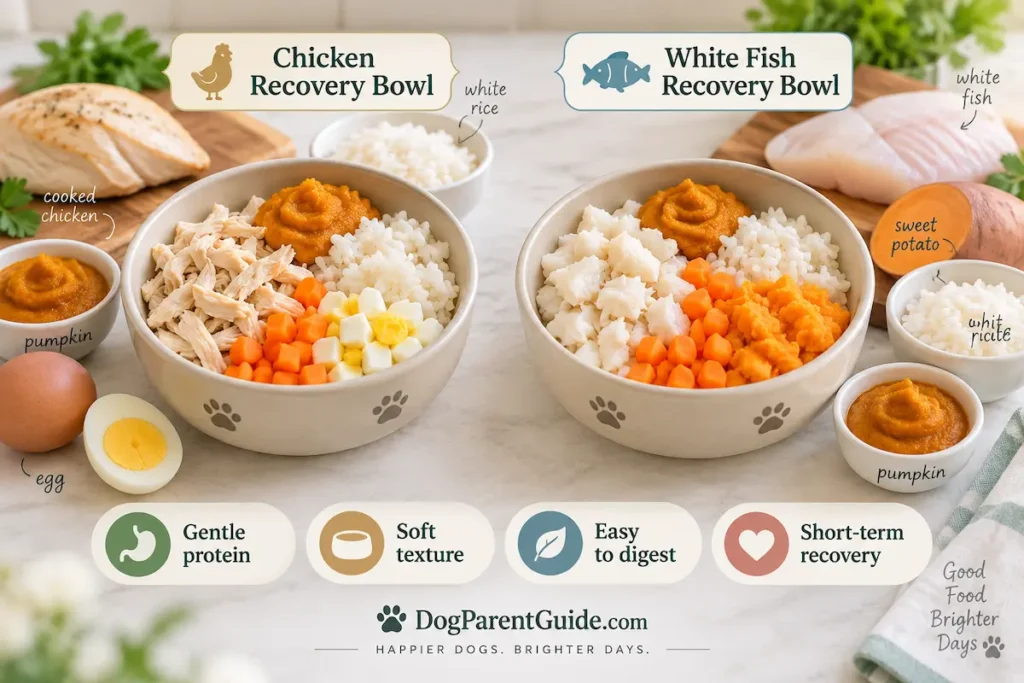
🍗 Recipe #1: Chicken Recovery Bowl
This is a practical starting point for a dog that already eats and tolerates chicken well.
It combines lean animal protein, easily digested carbohydrate, moderate fiber, and extra moisture without turning the bowl into a complicated recipe.
✔️ Best for: Short-term recovery, reduced appetite, soft-food needs, and dogs already accustomed to chicken.
Ingredients
- 1 cup cooked skinless, boneless chicken breast, finely shredded
- 1 cup very soft cooked white rice
- 1/3 cup plain pumpkin puree
- 1 fully cooked egg, finely chopped
- 1/2 to 1 cup warm water as needed
Use 100% plain pumpkin puree, not pumpkin pie filling.
Instructions
- Cook the chicken thoroughly without oil, salt, garlic, onion, sauces, or seasoning.
- Cook the white rice until very soft.
- Fully cook the egg.
- Finely shred or chop the chicken and egg.
- Mix everything with the pumpkin.
- Add warm water until the meal reaches a soft, moist consistency.
- Serve slightly warm, never hot.
Why This Bowl Works
Chicken breast provides concentrated animal protein while remaining relatively lean.
White rice contributes easily available carbohydrate and calories without a large fiber load.
Pumpkin adds moisture, potassium, carotenoids, and some fiber, while egg increases the amount of protein and energy packed into a relatively small portion.
That makes this bowl more nutritionally useful than plain chicken and rice alone.
It is still not complete and balanced for long-term feeding, however. It does not provide the carefully formulated calcium, phosphorus, trace minerals, vitamins, essential fatty acids, and other nutrients an everyday diet requires.
Think of it as a temporary bridge while your dog gets back on their feet.
🐟 Recipe #2: Chicken-Free Recovery Bowl
Chicken is not suitable for every dog.
If your dog has a known chicken allergy, does not tolerate poultry well, or is already eating a veterinarian-approved fish-based diet, white fish offers another option.
✔️ Best for: Dogs that cannot eat chicken and already tolerate fish and sweet potato.
Ingredients
- 1 cup cooked boneless white fish such as cod or pollock
- 1 cup cooked, mashed sweet potato
- 1/2 cup very soft cooked white rice
- 2 tablespoons plain pumpkin puree
- 1/2 to 1 cup warm water as needed
Instructions
- Cook the fish completely without butter, oil, salt, garlic, onion, or seasoning.
- Check carefully for bones and flake the fish into small pieces.
- Cook and mash the sweet potato until very soft.
- Mix the fish, sweet potato, rice, and pumpkin.
- Add warm water until the texture is easy to lick or chew.
- Serve slightly warm.
Why This Bowl Works
White fish provides high-quality animal protein while remaining relatively lean and easy to flake into a soft texture.
Sweet potato adds carbohydrate, potassium, beta-carotene, and fiber. White rice contributes additional easily available energy without adding much bulk.
The important word here is tolerates.
If your dog is following an elimination diet or has a diagnosed food allergy, do not introduce a random new protein simply because it appears in a recovery recipe.
For dogs dealing with ongoing food sensitivities, limited ingredient recipes can make it easier to keep the protein and ingredient list simple while you identify what works.
Use a protein your dog has already tolerated or one your veterinarian has specifically recommended.
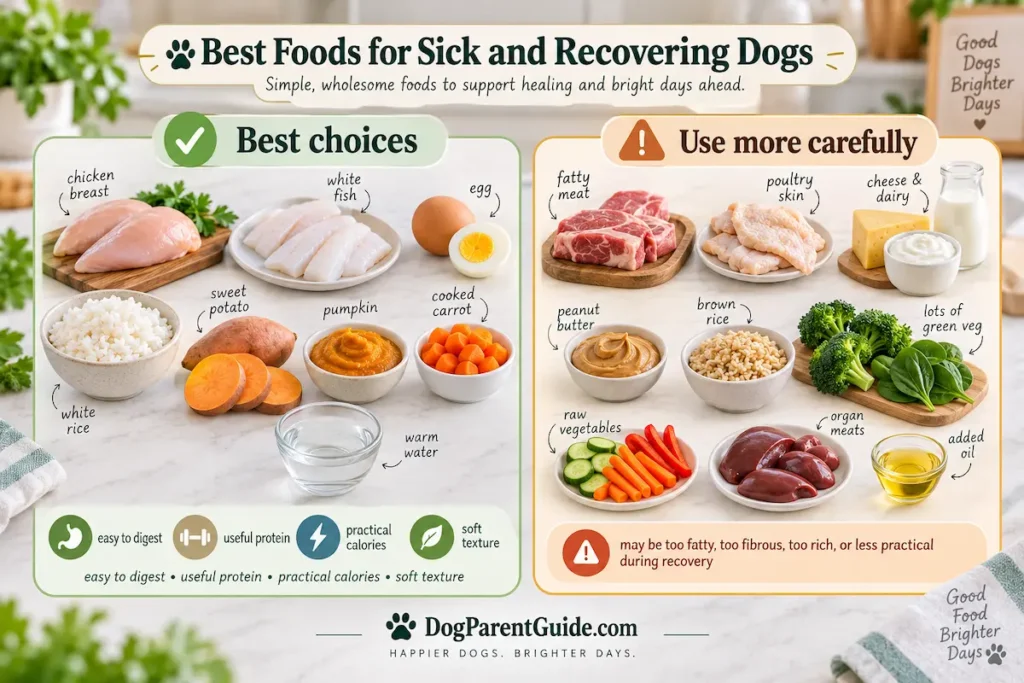
🥕 Best Foods for Sick and Recovering Dogs
There is no single list of foods that every sick dog should eat because the underlying illness always matters.
But when there is no medical reason to restrict them, several ingredients work particularly well in short-term recovery meals.
🎯 Lean Proteins
Chicken breast
Chicken breast provides concentrated protein without large amounts of fat. It can also be shredded very finely, making it easy to incorporate into soft meals.
Lean turkey
Turkey offers a similar nutritional role and can work well for dogs already accustomed to it.
Choose lean meat and avoid skin, seasoning, and excessive rendered fat.
White fish
Cod, pollock, and similar fish provide soft, lean animal protein and can be useful when poultry is not appropriate.
Cooked egg
Egg packs protein, fat, choline, selenium, riboflavin, vitamin B12, and other nutrients into a relatively small amount of food.
That can be valuable when a dog is eating only small portions.
🎯 Gentle Carbohydrates
White rice
White rice is soft, low in fiber, and easy to mix into a moist meal.
It provides calories without taking up excessive digestive space, which makes it useful when simplicity matters more than maximizing fiber.
Sweet potato
Sweet potato adds carbohydrate, potassium, beta-carotene, and fiber.
Cook and mash it thoroughly so the texture stays soft.
Plain potato
Cooked peeled potato can also provide easily eaten carbohydrate for dogs that tolerate it.
Serve it plain and fully cooked.
🎯 Useful Vegetables and Add-Ins
Pumpkin
Plain pumpkin provides moisture and fiber while giving the meal a soft consistency.
But pumpkin should support the meal, not dominate it. A dog eating very little still needs meaningful protein and calories.
Cooked carrot
Soft cooked carrot contributes beta-carotene and some fiber without the harder texture of raw carrot.
Use modest amounts rather than turning the bowl into mostly vegetables.
Warm water
Warm water is one of the simplest recovery-diet tools.
It adds moisture, softens the meal, and can increase aroma when mixed into slightly warmed food.
The broader rule is simple:
Protein and energy should build the recovery meal. Vegetables and extras should support it.
⚠️ Foods to Use More Carefully
One of the easiest mistakes to make is assuming:
dog-safe = ideal for a sick dog.
It doesn’t.
Many foods that fit perfectly well into a healthy dog’s diet may be less useful when appetite, digestion, or calorie intake is compromised.
Fatty Meat and Poultry Skin
Beef, pork, dark poultry meat, and skin can all be dog-safe when properly prepared.
But high amounts of fat may be difficult for some sick dogs to tolerate and can be inappropriate for dogs that require fat restriction.
If your veterinarian specifically wants fat intake reduced, a lower-fat homemade meal will be a better starting point than simply removing a few rich ingredients from this recipe.
A richer meal is not automatically a better recovery meal.
Cheese and Dairy
Some dogs tolerate small amounts of cheese perfectly well.
But dairy can add considerable fat, and some dogs do not handle lactose particularly well.
Recovery is not the ideal time to find out.
Peanut Butter
Dog-safe peanut butter without xylitol can be useful as an occasional treat.
But it is both calorie-dense and fat-dense.
That does not make it the automatic solution for a dog refusing meals, especially when the underlying condition calls for lower-fat feeding.
Brown Rice
Brown rice can be nutritious in a normal diet, but it contains more fiber than white rice.
When the goal is an easily digested source of calories with relatively little bulk, white rice is often the more practical recovery ingredient.
Large Amounts of Green Vegetables
Green beans, broccoli, and other dog-safe vegetables can provide useful nutrients and fiber.
But they are not particularly energy-dense.
If a sick dog is eating only a few spoonfuls, filling half the bowl with low-calorie vegetables can crowd out the protein and calories that matter more.
Some fibrous vegetables can also contribute additional digestive bulk or gas.
Raw Vegetables
Crunchy vegetables can be perfectly appropriate for healthy dogs.
During recovery, however, cooked and softened vegetables are often easier to chew and incorporate into a gentle meal.
Organ Meats
Liver and other organs are extremely nutrient-dense.
That is a reason to use them carefully, not an excuse to add large amounts.
A rich new ingredient can also make an already unsettled stomach harder to assess.
Large Amounts of Added Oil
Oil can dramatically increase the calories in a meal, but blindly adding fat is not an appropriate strategy for every sick dog.
Some dogs may benefit from a more energy-dense diet. Others specifically need less fat.
A food being healthy does not automatically make it recovery-friendly.
Context matters.
💪 Why Protein and Calories Matter
Chicken and rice has become almost synonymous with food for a sick dog.
But “bland” is not a nutrient requirement.
A recovering dog still needs protein, energy, water, vitamins, minerals, essential fatty acids, and other nutrients.
When calorie intake falls too low, the body may use dietary protein for energy rather than reserving it for its many structural and metabolic roles.
Meanwhile, illness, reduced activity, and poor food intake can contribute to loss of body weight and muscle.
That is why I would not build a recovery diet for sick dogs homemade around rice alone.
Protein should remain a meaningful part of the bowl.
If you want to understand the numbers behind that, our guide to how much protein dogs need explains protein requirements in a much more practical way.
Calories matter too.
If a dog normally eats 700 calories per day but is suddenly managing only 250, the fact that they are technically “eating something” does not mean their nutritional needs are being met.
That does not mean every sick dog needs a greasy, calorie-packed meal.
It means every small serving should provide useful nutrition.
🍽️ When Your Sick Dog Won’t Eat
Sometimes the recipe itself is not the main problem.
Nausea, pain, medication, stress, fever, fatigue, and gastrointestinal discomfort can all suppress appetite.
Before rotating through several completely different foods, try changing how you offer an appropriate meal.
Warm the Food Slightly
Warm food releases more aroma than refrigerator-cold food, which may make it more appealing.
Offer Smaller Portions
A full bowl can feel overwhelming to a nauseated dog.
Start with a few bites and offer more if your dog remains interested.
Feed More Often
Several small meals may be easier to manage than one or two large portions.
If you prepare a larger batch, portion it into small servings and follow safe homemade dog food storage practices so you are not repeatedly reheating the entire batch.
Try a Different Dish
Some dogs will lick food from a flat plate even when they ignore a deep bowl.
Keep the Environment Calm
Give your dog somewhere quiet to eat without another pet hovering nearby.
Track What They Actually Eat
Write down how much you offered and how much remained.
“I think he ate a little” becomes difficult to evaluate after several days.
A simple food record also gives your veterinarian better information if appetite does not improve.
If appropriate food, warming, smaller meals, and a quiet environment do not help, the underlying nausea or pain may need treatment.
The answer is not always a more exciting topping.
How Much Recovery Food Should You Feed?
There is no universal cup measurement for a sick dog.
A 10-pound Chihuahua recovering from a mild illness and a 70-pound Labrador recovering from surgery clearly require very different amounts.
Veterinary teams often use Resting Energy Requirement, or RER, as one starting point when evaluating calorie needs.
A commonly used shortcut for many dogs is:
RER ≈ 30 × body weight in kilograms + 70
For example, a 10 kg dog has an estimated RER of approximately:
30 × 10 + 70 = 370 calories per day
That does not mean every sick 10 kg dog should immediately receive exactly 370 calories.
Diagnosis, body condition, previous intake, nausea, digestive tolerance, and the severity of illness can all change the appropriate feeding plan.
For uncomplicated home recovery, the more useful takeaway is:
Pay attention to what your dog actually consumes, not just what you put in the bowl.
Watch appetite, weight, water intake, stool quality, vomiting, and overall energy.
💧 Moisture Helps, but It Has Limits
Adding warm water to either recovery recipe can turn it into a soft mash or stew-like meal.
That increases moisture while making the food easier to lick.
Fresh water should still remain available.
And extra water in food has limits.
A dog with repeated vomiting, significant diarrhea, very low fluid intake, or an inability to keep water down may need veterinary fluid therapy.
A moist homemade meal can support hydration.
It cannot correct serious dehydration by itself.
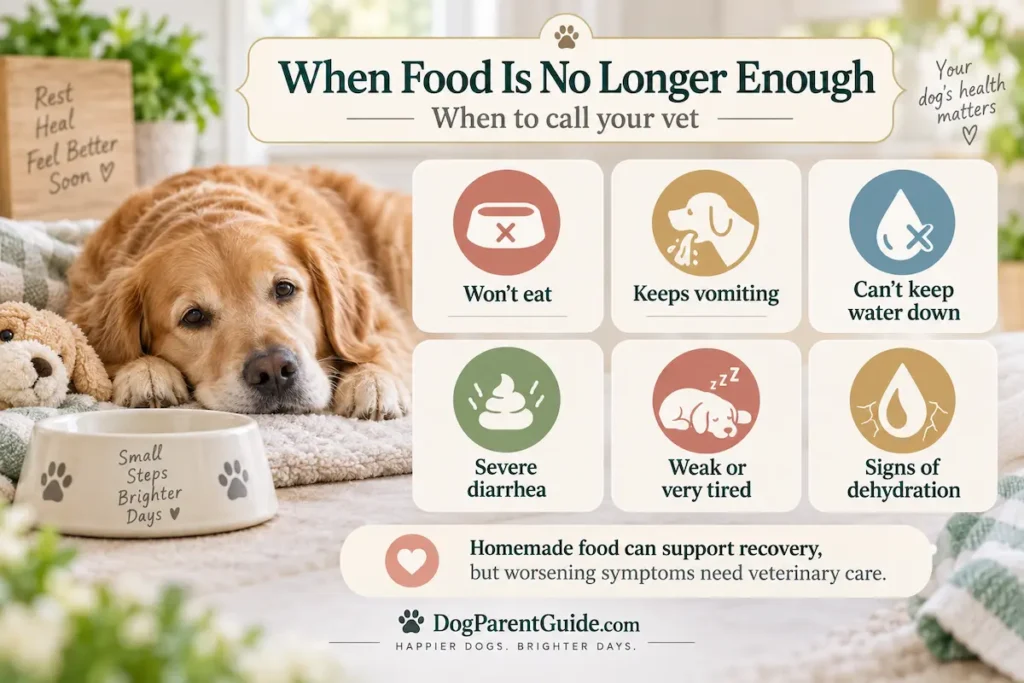
🚨 When Food Is No Longer Enough
A homemade recovery diet is useful only when home feeding is appropriate in the first place.
Contact your veterinarian promptly if your dog:
- refuses food completely
- continues eating dramatically less than normal
- repeatedly vomits
- cannot keep water down
- develops severe or bloody diarrhea
- becomes weak, collapsed, disoriented, or unusually lethargic
- has a swollen or painful abdomen
- appears dehydrated
- loses noticeable weight
- worsens instead of improving
- has a condition requiring a therapeutic diet
- is a very young puppy, diabetic, pregnant, medically fragile, or otherwise high-risk
Do not force food into a dog that refuses to swallow.
Force-feeding or inappropriate syringe feeding can create aspiration risk and may make food aversion worse.
At that point, the dog needs better medical support, not a more persuasive bowl of chicken.
🔄 Know When to Return to Normal Food
Both homemade recipes in this article are designed for short-term recovery feeding.
Neither recipe has been formulated as a complete and balanced everyday diet.
Long-term homemade dog food requires intentional formulation to provide appropriate amounts and ratios of calcium, phosphorus, essential fatty acids, vitamins, trace minerals, amino acids, and calories.
Once your dog’s appetite, digestion, and general condition improve, begin transitioning back toward their normal complete diet according to your veterinarian’s advice.
That might mean gradually moving from mostly recovery food to a mixture of recovery and regular food before returning fully to the usual diet.
Some dogs can transition quickly.
Others need longer.
If symptoms return when regular food is reintroduced, do not simply switch back to chicken and rice indefinitely.
That is a reason to look for the underlying cause.
The Bottom Line: Make Every Bite Count
A good recovery diet for sick dogs should be easy to eat, rich in useful protein and energy, and moist enough to support a dog that is not eating normally.
Choose ingredients your dog already tolerates, keep portions small and simple, and remember that these homemade recipes are intended for short-term recovery only.
If appetite remains poor, vomiting continues, hydration drops, or your dog is not clearly improving, contact your veterinarian rather than relying on homemade food alone.