
If you make your dog’s meals at home, you have probably wondered: how much protein does a dog need each day, and how much protein should homemade dog food actually contain?
For healthy adult dogs, AAFCO sets a minimum of 18% protein on a dry matter basis or 45 grams per 1,000 calories. Puppies and dogs in growth or reproduction need more.
But dog protein requirements are not just about adding more meat to the bowl. Calories, life stage, activity level, protein quality, amino acids, and the balance of the entire homemade diet all matter.
This guide breaks down protein requirements for dogs eating homemade food and shows you how to translate those numbers into something practical.
🥩 How Much Protein Does a Dog Need Per Day?
So, how much protein does a dog need on a daily basis?
According to AAFCO nutrient profiles, food for healthy adult dogs should provide at least:
- 18% crude protein on a dry matter basis
- 45 grams of protein per 1,000 kcal of metabolizable energy
For growth and reproduction, including puppies and pregnant or nursing dogs, the minimum is higher:
- 22.5% crude protein on a dry matter basis
- 56.3 grams of protein per 1,000 kcal
These are minimum nutrient standards, not perfect protein targets for every individual dog.
Protein requirements for dogs can vary depending on:
- age
- life stage
- activity level
- body condition
- overall calorie intake
- health status
- protein quality and digestibility
| Life Stage | Minimum Protein, Dry Matter | Protein per 1,000 kcal |
|---|---|---|
| Adult maintenance | 18% | 45 g |
| Growth & reproduction | 22.5% | 56.3 g |
For homemade dog food, the calorie-based number is especially useful because home-cooked meals often contain far more water than kibble.
A bowl may look relatively low in protein when you look at the percentage as served, but once moisture and calorie density are taken into account, the picture can be very different.
🧮 How Much Protein Should a Dog Get Based on Daily Calories?
One of the easiest ways to understand dog protein requirements is to look at protein relative to calories.
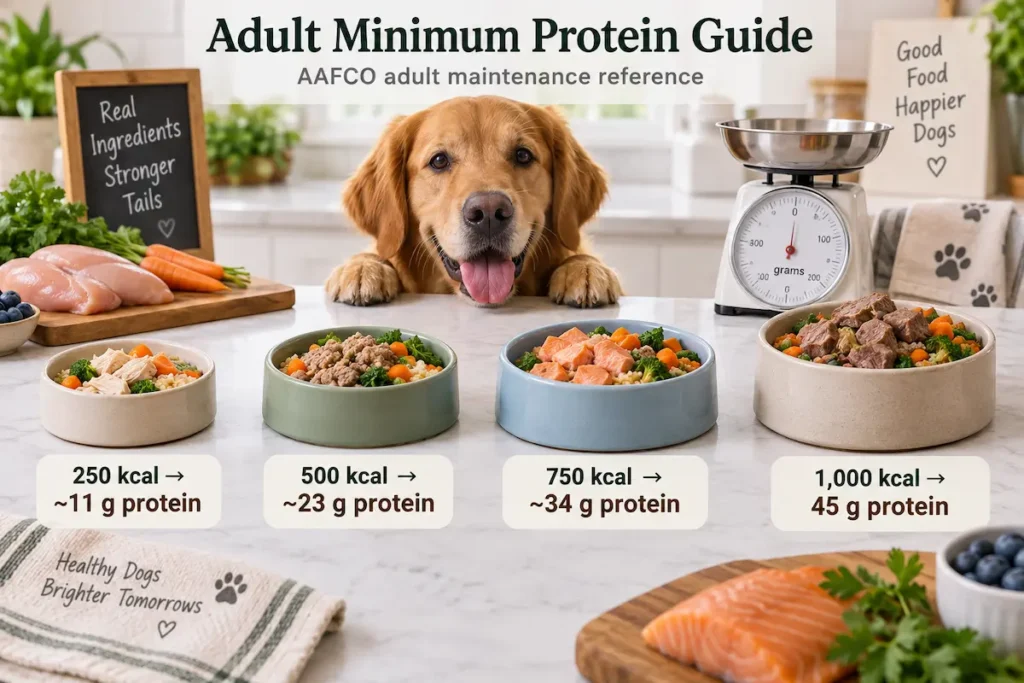
Using the AAFCO adult-maintenance minimum of 45 grams of protein per 1,000 calories, we can make the numbers easier to visualize.
| Calories Eaten per Day | Equivalent Adult Minimum Protein |
|---|---|
| 250 kcal | ~11 g |
| 400 kcal | ~18 g |
| 500 kcal | ~23 g |
| 600 kcal | ~27 g |
| 750 kcal | ~34 g |
| 800 kcal | ~36 g |
| 1,000 kcal | 45 g |
| 1,200 kcal | ~54 g |
For example, a healthy adult dog eating about 500 calories per day would receive the equivalent AAFCO adult-maintenance minimum at roughly 22.5 grams of protein per day.
That does not mean 22.5 grams is the perfect target for every dog eating 500 calories.
Think of this table as a reference point, not an individualized prescription.
Two dogs eating the same number of calories may still have somewhat different needs depending on age, activity, body condition, and health.
If you are unsure how many calories your dog should be eating, start with our guide on how much homemade dog food to feed your dog before trying to estimate daily protein intake.
⚖️ Why Protein Percentage Can Be Misleading in Homemade Dog Food
If you are trying to figure out how much protein homemade dog food should have, percentage alone can be confusing.
The biggest reason is water.
💧 As-Fed Protein vs. Dry Matter Protein
Imagine a homemade meal that contains:
- 10% protein as served
- 75% moisture
That means only 25% of the food is dry matter.
To convert the protein to a dry matter basis:
10 ÷ 25 × 100 = 40% protein on a dry matter basis
So although the meal appears to contain only 10% protein when you look at it as served, it contains 40% protein once the water is removed from the comparison.
This is why comparing the protein percentage on a dry kibble label directly with a fresh or homemade meal can be misleading.
The two foods may contain very different amounts of moisture.
🔢 Why Protein per 1,000 Calories Can Be More Useful
Protein per 1,000 calories solves another problem.
Dogs do not normally eat identical weights or volumes of different foods. They eat enough food to meet their energy needs.
Two homemade recipes could contain similar protein percentages but very different calorie densities.
Looking at protein relative to calories gives you a clearer picture of how much protein your dog actually receives while eating enough food to meet daily energy needs.
For homemade feeding, this is often more useful than simply asking what percentage of the bowl should be meat.
🍗 Dog Protein Requirements Are About More Than Meat
A homemade meal can contain plenty of meat and still fail to meet all of a dog’s nutritional needs.
That is because dogs do not simply need “chicken,” “beef,” or a high protein number.
They need the amino acids supplied by dietary protein.
🧬 Dogs Need Essential Amino Acids
Dogs require 10 essential amino acids from their diet:
- Arginine
- Histidine
- Isoleucine
- Leucine
- Lysine
- Methionine
- Phenylalanine
- Threonine
- Tryptophan
- Valine
These amino acids help support normal tissue maintenance, growth, and many other biological functions.
This is one reason protein quality matters.
⭐ Protein Quality Matters Too
Two foods that contain the same number of grams of crude protein are not necessarily nutritionally identical.
Important differences include:
- amino acid profile
- digestibility
- processing and cooking
- how the protein is combined with other ingredients
Animal-based foods can provide high-quality protein, but that does not mean a homemade diet should consist almost entirely of meat.
The goal is not to chase the highest possible protein percentage.
The goal is to provide adequate, digestible protein and essential amino acids within a nutritionally balanced diet.
🥩 Good Protein Sources for Homemade Dog Food
There is no single best protein source for every dog.
Different proteins can work well depending on your dog’s calorie needs, preferences, tolerance, and the rest of the recipe.
🍗 Lean Everyday Proteins
Common options include:
- chicken
- turkey
- lean beef
- lean pork
Chicken and turkey are popular because they are easy to find and versatile.
Keep in mind that fat and calorie content can vary significantly depending on the cut or grind.
For example, lean ground turkey and higher-fat ground turkey may provide similar amounts of protein but very different calories.
If turkey is one of your regular ingredients, see our ground turkey dog food recipes for more meal ideas.
🐟 Fish
Protein-rich fish options include:
- salmon
- sardines
- white fish
Fish provides protein, while oily fish such as salmon and sardines can also contribute omega-3 fatty acids.
But fish types vary considerably in fat and calorie density.
White fish is usually much leaner than salmon, so replacing one gram-for-gram with the other can significantly change the calories and fat in a recipe.
🥩 Other Protein Options
For more variety, some dog parents use:
- lamb
- duck
- venison
- rabbit
These proteins can also be useful when a veterinarian recommends exploring different protein sources for an individual dog.
Our homemade dog food for itchy skin guide includes several protein options, but suspected food allergies should be assessed properly rather than managed by randomly switching proteins over and over.
🥚 Eggs
Eggs provide high-quality, digestible protein and can be a useful ingredient in homemade dog food.
They can fit well into a formulated recipe, but adding an egg to an otherwise incomplete meal does not automatically make the entire diet balanced.
| Protein Source | Why Dog Parents Use It | What to Consider |
|---|---|---|
| Chicken | Affordable and versatile | Some cuts are much fattier than others |
| Turkey | Lean options available | Fat varies by grind |
| Beef | Flavorful and nutrient-dense | Calorie density can be high |
| Salmon | Protein plus omega-3 fats | Higher in fat and calories |
| White fish | Lean protein option | Lower calorie density |
| Sardines | Protein and omega-3 fats | Portions can add calories quickly |
| Eggs | Convenient and digestible | Should be part of a balanced recipe |
| Lamb or duck | Adds protein variety | Often higher in fat |
🥣 How Much Protein Should Homemade Dog Food Have?
This is where many homemade feeding guides oversimplify the answer.
You may see formulas such as:
50% meat + 25% vegetables + 25% carbohydrates
But there is no universal meat-to-vegetable ratio that automatically produces a complete and balanced homemade dog food.
Consider:
- 100 grams of chicken breast
- 100 grams of ground beef
- 100 grams of salmon
They do not provide identical amounts of:
- protein
- fat
- calories
- vitamins
- minerals
- essential fatty acids
Even different cuts of the same animal can have very different nutrient profiles.
So when asking how much protein should homemade dog food have, it is better to think in terms of total nutrient density rather than simply what percentage of the bowl is meat.
A Meat-Heavy Bowl Can Still Be Unbalanced
Imagine a homemade bowl containing:
- chicken breast
- brown rice
- carrots
- green beans
It may look healthy.
It may contain plenty of protein.
But that alone does not tell us whether the meal provides enough:
- calcium
- iodine
- zinc
- copper
- vitamin D
- vitamin E
- essential fatty acids
- other vitamins and minerals
This is one of the most common problems covered in our guide to homemade dog food mistakes.
Meeting dog protein requirements does not mean the whole diet is nutritionally complete.
🐶 How Much Protein Does a Puppy Need?
Puppies have higher protein requirements than adult dogs.
AAFCO’s growth and reproduction profile specifies a minimum of:
- 22.5% protein on a dry matter basis
- 56.3 grams of protein per 1,000 calories
That is higher than the adult-maintenance minimum of 18% and 45 grams per 1,000 calories.
But puppy nutrition is about much more than adding extra meat.
Growth increases nutritional demands for:
- energy
- amino acids
- calcium
- phosphorus
- essential fatty acids
- vitamins
- trace minerals
Mineral balance is particularly important during skeletal development.
Large and giant breed puppies also require careful attention to energy and mineral intake.
A homemade puppy diet should not simply be an adult recipe with more chicken added.
If homemade food will make up most or all of a puppy’s diet, professional formulation is especially important.
🐕 Do Senior Dogs Need Less Protein?
Not automatically.
A common assumption is that older dogs should eat less protein, but age alone is not a reason to put every senior dog on a low-protein diet.
Older dogs can lose lean muscle mass over time, which makes adequate protein intake important.
At the same time, many senior dogs need fewer total calories because their activity level decreases.
That creates an important distinction:
A senior dog may need fewer calories without needing a proportionally large reduction in protein.
Protein quality and digestibility can also matter more as dogs age.
The individual dog matters most.
A healthy senior and a senior dog with chronic kidney disease should not automatically follow the same protein strategy simply because both are older.
Monitoring both body condition and muscle condition can help you see whether a senior dog is maintaining healthy weight and lean tissue.
🏃 How Much Protein Do Active Dogs Need?
Highly active dogs can have different nutritional requirements from dogs that spend most of the day resting at home.
Working, sporting, or very active dogs may use substantially more energy and therefore eat more calories.
If your dog is especially active, you can also explore our 10 high-protein dog food recipes for active dogs for practical meal ideas built around protein-rich ingredients.
Protein requirements can also shift with activity.
However, that does not mean the solution is simply to double the amount of meat.
An active dog’s diet still needs an appropriate balance of:
- calories
- protein
- fat
- carbohydrates when used
- vitamins
- minerals
- essential fatty acids
The more food a dog needs to fuel activity, the more important it becomes to evaluate the whole diet, not just protein.
🩺 How Much Protein Does a Dog With Kidney Disease Need?
This is one area where generic protein numbers should not be used to formulate a homemade diet.
You may have heard that every dog with kidney disease needs low protein.
The reality is more complex.
Veterinary renal diets are designed around multiple nutritional factors, including:
- protein
- phosphorus
- calorie density
- sodium
- fatty acids
- hydration
- other nutrients depending on the dog
Reducing protein too aggressively without professional guidance can also be inappropriate because dogs still require enough essential amino acids to maintain body tissues.
If your dog has diagnosed kidney disease, work with your veterinarian or a board-certified veterinary nutritionist on an individualized diet.
Our kidney-friendly dog food guide can help you understand ingredient choices and meal ideas, but it should not replace a veterinary diet formulated for your dog’s specific condition.
🚩 When Should You Recheck Your Dog’s Protein Intake?
You do not need to calculate protein grams every time you fill your dog’s bowl.
But there are situations where it makes sense to review the diet more carefully.
Consider taking another look if:
- your dog is unintentionally losing weight
- you notice a decline in muscle condition
- the homemade diet is mostly meat and vegetables without a formulated nutrient plan
- you significantly reduced calories for weight loss
- your dog is a growing puppy
- your dog is pregnant or nursing
- your dog performs heavy athletic or working activity
- your dog has kidney, liver, gastrointestinal, or other medical conditions
- you frequently replace ingredients in a balanced recipe
- you are unsure whether the food is intended as a complete diet or only a topper
If homemade food provides most or all of your dog’s calories, the overall nutrient profile matters much more than simply reaching a certain protein number.
🧠 More Protein Does Not Automatically Mean Better Dog Food
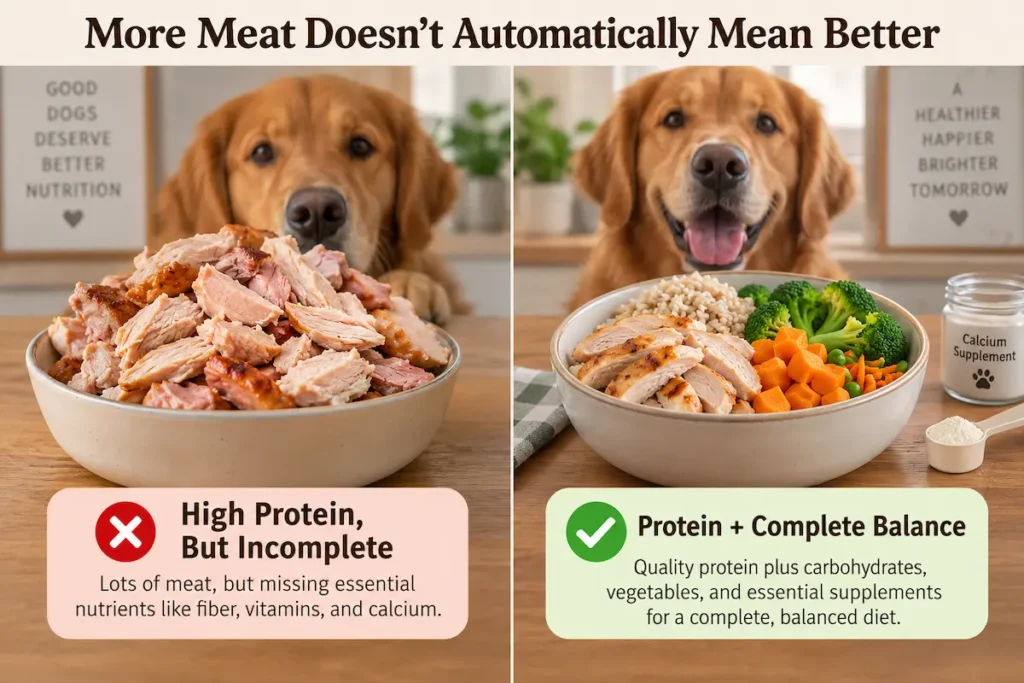
It is easy to look at two homemade bowls and assume the one with more meat is better.
But consider these two examples.
Bowl A
A large portion of chicken breast with a handful of broccoli.
This bowl may contain plenty of protein.
It might even contain far more protein than the dog requires.
But we still do not know whether it provides enough:
- calcium
- essential fatty acids
- trace minerals
- vitamins
- total calories
Bowl B
A carefully portioned protein source combined with other ingredients and supplements in amounts calculated to provide appropriate:
- amino acids
- calories
- fats
- calcium and phosphorus
- vitamins
- trace minerals
Bowl B may not look as dramatically high in protein, but it is far more thoughtfully formulated.
Protein is one part of the bowl, not the whole bowl.
That is also why rotating chicken one week, beef the next, and turkey the week after does not automatically make an incomplete recipe balanced.
✅ A Better Way to Think About Dog Protein Requirements
Instead of asking only:
“What percentage of my dog’s bowl should be meat?”
Work through these questions instead.
1. How Many Calories Does My Dog Need?
Protein intake cannot be separated from food intake.
A dog eating 300 calories per day and a dog eating 1,200 calories per day should not be expected to consume the same number of grams of protein.
Start with an appropriate calorie estimate, then adjust based on your dog’s real-world body weight and body condition.
2. How Much Protein Does the Recipe Provide per Calorie?
For a healthy adult dog, the AAFCO adult-maintenance reference of 45 grams per 1,000 calories gives you a practical minimum benchmark.
For example:
500 calories × 45 g ÷ 1,000 = 22.5 g protein
This is a nutrient-profile minimum, not a personalized target.
3. Where Is the Protein Coming From?
Look beyond total grams.
Consider:
- protein source
- amino acid quality
- digestibility
- how the protein fits into the complete recipe
4. Is the Rest of the Diet Balanced?
Adequate protein cannot compensate for inadequate calcium, iodine, essential fatty acids, vitamins, or other nutrients.
This is why properly formulated balanced homemade dog food recipes are very different from simply combining meat, rice, and vegetables.
5. Does Your Dog Have Different Nutritional Needs?
Age, growth, pregnancy, nursing, activity, body condition, and health status can all influence nutritional requirements.
A formula that works for one healthy adult dog should not automatically be assumed appropriate for a puppy or a dog with a medical condition.
6. Is the Homemade Food Complete or Supplemental?
A small homemade topper does not have to provide every nutrient in the same proportions as a complete diet if the rest of the diet is nutritionally complete.
But if homemade food supplies most or all of your dog’s daily calories, balance becomes much more important.
🥩 Bottom Line: How Much Protein Does a Dog Need?
So, how much protein does a dog need?
For healthy adult dogs, AAFCO’s adult-maintenance nutrient profile sets a minimum of 18% protein on a dry matter basis or 45 grams per 1,000 calories.
Puppies and dogs in growth or reproduction have higher minimum protein requirements.
For homemade dog food, however, the answer is not simply to put more meat in the bowl.
Your dog needs adequate high-quality protein and essential amino acids within a diet that also provides the right calories, fats, vitamins, minerals, and other nutrients.
When thinking about protein requirements for dogs eating homemade food, focus on protein relative to calories, protein quality, life stage, and the balance of the entire recipe.
If homemade food makes up most of your dog’s diet, especially for a puppy or dog with a medical condition, working with your veterinarian or a board-certified veterinary nutritionist is the safest way to make sure the recipe meets your dog’s individual needs.