Making your own dog food doesn’t require a culinary degree, a specialty grocery store, or a Sunday afternoon that disappears into chaos. It requires a large pot, a handful of reliable ingredients, and about 30 minutes.
The payoff — knowing exactly what goes into every bowl, every day — is one of the most straightforward improvements a dog parent can make to their dog’s quality of life.
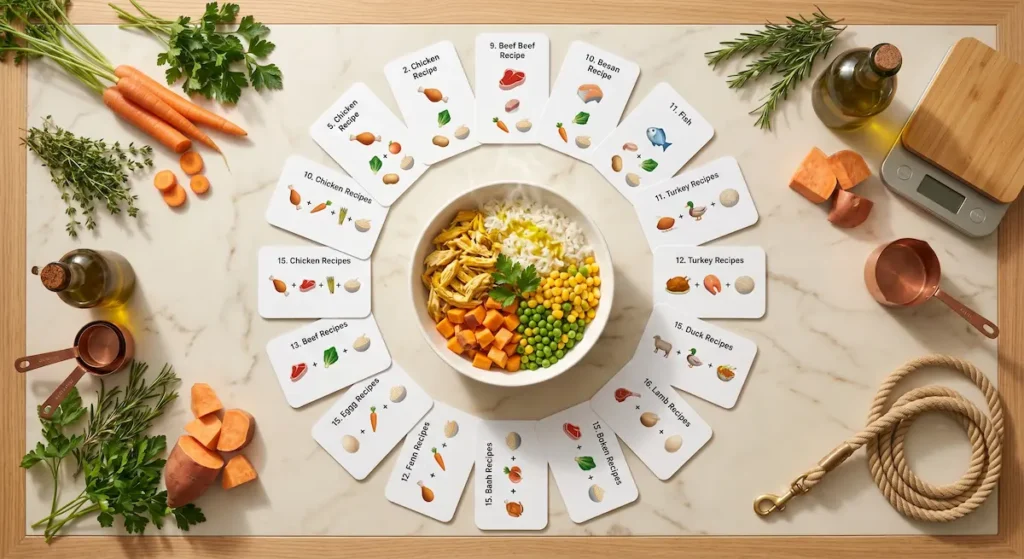
This is the complete guide: 15 make your own dog food recipes covering every protein, every life stage, and every dietary need, plus everything worth knowing about nutrition, safety, supplementation, and storage.
Consider it the only dog food resource worth bookmarking. 🙂
15 Make Your Own Dog Food Recipes
1. Classic Chicken & Brown Rice
The recipe every homemade dog food journey starts with — and the one most dogs never get tired of. Gentle, balanced, and universally accepted.
Classic Chicken & Brown Rice
Gentle, balanced, and the perfect starting point for homemade feeding
Ingredients
2 lbs boneless, skinless chicken breast
✦ Lean protein — the gentlest starting point
1 cup dry brown rice
1 cup chopped carrots
1 cup green beans, trimmed
½ cup frozen peas
4 cups low-sodium chicken broth
✦ No onion, no garlic — check label carefully
1 tablespoon olive oil
Instructions
Add chicken, rice, carrots, and broth to a large pot. Bring to a boil.
Reduce to a simmer, cover, and cook for 20 minutes.
Add green beans and peas for the final 5 minutes.
Remove chicken and shred with two forks. Return to the pot.
Stir in olive oil, mix well, and cool completely before portioning.
💊 Supplement note: Add fish oil (omega-3) and a vet-recommended multivitamin per serving at feeding time for complete long-term nutrition.
2. Beef & Sweet Potato Stew
Rich in iron and zinc — ideal for active dogs or those needing extra energy. Sweet potato adds fiber and natural sweetness that most dogs find irresistible.
Beef & Sweet Potato Stew
Hearty, warming, and loaded with nutrients from whole ingredients
Ingredients
2 lbs lean ground beef
✦ Use 90/10 lean — drain fat thoroughly
2 medium sweet potatoes, peeled and cubed
1 cup chopped zucchini
1 cup frozen peas
½ cup chopped spinach
4 cups water or low-sodium beef broth
Instructions
Brown ground beef using medium heat. Drain excess fat thoroughly.
Add sweet potato and broth. Bring to a boil.
Reduce to a simmer, cover, and cook for 18 minutes.
Add zucchini, peas, and spinach for the final 4 minutes.
Mash sweet potato slightly, mix well, and cool completely before portioning.
⚠️ Fat alert: Drain all excess fat after browning — excess fat increases pancreatitis risk in dogs. Always use 90/10 lean ground beef where possible.
💡 Tip: Slightly mashing the sweet potato adds texture and helps it blend with the broth for a heartier stew.
3. Turkey & Quinoa Power Bowl
Turkey’s lean protein plus quinoa’s complete amino acid profile makes this one of the most nutritionally impressive recipes in the guide. FYI, this one also smells remarkable while cooking.
Turkey & Quinoa Power Bowl
Complete plant-protein pairing with lean turkey for a nutrient-dense meal
Ingredients
2 lbs ground turkey
¾ cup dry quinoa, rinsed thoroughly
✦ Complete plant-based protein source
1 cup diced butternut squash
1 cup shredded spinach
1 cup grated carrot
4 cups water
Instructions
Sauté turkey in a large pot until fully cooked through.
Add quinoa, butternut squash, carrot, and water. Bring to a boil.
Reduce to a simmer, cover, and cook for 15 minutes.
Stir in spinach for the final 3 minutes until wilted.
Mix well — quinoa absorbs most of the liquid. Cool completely before portioning.
⚠️ Rinse quinoa first: Always rinse quinoa thoroughly under cold water before cooking to remove saponins, which can cause digestive upset in dogs.
💡 Protein note: Quinoa is one of the few plant-complete proteins — it covers all essential amino acids. This makes it a standout grain for homemade dog food.
4. Salmon & Potato Omega Recipe
For dogs with joint issues, skin conditions, or dull coats — salmon’s EPA and DHA omega-3s deliver results that no plant-based supplement fully matches.
Salmon & Potato Omega Recipe
Omega-3 powerhouse for coat health, joint support, and brain function
Ingredients
2 lbs boneless salmon fillets, skin removed
✦ Outstanding omega-3 source for coat and joints
3 medium white potatoes, cubed
1 cup chopped broccoli
1 cup chopped carrots
4 cups water
Instructions
Add potatoes, carrots, and water to a large pot. Bring to a boil.
Cook for 10 minutes until potatoes begin to soften.
Place salmon on top of the vegetables. Add broccoli.
Cover and steam over low heat for 8–10 minutes until salmon flakes easily.
Flake salmon thoroughly and check carefully for any remaining bones.
Stir everything together and cool completely before portioning.
⚠️ Bone check: Check meticulously for any remaining bones — this is critical, especially for small dogs. Even “boneless” fillets can occasionally have pin bones.
💡 Omega-3 benefit: Salmon is one of the best natural sources of omega-3 fatty acids (EPA & DHA), supporting coat shine, joint mobility, and cognitive health.
5. Lamb & Lentil Allergy-Friendly Recipe
Novel protein for dogs with sensitivities to chicken or beef. Lentils bring plant-based protein and bulk — and pressure-cook beautifully if an Instant Pot is available.
Lamb & Lentil Allergy-Friendly Recipe
A go-to rotation protein for elimination diet trials and sensitive stomachs
Ingredients
2 lbs ground lamb, fat trimmed
✦ Novel protein — ideal for elimination diet rotation
½ cup dry green lentils, rinsed
1 cup diced parsnip
1 cup chopped kale, stems removed
½ cup frozen peas
5 cups water
Instructions
Brown lamb in a large pot. Drain excess fat thoroughly.
Add lentils, parsnip, and water. Bring to a boil.
Reduce to a simmer, cover, and cook for 25 minutes until lentils are completely soft.
Add kale and peas for the final 5 minutes.
Stir well and cool completely before portioning.
⚠️ Fat alert: Lamb is naturally fattier than chicken or turkey. Always drain excess fat thoroughly after browning to reduce pancreatitis risk.
💡 Elimination diet: Lamb is a “novel protein” — less common than chicken or beef, making it a top choice for rotation feeding and elimination diet trials when sensitivities are suspected.
6. Chicken & Pumpkin Digestive Support
The recipe to reach for during digestive upset, loose stools, or dietary transitions. Pumpkin fiber works for both constipation and diarrhea — an unusually versatile ingredient. 🙂
Chicken & Pumpkin Digestive Support
Gentle on the stomach, naturally fiber-rich, and perfect for sensitive dogs
Ingredients
2 lbs boneless chicken thighs, skinless
✦ Slightly fattier — ideal for underweight or picky dogs
1 cup plain canned pumpkin
✦ 100% plain pumpkin only — no pie filling
1 cup brown rice
1 cup chopped celery
½ cup chopped carrots
4 cups water
Instructions
Add all ingredients except pumpkin to a large pot. Bring to a boil.
Reduce to a simmer, cover, and cook for 22 minutes.
Remove chicken and shred finely. Return to the pot.
Stir pumpkin evenly through the mixture.
Cool completely before serving.
⚠️ Pumpkin only: Use plain canned pumpkin — never pie filling, which contains spices, sugar, and xylitol that are toxic or harmful to dogs.
💡 Why pumpkin? Plain pumpkin is naturally high in soluble fiber and moisture, supporting digestion and stool consistency. It’s gentle on the gut and well-tolerated by most dogs.
7. Duck & Sweet Potato Novel Protein
Duck is rich, flavorful, and rarely found in commercial dog food — making it an excellent novel protein for allergy-prone dogs. IMO the best-smelling recipe on the entire list.
Duck & Sweet Potato
A premium novel protein option for dogs with chicken or beef sensitivities
Ingredients
2 lbs duck breast, excess fat trimmed
✦ Premium novel protein — less common than chicken or beef
2 medium sweet potatoes, peeled and cubed
1 cup chopped green beans
½ cup frozen blueberries
antioxidant-rich, dogs love the natural sweetness
4 cups water
Instructions
Sear duck breast in a large pot to render fat. Drain well.
Add sweet potato and water. Bring to a boil.
Reduce to a simmer, cover, and cook for 18 minutes.
Remove duck, shred or slice small, and return to the pot.
Add green beans and blueberries. Cook for 3 more minutes. Cool completely.
⚠️ Fat alert: Duck is naturally higher in fat than chicken or turkey. Always trim excess fat carefully and drain thoroughly after searing.
💡 Why blueberries? Blueberries add natural sweetness dogs love, plus antioxidants (anthocyanins) that support immune health and cognitive function.
8. Venison & Brown Rice Premium Recipe
The ultimate novel protein for dogs with complex allergies — lean, nutrient-dense, and virtually absent from commercial dog food. Most allergic dogs have zero prior exposure to venison.
Venison & Brown Rice Premium Recipe
Exceptionally lean, iron-rich wild game for active dogs and weight management
Ingredients
2 lbs ground venison
✦ Wild game — exceptionally lean with high iron content
1 cup brown rice
1 cup diced carrot
½ cup chopped green beans
½ cup plain canned pumpkin
4 cups water
Instructions
Brown venison in a large pot. Drain any excess liquid.
Add rice, carrot, and water. Bring to a boil.
Reduce to a simmer, cover, and cook for 20 minutes.
Add green beans for the final 5 minutes.
Stir pumpkin evenly through the mixture. Cool completely before portioning.
💡 Why venison? Venison is one of the leanest protein sources available — significantly lower in fat than beef or lamb. It’s exceptionally high in iron and B vitamins, making it ideal for active dogs and those on weight management programs.
9. White Fish & Brown Rice Lean Recipe
The weight management recipe — very low fat, high lean protein, and gentle on digestion. Ideal for overweight dogs or those recovering from illness.
White Fish & Brown Rice Lean Recipe
Ultra-lean, gentle on the stomach, and ideal for rotation with richer proteins
Ingredients
2 lbs boneless cod or tilapia
✦ Ultra-lean white fish — gentle and easy to digest
1 cup brown rice
1 cup chopped carrots
½ cup frozen peas
½ cup chopped green beans
4 cups water
Instructions
Cook brown rice in water for 18 minutes until nearly done.
Place fish fillets on top of the partially cooked rice.
Add carrots, peas, and green beans around the fish.
Cover and steam over low heat for 8 minutes until fish flakes easily.
Flake fish thoroughly, check for bones, stir together, and cool completely.
⚠️ Bone check: Always check for remaining bones even in “boneless” fillets. This is especially important for small breeds.
🔄 Protein rotation: White fish is very low in fat — rotate it with fattier proteins like salmon or duck to ensure adequate intake of fat-soluble vitamins (A, D, E, K) over time.
10. Pork & Vegetable Medley
Lean pork tenderloin is an underused protein in homemade dog food — comparable to chicken breast in fat content and equally digestible. Great rotation protein for variety-seeking dogs.
Pork & Vegetable Medley
Hearty, wholesome, and packed with variety for dogs who need more than chicken
Ingredients
2 lbs pork tenderloin, trimmed and cut into chunks
✦ Always use tenderloin — far leaner than shoulder or rib cuts
1 cup diced sweet potato
1 cup chopped broccoli
1 cup sliced zucchini
½ cup grated carrot
4 cups water
Instructions
Add pork and water to a large pot. Bring to a boil.
Skim foam, reduce to a simmer, and add sweet potato and carrot.
Cover and cook for 15 minutes.
Add broccoli and zucchini for the final 8 minutes.
Remove pork and shred. Return to pot, mix well, and cool completely.
⚠️ Cut matters: Use tenderloin only — shoulder and rib cuts carry significantly more fat and are not suitable for regular homemade feeding.
🍖 Cooking tip: Skim the foam that rises during the first boil — this removes impurities and keeps the broth clean for your dog.
11. Chicken & Oat Senior Recipe
Older dogs need softer textures, easier-to-digest proteins, and joint-supporting additions. This recipe addresses all three — the oats create a naturally smooth, almost porridge-like texture that senior dogs consistently accept well.
Chicken & Oat Senior
Gentle on digestion, supportive for aging joints and overall vitality
Ingredients
2 lbs boneless chicken breast
½ cup rolled oats
✦ Rolled oats — gentle fiber for senior digestion
1 cup plain canned pumpkin
1 cup mashed sweet potato
½ cup grated carrot
4 cups water
2 tablespoons fish oil (added after cooking)
Instructions
Add chicken, oats, pumpkin, sweet potato, carrot, and water to a large pot.
Bring to a boil, then reduce to a low simmer.
Cover and cook for 20 minutes, stirring occasionally.
Remove chicken and shred very finely. Return to pot.
Stir until smooth and creamy. Cool, then add fish oil before serving.
💛 Nutrition tip: Fish oil is added after cooking to preserve omega-3 integrity — heat degrades these beneficial fatty acids.
🦴 Senior support: Consider adding a vet-recommended glucosamine supplement to support aging joints alongside this meal.
12. Beef Liver & Vegetable Nutrient Boost
Organ meat is nutritionally extraordinary — liver delivers vitamins A, B12, iron, and copper in concentrations that no other ingredient matches. The key is the correct ratio: liver at no more than 10% of the total recipe volume.
Beef Liver & Vegetable Nutrient Boost
Iron, vitamin A, and B vitamins packed into every bite — rotate, don’t daily-feed
Ingredients
1.5 lbs lean ground beef
½ lb beef liver, chopped small
✦ Liver is a vitamin A powerhouse — small portions, big impact
1 cup brown rice
1 cup chopped spinach
½ cup diced carrot
½ cup frozen peas
4 cups water
Instructions
Add ground beef, liver, rice, carrot, and water to a large pot. Bring to a boil.
Break up beef as it cooks. Reduce to a simmer, cover, and cook for 20 minutes.
Add spinach and peas for the final 4 minutes.
Stir thoroughly — liver blends into the broth and enriches the batch.
Cool completely before serving.
⚠️ Rotate, don’t daily-feed: Excess vitamin A accumulates over time. Once or twice per week as part of a rotation is the sweet spot — never serve this every day.
🩸 Nutrient tip: Liver is one of the most nutrient-dense foods available — rich in iron, B12, and vitamin A. A little goes a long way in supporting your dog’s energy and coat health.
13. Egg & Rice Recovery Recipe
Eggs are the most bioavailable complete protein source available — 100% digestibility, all essential amino acids, and gentle enough for dogs recovering from illness or digestive disruption.
Egg & Rice Recovery
Gentle, digestible, and soothing — built for dogs returning to food after illness or surgery
Ingredients
8 eggs, beaten
1 cup white rice
✦ White rice over brown for recovery — easier to digest, gentler on the stomach
1 cup plain canned pumpkin
1 cup grated carrot
½ cup frozen peas
3 cups water
Instructions
Cook white rice in water in a large pot for 15 minutes.
Stir pumpkin, carrot, and peas into the cooked rice.
Reduce heat to very low.
Slowly stir in beaten eggs — they cook through gently within 2 minutes.
Mix thoroughly and cool completely before serving.
🌿 Recovery tip: White rice is chosen over brown for recovery because it has less fiber and is easier on an already-sensitive digestive tract. Start with small portions when reintroducing food.
💊 Post-illness note: This recipe is best for dogs returning to food after illness or surgery. Always reintroduce food gradually and consult your vet if symptoms persist after feeding.
14. Sardine & Sweet Potato Budget Omega Recipe
Canned sardines in water are the most underrated ingredient in homemade dog food — cheap, shelf-stable, and delivering omega-3 benefits comparable to salmon at a fraction of the cost.
Sardine & Sweet Potato Budget Omega
Outstanding omega-3s for joints and coat at a fraction of the cost of supplements
Ingredients
6 cans (3.75 oz) sardines in water, drained
✦ No added salt — always choose water-packed, not oil
1 cup brown rice
2 medium sweet potatoes, cubed
1 cup frozen peas
½ cup grated carrot
4 cups water
Instructions
Cook rice and sweet potato in water in a large pot for 20 minutes.
Add carrot and peas for the final 8 minutes.
Remove from heat and fold sardines gently through the mixture.
Stir well to distribute evenly. Cool completely before serving.
🌊 Omega-3 tip: Sardines are one of the lowest-mercury fish available — safe for regular feeding without the cost of fish oil supplements. The entire fish is eaten, adding calcium from the soft bones.
💰 Budget note: Canned sardines cost pennies compared to bottled fish oil — yet deliver comparable omega-3 benefits. This is the most cost-effective way to support your dog’s joint and coat health.
15. Mixed Protein Celebration Bowl
The special occasion recipe — combining chicken and egg for maximum protein, great flavor, and a nutritional profile that makes any meal feel like an event.
Works equally well as an everyday recipe for dogs that need high protein and exceptional palatability.
Mixed Protein Celebration Bowl
Double-protein punch with chicken and eggs — maximum taste and palatability for picky or under-the-weather dogs
Ingredients
2 lbs boneless chicken breast
4 eggs, beaten
✦ Rapid-absorption complete protein — adds a velvety richness dogs love
1 cup plain canned pumpkin
1 cup brown rice
½ cup grated carrot
½ cup chopped green beans
4 cups low-sodium chicken broth
Instructions
Add chicken, rice, carrot, and broth to a large pot. Bring to a boil.
Reduce to a simmer, cover, and cook for 20 minutes.
Remove chicken and shred finely. Return to the pot.
Reduce heat to very low and stir in beaten eggs gently until cooked through.
Stir in pumpkin and green beans. Mix well and cool completely.
🥚 Protein tip: Eggs are added off-heat for a reason — gentle cooking preserves their complete amino acid profile and creates soft, fluffy curds that dogs find irresistible.
🍽️ Palatability note: The chicken-and-egg protein combination is one of the most palatable mixes for dogs going through reduced appetite. Serve warm for maximum appeal.
Quick Reference Guide: All 15 Recipes
| # | Recipe | Protein | Best For | Cook Time |
| 1 | Chicken & Brown Rice | Chicken | All dogs, beginners | 25 min |
| 2 | Beef & Sweet Potato | Beef | Active, high-energy dogs | 22 min |
| 3 | Turkey & Quinoa | Turkey | Complete protein, weight management | 20 min |
| 4 | Salmon & Potato | Salmon | Joints, coat & skin health | 25 min |
| 5 | Lamb & Lentil | Lamb | Allergies, sensitivities | 30 min |
| 6 | Chicken & Pumpkin | Chicken | Sensitive stomachs | 25 min |
| 7 | Duck & Sweet Potato | Duck | Novel protein, allergies | 22 min |
| 8 | Venison & Brown Rice | Venison | Complex allergies, weight control | 25 min |
| 9 | White Fish & Brown Rice | White Fish | Weight management, recovery | 25 min |
| 10 | Pork & Vegetable | Pork | Protein variety | 25 min |
| 11 | Chicken & Oat Senior | Chicken | Senior dogs | 22 min |
| 12 | Beef Liver & Vegetable | Beef + Liver | Nutrient boost (rotate) | 24 min |
| 13 | Egg & Rice Recovery | Eggs | Illness recovery | 18 min |
| 14 | Sardine & Sweet Potato | Sardines | Budget omega-3 boost | 25 min |
| 15 | Mixed Protein Celebration | Chicken + Egg | High protein, special occasions | 25 min |
The Complete Guide to Making Your Own Dog Food
Why Make Your Own Dog Food?
The case for homemade dog food comes down to three things: ingredient control, nutritional quality, and long-term health impact.
- Commercial dog food — even premium brands — relies on processing methods that degrade nutrients, uses preservatives that extend shelf life at the expense of food quality, and often includes fillers that contribute calories without nutrition.
- When dog parents make their own dog food, they see exactly what goes into every bowl. No mystery ingredients. No unpronounceable additives. No guessing.
The health impact is observable. Dogs transitioning to quality homemade food consistently show improvements in coat quality, digestion, energy levels, and body composition within weeks.
These aren’t subtle changes — they’re the kind of visible improvements that make homemade feeding self-reinforcing once a dog parent sees them. 🙂
💡 You may be interested:
Getting the Nutritional Balance Right
The most important principle in homemade dog food is balance — not just within individual recipes, but across a rotating diet over time.
A single recipe fed every day, no matter how good, will eventually fall short in some micronutrient category. Rotation is the solution.
The basic formula for balanced homemade dog food:
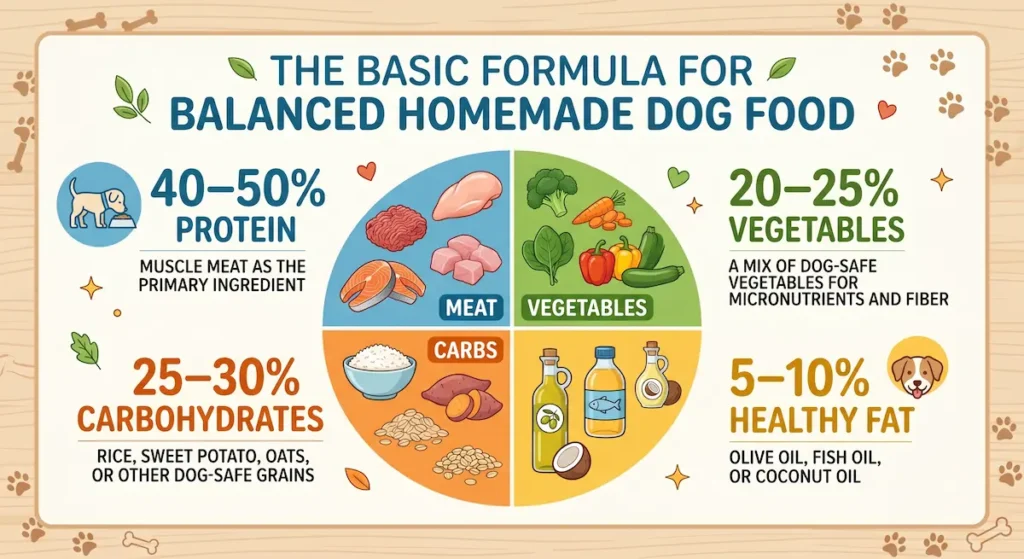
- Protein: 40–50% of the recipe — muscle meat as the primary ingredient
- Carbohydrates: 25–30% — rice, sweet potato, oats, or other dog-safe grains
- Vegetables: 20–25% — a mix of dog-safe vegetables for micronutrients and fiber
- Healthy fat: 5–10% — olive oil, fish oil, or coconut oil
Every recipe in this guide follows this formula. Rotating across at least three different protein sources per week — for example, chicken, beef, and salmon — naturally covers a broader micronutrient spectrum than any single recipe can provide alone.
The Non-Negotiable Supplements
Whole food alone doesn’t always cover every micronutrient requirement, particularly for calcium and certain fat-soluble vitamins.
These supplements are essential for dogs eating fully homemade diets long-term:
- Fish oil (omega-3) — joint, coat, and anti-inflammatory support; add after cooking to preserve potency
- Calcium — critical if commercial food is fully replaced; eggshell powder (baked and ground) is a free, effective source — add ½ teaspoon per meal for large dogs, ¼ teaspoon for small
- Canine multivitamin — fills micronutrient gaps; one bottle covers 1–2 months
- Vitamin E — antioxidant support; particularly important for active or senior dogs
- Glucosamine & chondroitin — joint health; start earlier rather than waiting for symptoms, especially in large breeds
A veterinary nutritionist consultation is worth the investment for dog parents committing fully to homemade feeding. It’s a one-time cost that provides tailored guidance for a specific dog’s needs.
How to Transition to Homemade Dog Food
Switching cold turkey — pun fully intended — is the most common mistake new homemade feeders make.
Dogs’ digestive systems need time to adjust to new food, regardless of how much better that food is. A rushed transition causes digestive upset that gets wrongly blamed on the new diet.
The 10-day transition plan:
- Days 1–3: 25% new food, 75% current food
- Days 4–6: 50% new food, 50% current food
- Days 7–9: 75% new food, 25% current food
- Day 10 onwards: 100% new food
Monitor stool consistency throughout. Loose stools are common in the first few days and usually resolve by day 5–7. If digestive upset persists beyond 10 days, slow the transition further or consult a vet.
Ingredients That Are Always Safe
Building a rotating homemade diet is easier with a reliable list of safe ingredients to draw from:
✅ Safe proteins: Chicken, turkey, beef, pork (tenderloin), salmon, cod, tilapia, sardines, eggs, duck, lamb, venison, rabbit
✅ Safe vegetables: Carrots, green beans, peas, broccoli (moderate), sweet potato, zucchini, spinach (moderate), kale (moderate), celery, cucumber, parsnip, butternut squash, pumpkin
✅ Safe grains: Brown rice, white rice, oats, barley, quinoa (rinsed)
✅ Safe fruits (as additions): Blueberries, apple (no seeds), banana, mango (no pit/skin), watermelon (no rind/seeds), strawberries
✅ Safe fats: Olive oil, coconut oil, fish oil, flaxseed oil
Ingredients That Are Never Safe
No exceptions — these never belong in any homemade dog food recipe:
- Onion, garlic, leeks, chives — toxic in all forms, raw, cooked, or powdered
- Grapes and raisins — cause kidney failure; even small amounts are dangerous
- Xylitol — causes liver failure; found in some peanut butters and sugar-free products
- Chocolate and cocoa — toxic at any quantity
- Macadamia nuts — cause neurological symptoms
- Cooked bones — become brittle and splinter; always remove before or after cooking
- Avocado — contains persin, causes digestive distress
- Nutmeg — toxic even in small amounts
- Raw kidney beans — contain toxic lectins; must be fully cooked
Portion & Feeding Guide
| Dog Size | Weight | Per Meal | Meals Per Day |
| Extra Small | Under 10 lbs | ¼–⅓ cup | 2–3 |
| Small | 10–20 lbs | ½–¾ cup | 2 |
| Medium | 20–50 lbs | 1–1½ cups | 2 |
| Large | 50–90 lbs | 2–3 cups | 2 |
| Extra Large | 90+ lbs | 3–5 cups | 2 |
Adjust based on activity level, age, and body condition. A dog that’s gaining weight gets less; a dog losing muscle mass gets more. Monitor body condition weekly rather than relying solely on weight.
Storage Guide
- Refrigerator — airtight containers for up to 4–5 days
- Freezer — portioned servings for up to 3 months; thaw overnight in the fridge
- Small dog tip — freeze in ice cube tray portions for easy single-serving thawing
- Fish-based recipes — use within 3 days refrigerated; fish deteriorates faster
- Organ meat recipes — label clearly with date and rotate within the weekly meal plan
- Labeling rule — always write recipe name and date on every container
Final Thoughts
Making your own dog food is one of those decisions that, once made, becomes permanent. Not because it’s obligatory — but because the difference it makes is visible, measurable, and deeply satisfying in the way that any genuine act of care for something important tends to be.
These 15 recipes cover every protein, every life stage, every budget, and every health need a dog is likely to have. Start with Recipe 1 or Recipe 6, build the rotation gradually, add the right supplements, and watch what happens over the following weeks.
Real food makes a real difference. Every bowl is evidence of that — and every dog that gets one deserves it. 🙂