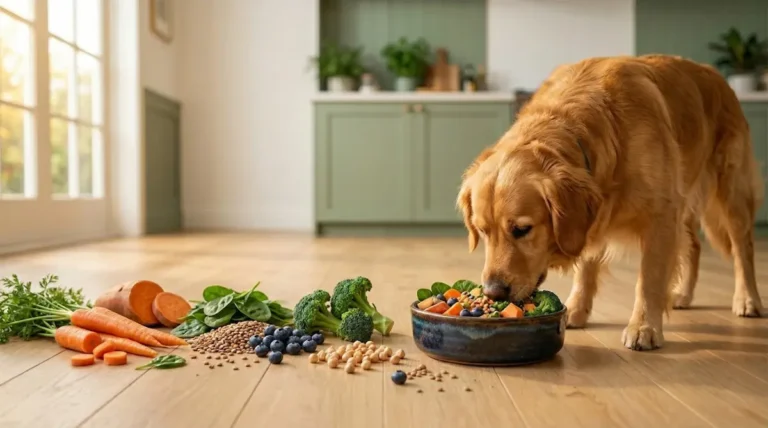
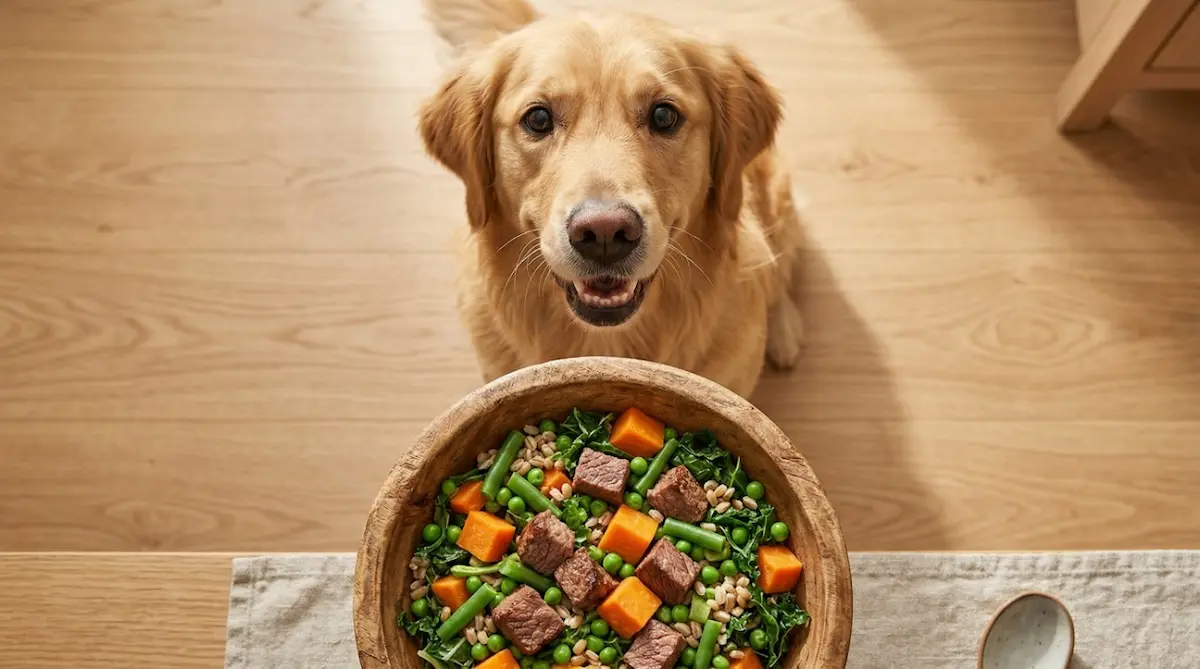
Let’s be real — figuring out what to feed a dog can feel overwhelming. Add “grain-free” to the mix and suddenly every recipe online either looks like a science experiment or calls for ingredients that require a trip to three different specialty stores.
Here’s the thing: grain-free homemade dog food doesn’t have to be complicated. It just needs to be balanced, safe, and made with ingredients a dog’s body actually knows what to do with.
This article covers everything — why grain-free works for some dogs, what to watch out for, and 15 solid recipes that cover every protein, every budget, and every level of cooking enthusiasm.
What Does “Grain-Free” Actually Mean for Dogs?
Grain-free simply means the food contains no wheat, corn, rice, barley, oats, or other cereal grains. Instead, carbohydrates come from sources like sweet potato, pumpkin, lentils, chickpeas, or green vegetables.
Dogs are facultative carnivores — meaning they thrive primarily on animal protein and fat, but their digestive systems can handle plant matter too. Some dogs genuinely do better without grains, especially those dealing with:
- Food allergies or sensitivities — grains, particularly wheat and corn, are among the more common dietary triggers
- Chronic digestive issues — bloating, loose stools, or excessive gas that doesn’t resolve on a standard diet
- Itchy skin or recurring ear infections — often linked to food intolerances
- Weight management challenges — grain-free diets tend to be higher in protein and lower in refined carbohydrates
That said, grain-free isn’t a magic fix for every dog. Some dogs do perfectly well on grains. The goal is finding what works for the individual dog — and if grain-free is the direction, doing it right.
The Grain-Free Homemade Dog Food Debate: What About DCM?
It would be irresponsible to write this article without addressing this. In 2018, the FDA began investigating a potential link between grain-free diets and dilated cardiomyopathy (DCM) — a serious heart condition in dogs.
Here’s where things currently stand:
- The investigation focused primarily on commercial grain-free kibble, particularly formulas high in legumes like peas and lentils as primary ingredients
- No definitive causal link has been proven between grain-free diets and DCM as of the most recent updates
- The concern appears more strongly associated with taurine deficiency in certain breeds and diet formulations rather than grain-free status alone
- Many veterinary cardiologists and canine nutritionists continue to support well-formulated grain-free diets, particularly fresh food diets
The takeaway:
Always consult a vet before making significant dietary changes, especially for breeds predisposed to heart issues (Golden Retrievers, Dobermans, Boxers, Great Danes). For most healthy dogs, a balanced, whole-food grain-free diet made at home is considered safe and often beneficial.
Building a Balanced Grain-Free Dog Food Recipe
Before jumping into the recipes, understanding the basic formula matters. A balanced homemade dog food meal generally follows this structure:
- Protein (40–50%) — lean muscle meat, organ meat, eggs, fish
- Vegetables (25–35%) — dog-safe veggies that provide fiber, vitamins, and minerals
- Healthy carbohydrates (15–25%) — sweet potato, pumpkin, butternut squash, lentils
- Fat source (5–10%) — naturally occurring in meat, or added via fish oil, coconut oil
- Supplements — calcium (from bone meal or eggshell powder), omega-3s, and a canine multivitamin to fill nutritional gaps
✅ A word on supplements: homemade diets almost always need supplementation to be truly complete. Even the best whole-food recipes can fall short on calcium, zinc, or certain vitamins over time. A good canine multivitamin and a calcium source go a long way toward making these recipes nutritionally complete for long-term feeding.
Ingredients to Always Avoid in Grain-Free Dog Food
Before getting into the recipes, a quick safety reminder. These ingredients should never appear in homemade dog food regardless of how natural they sound:
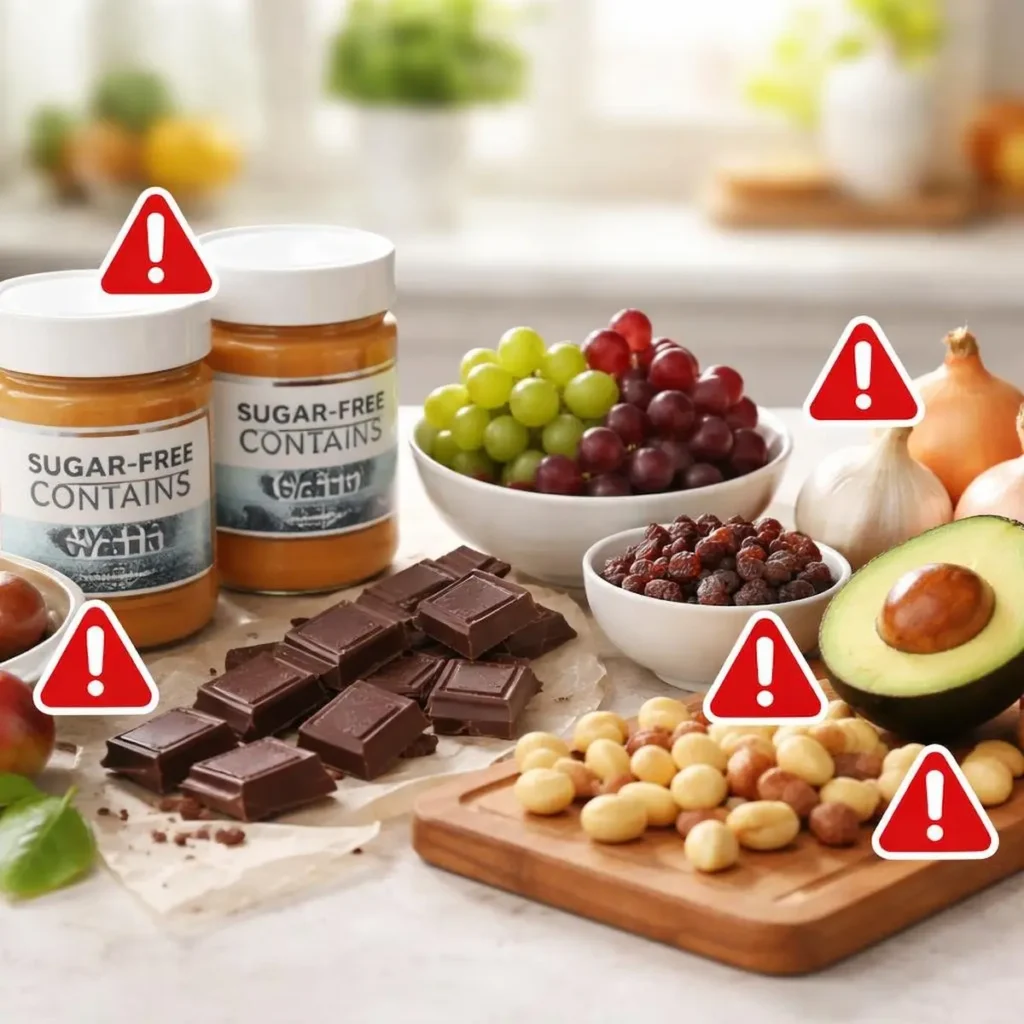
- Onions and garlic (toxic — cause red blood cell damage)
- Grapes and raisins (cause kidney failure)
- Macadamia nuts (toxic to dogs)
- Xylitol (found in some peanut butters and sweeteners — extremely toxic)
- Avocado (contains persin, harmful to dogs)
- Chocolate and caffeine
- Cooked bones (splinter and cause internal injury — raw bones are a separate conversation)
- Excess salt
- Nutmeg and certain other spices
How Much to Feed?
General rule of thumb for homemade food: dogs need approximately 2–3% of their ideal body weight in food per day, split across two meals.
- A 20 lb dog needs roughly 6–10 oz of food daily
- A 50 lb dog needs roughly 15–24 oz daily
- A 100 lb dog needs roughly 30–48 oz daily
Active dogs, puppies, and pregnant or nursing females need more. Senior dogs or those managing weight need less. When in doubt, start at 2.5% and adjust based on body condition over a few weeks.
15 Grain-Free Homemade Dog Food Recipes
These recipes are organized by primary protein source — beef, chicken, turkey, fish, and lamb — so it’s easy to rotate proteins and keep the diet varied. Variety across proteins helps ensure a broader nutritional profile over time.
🥩 Beef-Based Recipes
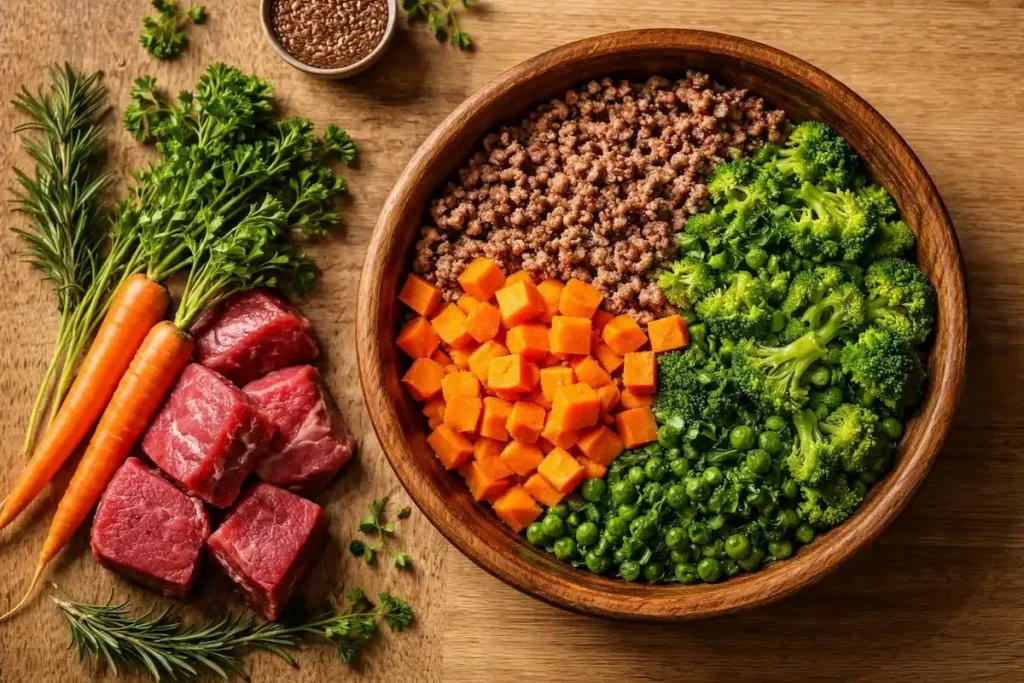
Recipe 1: Classic Beef and Sweet Potato Bowl
The workhorse recipe. Simple, affordable, and almost universally loved by dogs. This one is a great starting point for anyone new to homemade dog food.
Classic Beef & Sweet Potato Bowl
A hearty, nutrient-dense everyday meal built around lean ground beef and beta-carotene-rich roots
Ingredients
2 lbs lean ground beef (85/15)
✦ Drain excess fat after browning — too much fat can cause digestive upset
2 cups sweet potato, peeled and cubed
steam or boil until tender — primary carb and beta-carotene source
1 cup zucchini, diced
low-calorie, hydrating filler — cooks down quickly in the pan
1 cup spinach, chopped
added at the end — iron, folate, and antioxidants
½ cup pumpkin puree (plain)
⚠️ Plain pumpkin only — not pie filling, which contains xylitol or spices
2 tablespoons fish oil
✦ Add after cooling — heat degrades omega-3s. Drizzle just before serving
Canine multivitamin + calcium supplement
per package directions — essential for long-term nutritional balance
Instructions
Brown ground beef in a large pan over medium heat, breaking it apart as it cooks. Drain excess fat.
Steam or boil sweet potato separately until tender, about 15 minutes. Set aside.
Add zucchini and spinach to the pan with the beef. Cook for 3–4 minutes until softened.
Combine beef mixture with cooked sweet potato and pumpkin puree. Stir well until evenly mixed.
Cool completely, then add supplements per package directions. Drizzle fish oil just before serving.
Portion into airtight containers and refrigerate. Serve at room temperature.
🥣 Portioning guide: A 50 lb adult dog typically needs about 2–2.5 cups per day split across two meals. This batch covers roughly 4 days — adjust quantity based on your dog’s actual weight, activity level, and vet guidance. Always transition to new food gradually over 7 days to avoid digestive upset.
Nutritional Highlights
- 🥩 High protein
- 🍠 Beta-carotene
- 🐟 Omega-3 (DHA/EPA)
- 🥬 Iron from spinach
- 🎃 Gut-supporting fiber
Recipe 2: Beef Liver and Vegetable Stew
Organ meat is one of the most nutrient-dense foods a dog can eat. Liver is loaded with Vitamin A, B vitamins, iron, and zinc.
The key is keeping the quantity reasonable — organ meat should make up no more than 10% of the total diet to avoid Vitamin A toxicity over time.
Beef Liver & Vegetable Stew
Micronutrient-dense organ meat stew — rich in Vitamin A, B12, and iron with gentle fiber-forward veggies
Ingredients
1.5 lbs lean ground beef
the protein base — drain any excess fat after browning
½ lb beef liver, finely chopped
⚠️ Keep to 10–25% of total meat — excess liver causes Vitamin A toxicity over time
1 cup butternut squash, cubed
anti-inflammatory, beta-carotene rich — simmers down into a soft, easy-to-eat texture
1 cup green beans, chopped
low-calorie fiber source — good for weight management
½ cup carrots, grated
grated carrots cook faster and distribute evenly through the stew
1 cup low-sodium beef broth
⚠️ Must be onion-free and garlic-free — both are toxic to dogs
Canine multivitamin + calcium supplement
per package directions — add after cooling, not during cooking
🫀 Liver ratio note: At ½ lb liver to 1.5 lbs ground beef, this recipe sits at ~25% organ meat — the upper safe limit for regular feeding. If rotating this into a weekly meal plan, consider reducing to ¼ lb liver (≈15%) for daily feeding, or serve this version 2–3× per week only.
Instructions
Sauté liver in a lightly oiled pan over medium heat for 3–4 minutes until cooked through. Do not overcook — liver toughens quickly. Set aside.
Brown ground beef in the same pan. Drain excess fat.
Add beef broth, butternut squash, green beans, and carrots. Stir to combine, then simmer for 15 minutes until vegetables are tender.
Stir in the cooked liver. Mix everything well so liver is distributed evenly throughout.
Cool completely before adding supplements. Serve at room temperature.
🍲 Stew consistency tip: If there’s excess liquid after simmering, leave it in — the broth carries water-soluble B vitamins and minerals that have leached from the vegetables during cooking. This “stew liquid” is nutritious, not waste. Some dogs prefer a wetter texture too.
Nutritional Highlights
- 🫀 Vitamin A & B12 (liver)
- 🩸 Iron-rich
- 🎃 Anti-inflammatory
- 🫘 Digestive fiber
- 🥕 Beta-carotene
Recipe 3: Beef and Egg Power Bowl
Eggs are one of the most bioavailable protein sources available. Scrambled or hard-boiled eggs mixed into a beef base creates a protein-dense meal that works especially well for active dogs or dogs recovering from illness.
Beef & Egg Power Bowl
Double-protein muscle fuel — ground beef and whole eggs with sulforaphane-rich broccoli
Ingredients
1.5 lbs lean ground beef
primary protein base — drain excess fat after browning
4 eggs, scrambled (cooked)
⚠️ Cook in a dry pan — no butter, oil, salt, or seasoning of any kind
1 cup sweet potato, mashed
cook and mash beforehand — acts as a binding base for the bowl
1 cup broccoli florets, steamed and chopped
✦ Chop finely after steaming — easier to digest and distribute evenly
½ cup peas, fresh or frozen (thawed)
plant protein and fiber — thawed frozen peas are fine, no cooking needed
1 tablespoon coconut oil
✦ Add after cooling — stir in just before serving to preserve beneficial fats
Canine multivitamin + calcium supplement
per package directions — add after food has fully cooled
Instructions
Brown ground beef in a pan over medium heat, breaking it apart as it cooks. Drain excess fat.
Scramble eggs in a dry pan — no butter, oil, or seasoning. Cook until just set, then remove from heat.
Steam broccoli until tender, then chop finely.
Cook and mash sweet potato if not already prepared.
Combine all ingredients — beef, eggs, sweet potato, broccoli, and peas — and mix thoroughly.
Cool completely. Add coconut oil, then add supplements per package directions. Serve at room temperature.
🥦 Broccoli serving note: Broccoli is safe for dogs in moderate amounts but contains isothiocyanates, which can cause gastric irritation in large quantities. Keep broccoli to under 10% of the total meal — this recipe is well within that range. Steaming and chopping finely also makes it easier on digestion.
Nutritional Highlights
- 💪 Double-protein
- 🥦 Sulforaphane
- 🫛 Plant protein
- 🍠 Beta-carotene
- 🥥 Healthy fats
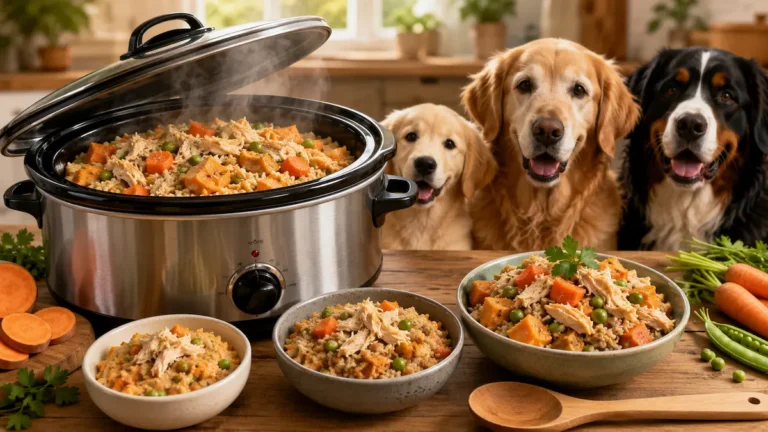
Recipe 4: Slow Cooker Beef and Pumpkin Stew
For the days when spending time standing over a stove sounds like absolutely nobody’s idea of fun.
Throw everything in the slow cooker in the morning and come home to a ready batch. IMO, this is the recipe that makes homemade dog food genuinely sustainable long-term.
Slow Cooker Beef & Pumpkin Stew
Set-and-forget comfort stew — collagen-rich stew meat slow-braised with gut-soothing pumpkin
Ingredients
2 lbs beef stew meat, cut into small pieces
✦ Stew cuts (chuck, brisket) are ideal — connective tissue breaks down into collagen over long cooking
1 cup plain pumpkin puree
⚠️ Plain pumpkin only — not pie filling, which contains xylitol and spices toxic to dogs
1 cup sweet potato, cubed
will soften and partially break down during long cooking — adds natural sweetness and body
1 cup green beans, chopped
low-calorie fiber — add these in the last 2 hours on low to avoid over-softening
½ cup carrots, sliced
hardy enough to go in from the start — holds shape well through long cooking
2 cups water or low-sodium broth
⚠️ Broth must be onion-free and garlic-free — check the label carefully
Fish oil (per serving)
✦ Add to each bowl individually at serving time — never into the hot slow cooker
Canine multivitamin + calcium supplement
per package directions — add to each cooled portion before serving
Instructions
Add beef, sweet potato, carrots, pumpkin puree, and broth to the slow cooker. Stir to combine.
Cook on low for 6–8 hours or high for 3–4 hours. Add green beans in the final 1–2 hours to prevent over-softening.
Once cooked, shred or break up beef pieces with a fork or spoon into bite-sized chunks.
Cool completely before portioning into airtight containers.
Add fish oil and supplements to each individual serving at feeding time — not to the whole batch.
❄️ Batch & freeze tip: This stew freezes well for up to 3 months. Portion into single-day servings using silicone molds or zip-lock bags before freezing. Thaw overnight in the fridge — never microwave, as it can create hot spots. Add supplements and fish oil only after thawing, never before freezing.
Nutritional Highlights
- 🦴 Collagen for joints
- 🎃 Gut-soothing fiber
- 🍠 Beta-carotene
- 🥕 Anti-inflammatory
- 🍲 Mineral-rich broth
🍗 Chicken-Based Recipes
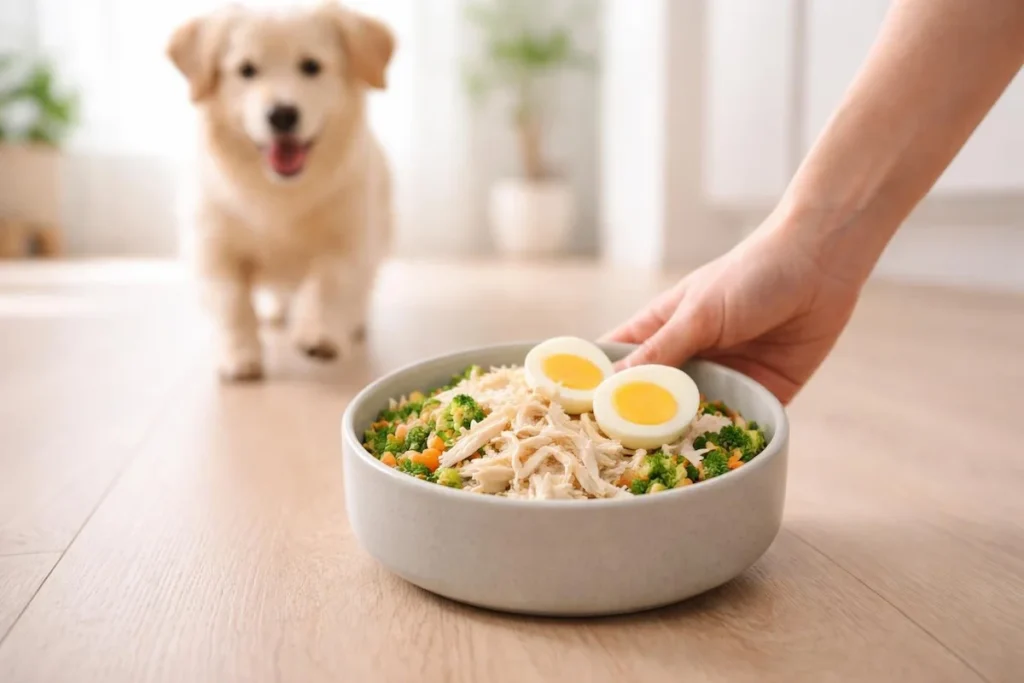
Recipe 5: Chicken and Sweet Potato Everyday Mix
Chicken is the most accessible protein for homemade dog food — affordable, easy to cook, and almost universally well-tolerated. This recipe is a reliable daily rotation staple.
Chicken & Sweet Potato Everyday Mix
A reliable daily staple — poached thighs, antioxidant blueberries, and taurine for heart health
Ingredients
2 lbs boneless, skinless chicken thighs
✦ Thighs over breast — higher in taurine, zinc, and natural fat for sustained energy
2 cups sweet potato, peeled and mashed
boil or steam until soft — forms the binding base of the mix
1 cup kale, finely chopped
✦ Chop very finely and lightly steam — raw kale is harder to digest for dogs
1 cup zucchini, diced
lightly steamed — hydrating, low-calorie filler with mild flavor
½ cup blueberries
✦ Add fresh or frozen (thawed) — no cooking needed, antioxidants are best preserved raw
2 tablespoons fish oil
add per serving at feeding time — not into the stored batch
Canine multivitamin + calcium supplement
per package directions — add after cooling, per serving
Why thighs? Chicken thighs contain significantly more taurine than breast meat — an amino acid essential for canine heart health. They’re also higher in zinc, B vitamins, and natural fat, which makes this mix more satiating and nutritionally complete than a breast-based version.
Instructions
Poach chicken thighs in plain, unseasoned water over medium heat until cooked through, about 20 minutes. No salt, no aromatics.
Remove chicken and let cool. Reserve the poaching liquid — it’s a light, nutrient-rich broth you can add back in for a wetter texture.
Shred chicken finely once cooled enough to handle.
Boil or steam sweet potato until soft, then mash.
Lightly steam kale and zucchini until just tender — do not overcook.
Combine shredded chicken, mashed sweet potato, steamed vegetables, and blueberries. Mix well.
Cool completely. Add fish oil and supplements to each individual serving at feeding time.
🫐 Blueberry note: Blueberries are one of the best antioxidant fruits for dogs — they’re safe, low-sugar relative to other fruits, and small enough to serve whole for most dogs. For small breeds or dogs who tend to gulp food, halve them before mixing in. Frozen blueberries work just as well and are often cheaper year-round.
Nutritional Highlights
- ❤️ Taurine (heart health)
- 🫐 Antioxidants
- 🥬 Vitamin K
- 🍠 Beta-carotene
- 🐟 Omega-3 (DHA/EPA)
Recipe 6: Chicken, Egg, and Veggie Scramble
A lighter, faster recipe that works well as a second daily meal or for dogs with smaller appetites. The whole thing comes together in about 15 minutes.
Chicken, Egg & Veggie Scramble
One-pan, 20-minute meal — ground chicken and eggs scrambled together with choline-rich goodness
Ingredients
1 lb ground chicken
cook until no pink remains — ground thigh meat preferred for more nutrients
3 eggs
✦ Scrambled directly into the pan with the chicken — yolk and white both, no discarding
1 cup spinach, chopped
added at the end — wilts quickly in residual heat, no overcooking
½ cup sweet potato, steamed and cubed
pre-cook before starting — folds in at the end, no extra pan needed
½ cup peas, fresh or frozen (thawed)
no cooking needed if thawed — stir in with the sweet potato at the end
1 tablespoon coconut oil
✦ Added to the pan before the eggs — doubles as cooking fat and a healthy fat source
Canine multivitamin + calcium supplement
per package directions — add after food has cooled
Choline from eggs: Egg yolks are one of the richest dietary sources of choline — a nutrient that supports brain function, nerve signaling, and liver health in dogs. Scrambling the eggs directly into the chicken means no extra dishes and the yolk stays fully incorporated into the meal rather than being separated out.
Instructions
Steam sweet potato ahead of time and set aside. Thaw peas if frozen.
Cook ground chicken in a pan over medium heat, breaking it apart, until no pink remains.
Add coconut oil to the pan. Crack in eggs and scramble them directly into the chicken — mix continuously until eggs are just set.
Stir in spinach and cook for 1–2 minutes until wilted. Remove from heat.
Fold in sweet potato and peas. Mix well — residual heat will warm them through.
Cool completely. Add supplements per package directions before serving.
⚡ Fastest in the series: This is the quickest fresh meal in the rotation — one pan, 20 minutes, minimal prep. It’s an ideal recipe for busy days or as a smaller supplemental batch alongside a larger slow-cooker meal. The smaller yield (~5–6 cups) also makes it easy to scale up simply by doubling ingredients.
Nutritional Highlights
- 🧠 Choline (brain health)
- 🍗 High-protein
- 🥬 Iron & folate
- 🫛 Plant protein
- 🥥 Healthy fats
Recipe 7: Chicken Liver and Vegetable Rice-Free Stir
Same concept as the beef liver recipe but with a milder flavor profile — great for picky eaters or dogs transitioning away from commercial food for the first time.
Chicken Liver & Vegetable Stir
Organ-boosted, grain-free stir — exceptional B12 and iron from chicken liver with potassium-rich squash
Ingredients
1.5 lbs ground chicken
protein base — ground thigh meat preferred for higher nutrient density
¼ lb chicken livers, chopped
⚠️ Keep organ meat to ≤25% of total — excess liver causes Vitamin A toxicity over time
1 cup butternut squash, steamed and mashed
steam and mash beforehand — folds in easily and adds potassium and fiber
1 cup green beans, finely chopped
chop finely before adding — cooks evenly and distributes well through the stir
½ cup carrots, grated
grated for fast, even cooking — beta-carotene and crunch
½ cup pumpkin puree (plain)
⚠️ Plain pumpkin only — not pie filling, which contains xylitol and spices toxic to dogs
Canine multivitamin + calcium supplement
per package directions — add to each cooled serving before feeding
Liver ratio note: At ¼ lb liver to 1.5 lbs ground chicken, this sits at ~14% organ meat — a safe daily feeding level. Chicken liver is more intensely flavored than beef liver, which makes it highly palatable for most dogs. If your dog is new to organ meat, start with half the liver amount and build up gradually over 1–2 weeks.
Instructions
Steam butternut squash ahead of time and mash. Set aside.
Cook chicken livers in a lightly oiled pan over medium heat, 3 minutes per side, until cooked through but not overdone. Set aside and chop finely once cooled slightly.
Brown ground chicken in the same pan, breaking it apart. Cook until no pink remains.
Add green beans and grated carrots to the pan. Cook for 3–4 minutes until just tender.
Reduce heat to low. Mix in mashed butternut squash and pumpkin puree until evenly combined.
Fold in chopped livers gently — avoid breaking them down too much, small pieces distribute better.
Cool completely before portioning. Add supplements per package directions to each serving.
🍗 Chicken liver vs beef liver: Chicken livers are slightly milder in flavor than beef liver and typically better accepted by picky dogs. They’re equally rich in B12 and iron, and slightly higher in folate. If you’re rotating between this recipe and the Beef Liver Stew, you’re covering a wide range of micronutrients without over-relying on any single organ source.
Nutritional Highlights
- 🫀 B12 & iron (liver)
- 🎃 Potassium & fiber
- 🥕 Beta-carotene
- 🫘 Digestive fiber
- 🍗 High-protein
Recipe 8: Chicken and Lentil Grain-Free Bowl
Lentils are a grain-free carbohydrate source that also pack a solid protein punch. Given the DCM conversation mentioned earlier, this recipe keeps lentils as a supporting ingredient rather than a primary one — roughly 15% of the total volume — which aligns with current nutritional guidance.
Chicken & Lentil Grain-Free Bowl
Plant-protein boost with poached thighs — best as a rotation meal, not an everyday staple
Ingredients
2 lbs chicken thighs, boneless and skinless
✦ Poach in plain water — reserve the liquid as a light broth to moisten the bowl
½ cup green or brown lentils, rinsed
✦ Cook until completely soft and fully drain — undercooked lentils are hard on digestion
1 cup sweet potato, cubed
steam until tender — primary carb and beta-carotene source
1 cup spinach
stir into the warm mix at the end — wilts without needing separate cooking
½ cup zucchini, diced
steam with the sweet potato — mild flavor, easy on digestion
2 cups water (for lentils)
cook lentils in plain water — drain fully before combining with other ingredients
Fish oil (per serving)
add to each bowl at feeding time — not into the stored batch
Canine multivitamin + calcium supplement
per package directions — add after cooling, per serving
Rotation note: Legumes including lentils have been flagged in ongoing FDA research into a possible link with dilated cardiomyopathy (DCM) in dogs. The science is still inconclusive, but the current guidance from most veterinary nutritionists is to rotate lentil-containing meals rather than feed them daily. This bowl works well as 2–3 servings per week within a varied meal plan.
Instructions
Rinse lentils thoroughly under cold water. Cook in 2 cups of plain water over medium heat for ~20 minutes until completely soft. Drain fully and set aside.
Poach chicken thighs in plain unseasoned water until cooked through, about 20 minutes. Reserve the poaching liquid. Let cool, then shred finely.
Steam sweet potato and zucchini together until tender, about 12–15 minutes.
Combine shredded chicken, drained lentils, and steamed vegetables in a large bowl. Mix well.
Stir in spinach — the residual warmth of the mix will wilt it without extra cooking.
If the mix feels dry, stir in a splash of reserved poaching liquid to loosen.
Cool completely. Add fish oil and supplements to each serving at feeding time.
🫘 Lentil prep matters: Always cook lentils until genuinely soft — not just tender. Undercooked lentils contain lectins and phytic acid that interfere with nutrient absorption and can irritate a dog’s gut. If in doubt, cook a few minutes longer. Fully drained lentils also prevent the bowl from becoming too wet during storage.
Nutritional Highlights
- 🍗 Taurine (thighs)
- 🫘 Plant protein & iron
- 🍠 Beta-carotene
- 🥬 Folate & Vitamin K
- 🌱 High-fiber
🦃 Turkey-Based Recipes
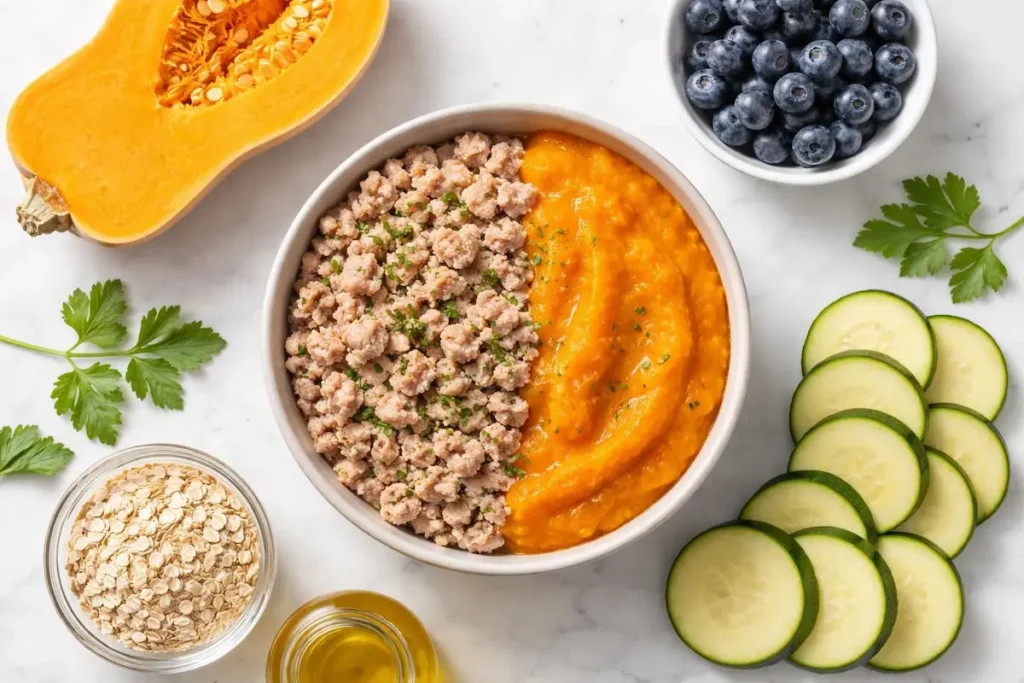
Recipe 9: Ground Turkey and Pumpkin Everyday Bowl
Turkey is leaner than beef and chicken thighs, making it a smart choice for dogs managing their weight. It’s also a good option for dogs with chicken sensitivities, since turkey is a different enough protein to sometimes be tolerated better.
Ground Turkey & Pumpkin Everyday Bowl
Ultra-lean, digestion-friendly daily staple — ideal for sensitive stomachs and weight management
Ingredients
2 lbs ground turkey (93/7 lean)
✦ 93/7 keeps fat low — good for weight-conscious dogs or those prone to pancreatitis
1 cup pumpkin puree (plain)
⚠️ Plain pumpkin only — not pie filling, which contains xylitol and spices toxic to dogs
1 cup sweet potato, mashed
steam and mash beforehand — acts as the binding base of the bowl
1 cup spinach, chopped
wilted in the pan’s residual heat — iron, folate, and antioxidants
½ cup green beans, chopped
add raw or lightly steamed — low calorie and high fiber
2 tablespoons fish oil
✦ Mix in only after cooling — heat destroys omega-3s. Add to the full batch or per serving
Canine multivitamin + calcium supplement
per package directions — add after food has fully cooled
Why turkey works as a daily protein: Ground turkey at 93/7 is one of the leanest fresh proteins available, making it ideal for dogs on calorie-restricted diets, those recovering from digestive issues, or breeds prone to pancreatitis. It’s also a novel protein for dogs previously fed only chicken or beef — useful for identifying or managing food sensitivities.
Instructions
Steam sweet potato until soft, then mash. Set aside.
Brown ground turkey in a large pan over medium heat, breaking it apart, until fully cooked through — no pink, no translucency.
Add chopped spinach to the pan and stir for 1–2 minutes until wilted. Remove from heat.
Combine turkey and spinach with mashed sweet potato, pumpkin puree, and green beans. Mix thoroughly.
Cool completely. Stir in fish oil and add supplements per package directions before serving.
🎃 Pumpkin as a digestive regulator: Plain pumpkin puree works both ways — the soluble fiber firms up loose stools and the water content helps with mild constipation. For dogs with chronic digestive sensitivity, this bowl is one of the safest daily options in the series. Start with a smaller serving (about 75% of normal) for the first 2–3 days when introducing this as a new meal.
Nutritional Highlights
- 🦃 Lean muscle protein
- 🎃 Digestive regulation
- 🐟 Omega-3 anti-inflammatory
- 🍠 Beta-carotene
- 🥬 Iron & folate
Recipe 10: Turkey, Blueberry, and Sweet Potato Blend
This one reads almost like a gourmet meal. Blueberries bring serious antioxidant power, and the flavor combination is one that dogs consistently go wild for. It’s basically the fancy dinner of the rotation.
Turkey, Blueberry & Sweet Potato Blend
Antioxidant-forward lean meal — blueberry and kale paired with ultra-lean turkey for coat and cell health
Ingredients
1.5 lbs ground turkey
brown and drain any excess fat — lean turkey keeps this meal low in saturated fat
½ cup blueberries, fresh or frozen
✦ Add raw after cooling — cooking destroys heat-sensitive antioxidants like anthocyanins
1.5 cups sweet potato, steamed and mashed
slightly larger portion than most recipes — forms a rich, binding base
1 cup kale, finely chopped and steamed
✦ Chop very finely before steaming — raw or coarsely chopped kale is harder for dogs to digest
½ cup carrots, grated
steam lightly with the kale — grated carrots cook quickly and distribute evenly
1 tablespoon coconut oil
✦ Mix in after the batch has cooled — medium-chain fatty acids support coat gloss and skin health
Canine multivitamin + calcium supplement
per package directions — add after cooling, per serving
Why blueberries belong in a dog’s bowl: Blueberries rank among the highest ORAC (oxygen radical absorbance capacity) scores of any fruit. The anthocyanins that give them their deep color are potent free-radical scavengers — supporting cellular aging, cognitive function, and immune response. At ½ cup per ~7 cup batch, the concentration is effective without being excessive.
Instructions
Steam sweet potato until soft, then mash. Set aside.
Steam kale and grated carrots together until tender. Kale should be fully softened — not just wilted.
Brown ground turkey in a pan over medium heat, breaking it apart. Drain any excess fat.
Combine turkey, mashed sweet potato, steamed kale, and carrots in a large bowl. Mix well.
Cool completely. Fold in blueberries, coconut oil, and supplements. Mix gently to avoid crushing the berries entirely.
🥬 Kale serving note: Like broccoli, kale contains compounds (isothiocyanates and oxalates) that can cause digestive irritation if fed in large amounts or too frequently. At 1 cup per batch served 3–4 days, this recipe is within safe limits. Dogs with known thyroid issues should have kale limited further — check with your vet if unsure.
Nutritional Highlights
- 🫐 Anthocyanin antioxidants
- 🥬 Vitamins A, C & K
- 🥥 Coat & skin health
- 🍠 Beta-carotene
- 🦃 Lean protein
Recipe 11: Turkey and Zucchini Light Bowl
A lower-calorie option built specifically for dogs on a weight management plan. High protein, high fiber, lower carbohydrate — this recipe keeps dogs satisfied without overloading on calories.
Turkey & Zucchini Light Bowl
The leanest meal in the series — extra-lean 99/1 turkey with hydrating, high-fiber vegetables for weight loss support
Ingredients
2 lbs ground turkey (extra lean, 99/1)
✦ 99/1 is the leanest commercially available ground turkey — virtually no fat
2 cups zucchini, diced
✦ The largest vegetable portion in this series — zucchini is ~95% water, great for satiety with minimal calories
1 cup spinach
stir into the warm mix at the end — wilts instantly with no extra cooking needed
½ cup pumpkin puree (plain)
⚠️ Plain pumpkin only — not pie filling, which contains xylitol and spices toxic to dogs
½ cup broccoli, steamed and chopped
✦ Steam until just tender and chop finely — do not overcook or sulforaphane degrades significantly
1 tablespoon fish oil
add after cooling — essential fat supplement for an otherwise very low-fat meal
Canine multivitamin + calcium supplement
per package directions — add after food has fully cooled
Designed for weight loss or pancreatitis recovery: At 99/1, this is the leanest recipe in the entire series. The high volume of water-rich vegetables (zucchini, spinach, broccoli) creates a larger meal volume with fewer calories — dogs feel full longer. The single tablespoon of fish oil is the only meaningful fat source, making this suitable for dogs under veterinary-supervised calorie restriction or recovering from pancreatitis flare-ups. Always confirm with your vet before switching a dog with pancreatitis history to any new diet.
Instructions
Cook ground turkey in a pan over medium heat, breaking it apart until fully cooked through. No pink. Drain any minimal fat that renders out.
Steam zucchini and broccoli together until just tender — pull them while still slightly firm. Chop broccoli finely after steaming.
Combine turkey, zucchini, broccoli, and pumpkin puree in a large bowl. Mix well.
Fold in spinach — the residual warmth of the mix will wilt it through without extra cooking.
Cool completely. Add fish oil and supplements per package directions before serving.
🥒 Zucchini as a volume food: At ~95% water content, zucchini is one of the best volume foods for overweight dogs — it adds bulk and satisfaction without adding meaningful calories. Two cups of raw zucchini contains only about 33 calories total. For dogs that seem perpetually hungry on a calorie-restricted diet, increasing the zucchini portion slightly is a safe way to stretch the meal.
Nutritional Highlights
- ⚖️ Ultra-low fat
- 🥒 High satiety volume
- 🎃 Digestive regulation
- 🥦 Sulforaphane
- 🐟 Essential omega-3
🐟 Fish-Based Recipes
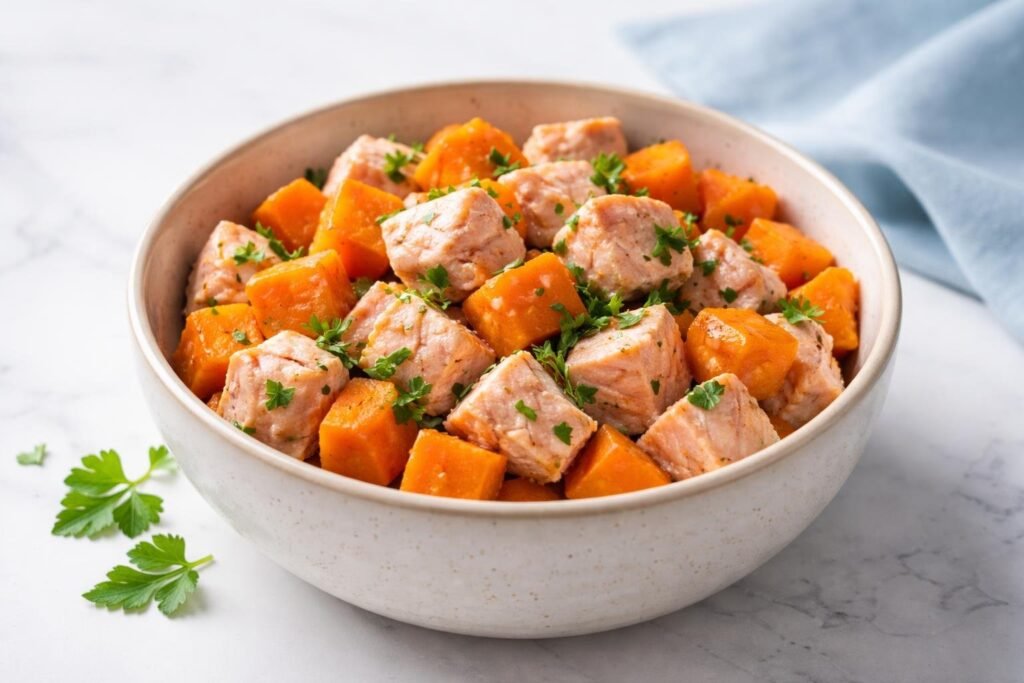
Recipe 12: Salmon and Sweet Potato Omega Bowl
Fish-based dog food is criminally underused in homemade feeding rotations.
Salmon is one of the richest natural sources of omega-3 fatty acids, which support coat shine, joint health, brain function, and inflammation reduction.
Dogs that struggle with itchy skin often respond remarkably well to more fish in their diet.
Salmon & Sweet Potato Omega Bowl
The highest omega-3 meal in the series — wild salmon with beta-carotene roots and anti-inflammatory vegetables
Ingredients
1.5 lbs fresh salmon (or canned in water, no salt)
⚠️ Must be fully cooked — raw salmon can carry a parasite fatal to dogs (see safety note below)
2 cups sweet potato, steamed and mashed
primary carb base — beta-carotene and natural sweetness complement the salmon well
1 cup green beans, chopped
steam lightly — low-calorie fiber that balances the richness of salmon
½ cup peas, fresh or frozen (thawed)
no cooking needed — thawed peas add plant protein and fold in easily
½ cup carrots, grated
lightly steam or add raw — grated carrots soften quickly in residual heat
1 tablespoon coconut oil
✦ Add after cooling — pairs with salmon’s natural omega-3s for enhanced fat-soluble nutrient absorption
Canine multivitamin + calcium supplement
per package directions — add after food has fully cooled
Instructions
Steam sweet potato until soft and mash. Set aside.
Fresh salmon: Bake at 375°F (190°C) for 15–18 minutes until fully cooked through. Canned salmon: Drain liquid completely. With either option, check carefully and remove all bones before use.
Flake salmon into small, bite-sized pieces. Run your fingers through the flaked fish a second time to catch any remaining fine bones.
Steam green beans and carrots until just tender.
Combine salmon, sweet potato, green beans, carrots, and thawed peas. Mix gently to keep salmon in flakes rather than breaking it down to a paste.
Cool completely. Add coconut oil and supplements per package directions before serving.
Canned vs fresh salmon: Both work equally well nutritionally. Canned salmon in water (no salt added) is a cost-effective and convenient option that’s available year-round. If using canned, choose varieties with soft, edible bones — these are actually safe and add calcium. Always check the label: avoid anything with added salt, oil, or seasoning.
🧡 Omega-3 note: Salmon delivers DHA and EPA directly — the most bioavailable forms of omega-3 for dogs. Unlike flaxseed oil (which provides ALA that dogs must convert), salmon’s omega-3s are immediately usable. This makes it particularly valuable for dogs with inflammatory conditions, joint issues, allergies, or dull coats. Rotating this meal into the weekly plan 2–3 times provides meaningful anti-inflammatory support.
Nutritional Highlights
- 🐟 DHA & EPA omega-3
- 🍠 Beta-carotene
- 🥕 Anti-inflammatory
- 🫘 Digestive fiber
- 💪 Complete protein
Important: Always use fully cooked salmon — raw salmon can carry a parasite called Neorickettsia helminthoeca that causes salmon poisoning disease in dogs, which can be fatal. Cook it through every single time.
Recipe 13: Sardine and Pumpkin Superfood Mix
Sardines are the budget-friendly omega-3 powerhouse. Canned sardines in water (no salt added) require zero cooking prep and pack an incredible nutritional punch. This recipe takes about 10 minutes total — genuinely one of the fastest homemade meals possible.
Sardine & Pumpkin Superfood Mix
A double omega-3 hit — sardines and egg yolk with digestive pumpkin, iron-rich spinach, and gut-friendly fiber
Ingredients
2 cans sardines in water, no salt added (drained)
✦ One of the richest whole-food sources of EPA and DHA available — no cooking needed if canned
1 cup plain pumpkin puree
✦ Plain only — not pumpkin pie filling. Canned or fresh both work. Regulates digestion in both directions (constipation and loose stools)
1 cup sweet potato, steamed and mashed
adds body and beta-carotene — balances the softer texture of pumpkin
1 cup spinach, wilted
✦ Brief wilting reduces oxalates — do not serve raw spinach in large amounts to dogs
½ cup zucchini, diced and steamed
low-calorie hydration booster — mild flavor that blends seamlessly into the mix
1 egg, scrambled
✦ Second omega-3 source via yolk — also adds B12, selenium, and complete amino acids. Always fully cook for dogs
Canine multivitamin + calcium supplement
per package directions — add after food has fully cooled, per serving
Choosing your sardines: Look for sardines packed in water with no added salt. Avoid sardines in oil, tomato sauce, or any seasoned brine — these contain additives that are unsafe or unnecessary for dogs. Bone-in sardines are perfectly fine and actually add a small calcium boost; the soft bones mash easily and pose no choking risk.
Instructions
Steam sweet potato until soft and mash. Set aside to cool slightly.
Scramble the egg in a dry pan over medium heat until fully cooked through. No butter, no oil, no salt. Set aside.
Steam zucchini until just tender, about 3–4 minutes. In the same pan or a separate one, wilt spinach briefly — 1 to 2 minutes until just collapsed. Do not overcook.
Drain sardines thoroughly. Mash in a large mixing bowl until no large chunks remain.
Add pumpkin puree, mashed sweet potato, wilted spinach, steamed zucchini, and scrambled egg to the bowl. Mix gently until evenly combined.
Cool completely before serving. Add supplements per package directions to each individual serving at feeding time.
🎃 Pumpkin as a digestive reset: Plain pumpkin puree is one of the most reliably effective home remedies for both constipation and loose stools in dogs. The soluble fiber absorbs excess water in diarrhea cases, while the bulk helps move things along in constipation. If your dog has a sensitive stomach, this is an ideal weekly rotation meal — especially after richer proteins like beef or lamb.
Why scrambled, not raw? Raw egg whites contain avidin, a protein that blocks biotin (vitamin B7) absorption. Cooking deactivates avidin entirely. The yolk is where the omega-3s and fat-soluble vitamins live — cooking the whole egg preserves these while eliminating the avidin issue. Scrambling without fat or salt is the simplest approach.
Storage: Refrigerate in an airtight container for up to 3–4 days. This recipe has a higher moisture content than most due to the pumpkin and spinach — check freshness before each serving. Freeze in individual portions for up to 2 months; thaw overnight in the refrigerator before use.
Nutritional highlights
- Double omega-3 (sardine + egg)
- Digestive fiber (pumpkin)
- Iron-rich (spinach)
- Beta-carotene
- B12 & selenium
- Gut-friendly
🐑 Lamb-Based Recipes
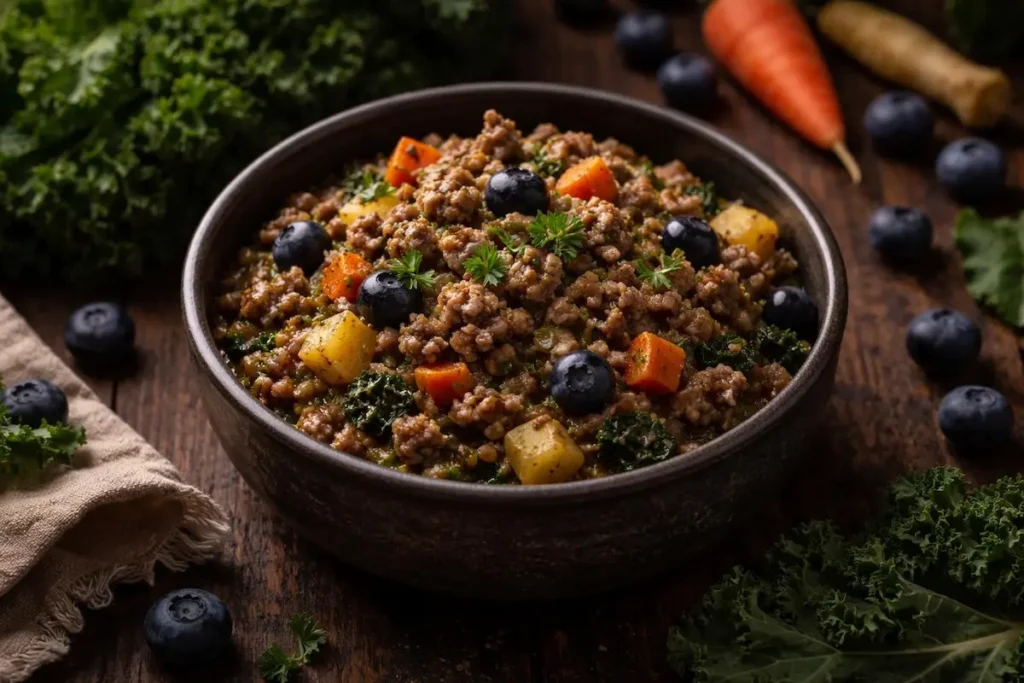
Recipe 14: Ground Lamb and Root Vegetable Bowl
Lamb is an excellent choice for dogs with sensitivities to chicken or beef — it’s a novel protein that many allergy-prone dogs haven’t been exposed to before, making it a useful tool for elimination diets. It’s richer in flavor than chicken and has a naturally higher fat content, so slightly smaller portions than beef or turkey recipes are appropriate.
Ground Lamb & Root Vegetable Bowl
A novel protein for allergy-prone dogs — L-carnitine-rich lamb with beta-carotene root vegetables and sustained energy carbs
Ingredients
1.5 lbs ground lamb
✦ Novel protein — ideal for dogs with chicken or beef sensitivities. Rich in L-carnitine, zinc, and B12
1 cup sweet potato, cubed and steamed
primary slow-release carb — beta-carotene and natural sweetness balance the richness of lamb
1 cup butternut squash, cubed and steamed
✦ Second root vegetable for layered beta-carotene — softer texture than sweet potato, mashes easily into the mix
½ cup carrots, grated
add raw or lightly steamed — grated carrots soften in residual heat and add crunch dogs enjoy
½ cup green beans, chopped
steam lightly — low-calorie fiber source that offsets the higher fat content of ground lamb
2 tablespoons fish oil
✦ Add per serving at feeding time — not into the stored batch. Balances lamb’s omega-6 ratio with EPA/DHA
Canine multivitamin + calcium supplement
per package directions — add after food has fully cooled, per serving
Why lamb for allergy dogs? Lamb is considered a “novel protein” for most dogs because it appears less frequently in commercial dog foods dominated by chicken and beef. Dogs with food sensitivities often react to proteins they’ve been repeatedly exposed to — rotating in lamb gives the immune system a break from common triggers. If your dog is currently on an elimination diet, confirm with your vet before introducing any new protein.
Instructions
Brown ground lamb in a skillet over medium heat, breaking it up as it cooks. Once fully cooked through, drain excess fat thoroughly — tilt the pan and spoon it off, or transfer lamb to a paper towel-lined plate. Lamb runs richer than other proteins; skipping this step adds unnecessary fat to the final batch.
Steam sweet potato and butternut squash until fork-tender, about 10–12 minutes. Steam green beans separately for 4–5 minutes until just tender — do not overcook.
Combine drained lamb with steamed sweet potato, butternut squash, green beans, and grated carrots in a large mixing bowl. Mix well to distribute evenly.
Cool completely before serving. Add fish oil and supplements per package directions to each individual serving at feeding time — not into the stored batch.
🥕 Root vegetable note: Sweet potato and butternut squash both belong to the beta-carotene family but bring slightly different textures. Sweet potato holds its shape better and adds body; butternut squash becomes softer and blends into the lamb almost like a sauce. Together they create a richer, more varied texture than using either alone — which is especially useful for picky eaters who bore easily of uniform textures.
L-carnitine and heart health: Lamb is one of the better dietary sources of L-carnitine — an amino acid that plays a role in fatty acid metabolism and has been studied in relation to canine dilated cardiomyopathy (DCM). While research is ongoing, dogs eating grain-free diets are sometimes monitored for taurine and carnitine levels. Including lamb in the rotation provides a natural source of both nutrients alongside the fish oil’s omega-3 support.
Storage: Refrigerate in an airtight container for up to 3–4 days. Because ground lamb retains more residual fat than leaner proteins, the mixture may solidify slightly when chilled — this is normal. Let it come to room temperature for 5–10 minutes before serving, or add a small splash of warm water to loosen. Freeze in individual portions for up to 2 months.
Nutritional highlights
- Novel protein (allergy-friendly)
- L-carnitine (heart health)
- Beta-carotene (root veg)
- Sustained energy carbs
- Omega-3 via fish oil
- Zinc & B12
Recipe 15: Lamb, Kale, and Blueberry Anti-Inflammatory Bowl
The finale recipe and honestly one of the most nutritionally impressive on the list. Lamb, kale, and blueberries together create an anti-inflammatory powerhouse that’s particularly well-suited for senior dogs or any dog dealing with joint issues, skin conditions, or chronic inflammation.
Lamb, Kale & Blueberry Anti-Inflammatory Bowl
Curcumin, anthocyanins, and L-carnitine in one bowl — built for aging dogs, allergy-prone dogs, and long-term joint support
Ingredients
1.5 lbs ground lamb
✦ Novel protein rich in L-carnitine — supports heart function and fatty acid metabolism
1 cup kale, finely chopped and steamed
✦ Chop finely before steaming — delivers vitamins A, C, and K with significantly reduced oxalate load when cooked
½ cup blueberries, fresh or frozen
✦ Add raw — anthocyanins are heat-sensitive. Frozen blueberries work equally well and are cheaper year-round
1 cup sweet potato, mashed
steamed and mashed — forms the binding base, adds beta-carotene and sustained energy
½ cup plain pumpkin puree
plain only, not pie filling — carries the turmeric blend and adds soluble fiber for digestive balance
¼ teaspoon turmeric
✦ Mix into pumpkin puree before combining — fat and black pepper both required for curcumin to absorb
A pinch of black pepper
✦ Piperine in black pepper increases curcumin bioavailability by up to 2,000% — do not skip this
1 tablespoon coconut oil
add after cooling — provides the dietary fat needed for curcumin absorption alongside the black pepper
Canine multivitamin + calcium supplement
per package directions — add to each serving after food has fully cooled
The turmeric trio: Curcumin (turmeric’s active compound) is poorly absorbed on its own. It needs three things to work: fat, heat activation, and piperine from black pepper. This recipe delivers all three — coconut oil provides the fat, the cooking process activates the curcumin, and the pinch of black pepper completes the absorption pathway. Without black pepper, most of the turmeric passes through without benefit.
Instructions
Brown ground lamb over medium heat, breaking it up as it cooks. Once cooked through, drain excess fat thoroughly — lamb is significantly fattier than other proteins in this series.
Steam kale until just tender, about 3–4 minutes. Do not overcook — kale should be wilted but still hold some color and texture.
In a small bowl, stir turmeric and black pepper directly into the pumpkin puree until fully combined. This ensures even distribution and activates the curcumin before mixing into the batch.
Combine drained lamb, steamed kale, blueberries, mashed sweet potato, and the spiced pumpkin mixture in a large bowl. Mix gently — avoid crushing the blueberries completely.
Cool completely. Add coconut oil and supplements per package directions before serving. Do not add coconut oil to warm food — heat degrades some of its beneficial properties.
🫐 Blueberries and cognitive aging: Anthocyanins — the pigment compounds that make blueberries blue — have been studied for their effect on oxidative stress in aging dog brains. Dogs experience cognitive decline similar to early-stage dementia as they age (Canine Cognitive Dysfunction). While blueberries are not a treatment, regular inclusion of anthocyanin-rich foods is one of the dietary strategies used in senior dog nutrition protocols. This makes the recipe particularly well-suited as a rotation meal for dogs over 7 years old.
Best used as a rotation meal: The combination of anti-inflammatory ingredients in this bowl — curcumin, anthocyanins, coconut oil, and L-carnitine — makes it well-suited for dogs with joint issues, allergies, or early signs of aging. Rotate it in 2–3 times per week rather than as a daily meal; dietary diversity is more beneficial than relying on any single recipe regardless of its nutrient density.
Nutritional Highlights
- 🌿 Curcumin (anti-inflammatory)
- 🫐 Anthocyanins (cognitive support)
- ❤️ L-carnitine (heart health)
- 🥬 Vitamins A, C & K
- 🎃 Digestive fiber
- 🍠 Beta-carotene
Grain-Free Recipe Quick Reference Guide
| Recipe | Primary Protein | Best For | Prep Time |
| Classic Beef & Sweet Potato | Beef | All dogs, beginners | 25 min |
| Beef Liver & Vegetable Stew | Beef + Organ | Nutrient boost | 30 min |
| Beef & Egg Power Bowl | Beef + Egg | Active dogs | 20 min |
| Slow Cooker Beef & Pumpkin | Beef | Busy schedules | 10 min + slow cook |
| Chicken & Sweet Potato Mix | Chicken | Daily rotation | 30 min |
| Chicken, Egg & Veggie Scramble | Chicken + Egg | Quick meals | 15 min |
| Chicken Liver & Vegetable Stir | Chicken + Organ | Picky eaters | 25 min |
| Chicken & Lentil Bowl | Chicken | Varied carb source | 35 min |
| Ground Turkey & Pumpkin Bowl | Turkey | Weight management | 25 min |
| Turkey, Blueberry & Sweet Potato | Turkey | Antioxidant boost | 25 min |
| Turkey & Zucchini Light Bowl | Turkey | Weight loss dogs | 20 min |
| Salmon & Sweet Potato Omega Bowl | Salmon | Skin & coat health | 30 min |
| Sardine & Pumpkin Superfood Mix | Sardine | Budget-friendly, fast | 10 min |
| Ground Lamb & Root Vegetable | Lamb | Allergy-prone dogs | 30 min |
| Lamb, Kale & Blueberry Bowl | Lamb | Senior/inflamed dogs | 30 min |
Storage Reminders for All These Recipes
All 15 recipes follow the same storage rules:
- Fridge: Store in airtight glass containers for up to 4 days
- Freezer: Portion into individual meal sizes and freeze for up to 3 months
- Thawing: Move from freezer to fridge the night before — never thaw on the counter
- Reheating: Let cold food sit for 10 to 15 minutes before serving, or warm briefly and stir to eliminate hot spots
Batch cooking on weekends and freezing 3 to 4 weeks’ worth of meals at a time makes this entire system genuinely manageable — even for busy households.
Final Thoughts
Grain-free homemade dog food isn’t a trend — for the right dogs, it’s a genuinely meaningful dietary upgrade. Whole proteins, dog-safe vegetables, and smart carbohydrate choices from sweet potato, pumpkin, and squash give dogs exactly what their bodies are designed to run on.
The 15 recipes above aren’t just theoretically healthy — they’re practical, rotatable, and built around ingredients that are easy to find and affordable to buy in bulk. Start with one or two recipes, watch how the dog responds over two to three weeks, and build from there.
Rotate proteins. Add supplements. Label everything. And maybe invest in a good slow cooker — because Recipe 4 alone is worth it. 🙂