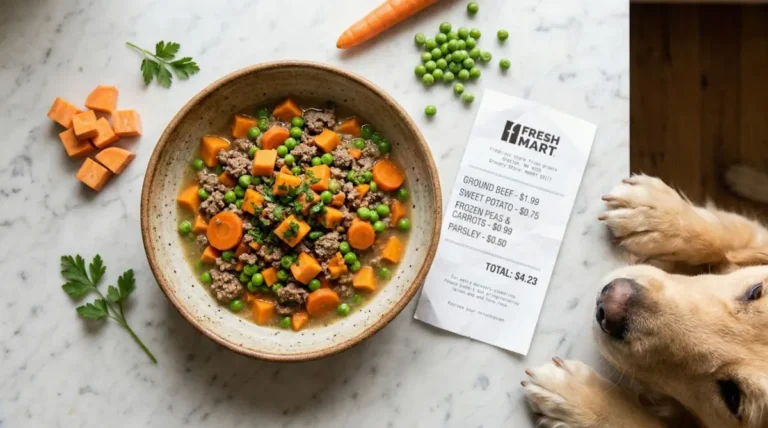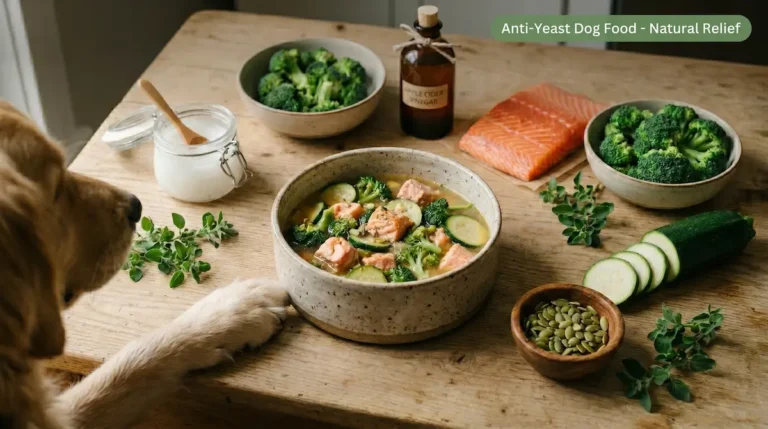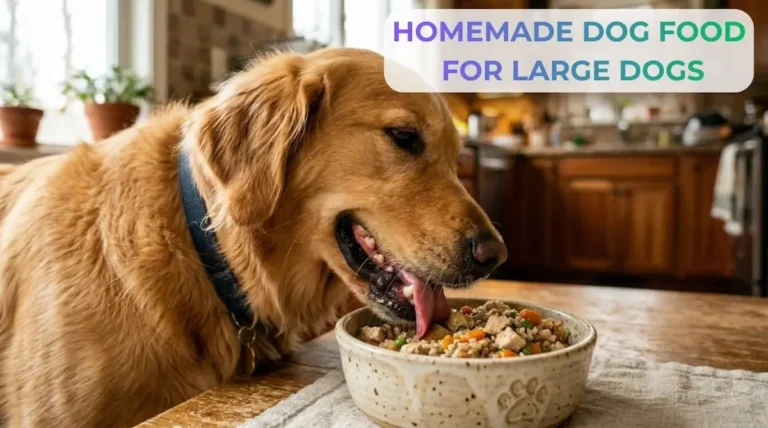
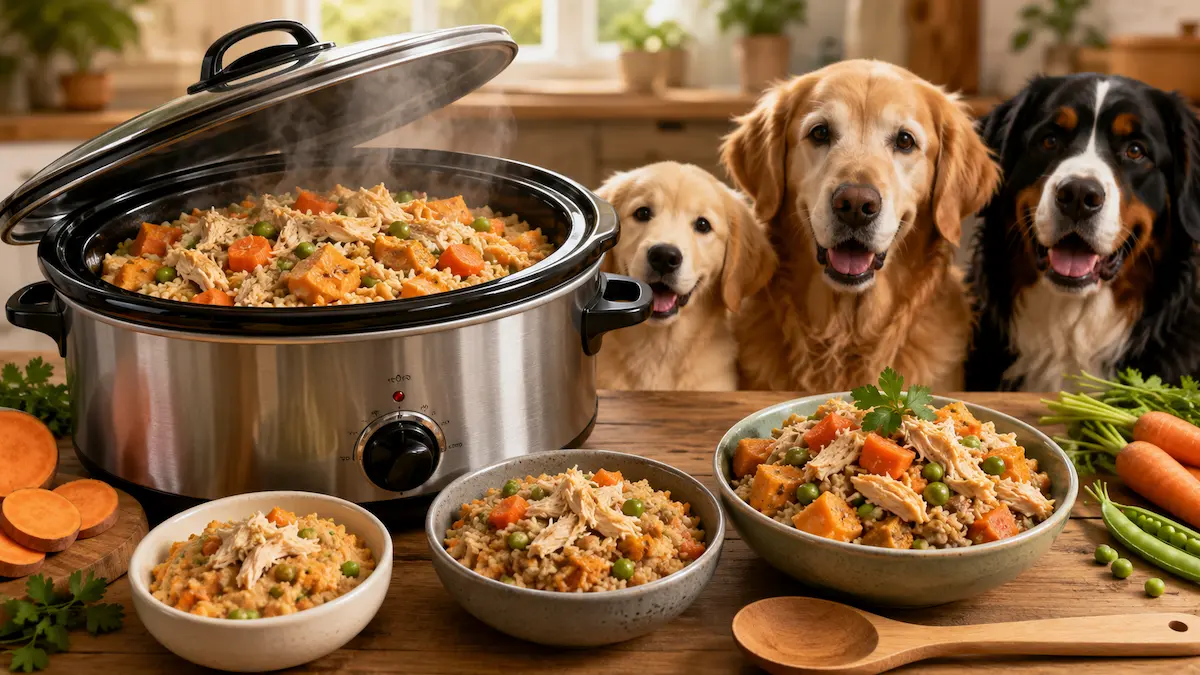
Looking for slow cooker dog food recipes for every life stage? A growing puppy, a senior dog, and a large-breed adult do not need the exact same bowl.
- A puppy needs more calories, more protein, and softer textures than an adult dog.
- A senior dog needs joint support, easier-to-digest proteins, and lower caloric density than they did at three years old.
- A large breed needs bigger batches, controlled calorie density, and bone-supporting nutrients that small breed recipes don’t prioritize.
The slow cooker handles all of it beautifully — the same hands-off, set-it-and-leave-it convenience, but with recipes specifically designed for where a dog is in their life rather than a one-size-fits-all approach.
This guide includes 10 homemade slow cooker dog food recipes organized by life stage: puppy recipes, senior dog recipes, and large-breed recipes. Use them for fresh meal prep, rotation meals, or vet-guided homemade feeding.
Important nutrition note: These recipes are homemade meal-prep ideas and are not automatically “complete and balanced” as a full-time diet unless reviewed and adjusted by your veterinarian or a board-certified veterinary nutritionist. Dogs need complete nutrition across protein, fat, minerals, vitamins, and calories, and their needs change by life stage.
If you’re looking for one simple beginner-friendly batch, start with our basic CrockPot dog food recipes guide. This article goes one step further with slow cooker dog food recipes organized by life stage.
Before You Make Homemade Slow Cooker Dog Food
Homemade slow cooker dog food can be a helpful way to prep fresh meals, but these recipes are not automatically complete and balanced for long-term daily feeding.
If you plan to use homemade food as your dog’s main diet, check with your veterinarian first — especially for puppies, senior dogs, large breeds, or dogs with health conditions.
✅ Always use dog-safe ingredients. Choose plain water, low-sodium broth, or bone broth with no onion, garlic, chives, added seasoning, or artificial sweeteners.
✅ Cook proteins fully, let the food cool before serving, and introduce any new recipe gradually over several days.
How to Choose the Right Recipe for Your Dog’s Life Stage
Start with your dog’s age, size, and texture needs. Puppies usually need softer, more calorie-supportive meals, senior dogs often do better with gentle textures and joint-supportive ingredients, and large breeds benefit from bigger batches with careful portion control.
Use the quick guide below to choose the best slow cooker dog food recipe for your dog, then adjust portions based on their body condition, activity level, and your vet’s guidance.
| # | Recipe | Life Stage | Protein | Cook Time (LOW) | Key Benefit |
|---|---|---|---|---|---|
| 1 | Chicken Growth Batch | Puppy | Chicken thighs | 6–7 hrs | Calorie-dense, DHA |
| 2 | Beef & Egg Brain Batch | Puppy | Beef + eggs | 5–6 hrs | Brain development |
| 3 | Salmon DHA Batch | Puppy | Salmon | 5–6 hrs | Neurological support |
| 4 | Chicken & Turmeric | Senior | Chicken | 6–7 hrs | Joint, anti-inflammatory |
| 5 | Salmon Soft Batch | Senior | Salmon | 5 hrs | Omega-3, joint mobility |
| 6 | Turkey & Blueberry | Senior | Turkey | 5–6 hrs | Cognitive support |
| 7 | Beef & Bone Broth | Senior | Beef | 5–6 hrs | Collagen, gut health |
| 8 | Chicken Big Batch | Large Breed | Chicken | 7–8 hrs | Full week yield |
| 9 | Beef Stew Joint Batch | Large Breed | Beef stew | 8–9 hrs | Collagen, joint support |
| 10 | Turkey Weight Mgmt | Large Breed | Turkey | 6–7 hrs | Satiety, weight control |
💡 Related Articles:
🐶 Puppy Slow Cooker Dog Food Recipes
Puppies have significantly different nutritional requirements than adult dogs — higher calorie density per pound of body weight, more protein for growth and development, more calcium and phosphorus for bone formation, and DHA for brain and eye development.
The recipes in this section address all of these requirements while maintaining the soft, easily digestible textures that young digestive systems handle best.
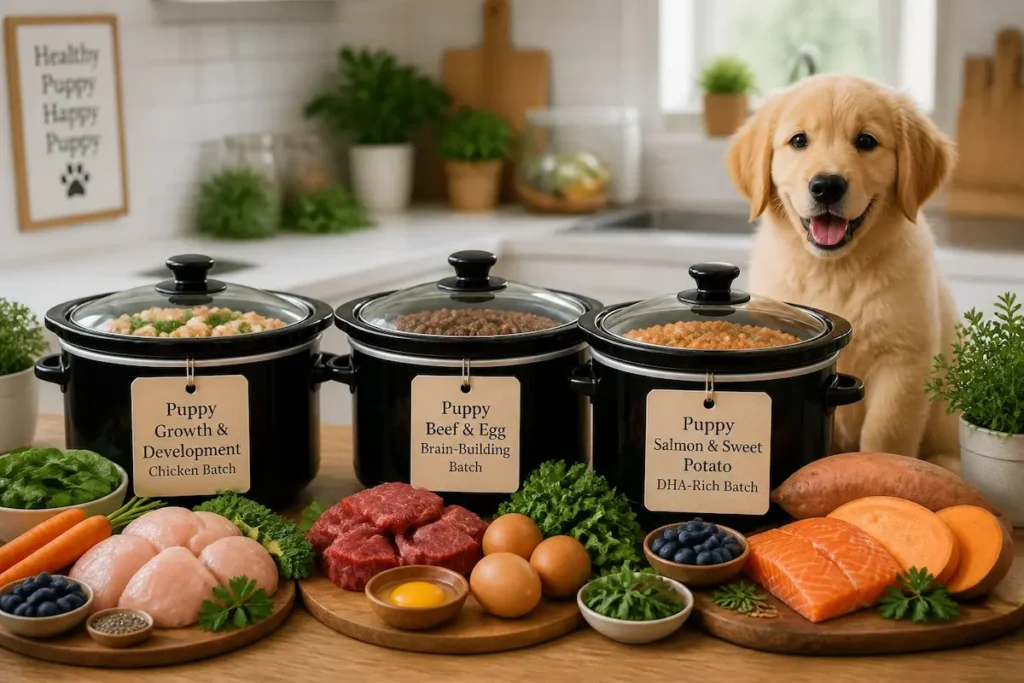
1. Puppy Growth & Development Chicken Batch
The foundation puppy slow cooker recipe — designed around the higher protein and caloric needs of a growing dog with soft textures appropriate for puppies transitioning from mother’s milk or commercial puppy food.
🥣 Ingredients (makes ~8 cups):
- 2.5 lbs boneless chicken thighs (slightly fattier than breast — appropriate for puppy caloric needs)
- ½ cup brown rice
- 1 cup finely diced sweet potato
- 1 cup chopped carrots
- ½ cup frozen peas
- 1 tablespoon coconut oil
- 4 cups low-sodium chicken broth (no onion, no garlic)
- 1 tablespoon fish oil (added after cooking — DHA for brain development)
🧑🍳 Instructions:
- Add chicken thighs, rice, sweet potato, carrots, and broth to the slow cooker.
- Cook on LOW for 6–7 hours or HIGH for 3–4 hours.
- Add peas in the final 30 minutes.
- Remove chicken and shred very finely — smaller pieces than adult recipes.
- Return chicken to the slow cooker and stir in coconut oil.
- Cool completely, then add fish oil to each portion before serving.
🐾 Puppy note: Chicken thighs are intentionally used here rather than breast — puppies need more calories and fat than adult dogs for healthy growth. The slightly higher fat content is appropriate for puppies under 12 months and should be adjusted to leaner cuts as the puppy approaches adulthood.
🐟 Nutrition note: Fish oil’s DHA is critical for puppy brain and eye development — add to each serving post-cook to preserve the omega-3 integrity. Never cook fish oil; heat destroys its beneficial compounds.
2. Puppy Beef & Egg Brain-Building Batch
Eggs deliver DHA alongside their complete amino acid profile — an ideal protein addition for puppies whose brain development is actively ongoing through the first year of life. Ground beef provides iron for healthy blood development.
🥣 Ingredients (makes ~8 cups):
- 2 lbs lean ground beef
- 3 eggs, beaten
- ½ cup white rice (easier to digest than brown for young puppies)
- 1 cup finely diced sweet potato
- ½ cup chopped carrots
- ½ cup chopped green beans
- 4 cups water
🧑🍳 Instructions:
- Brown ground beef in a pan and drain fat. Add to the slow cooker.
- Add rice, sweet potato, carrots, green beans, and water.
- Cook on LOW for 5–6 hours.
- In the final 20 minutes, reduce to the LOW setting if on HIGH.
- Stir beaten eggs slowly into the hot batch — they cook through gently in 10–15 minutes on LOW.
- Mix thoroughly and cool completely before serving.
🐾 Puppy note: White rice is used here rather than brown — it’s easier for young digestive systems to process. Transition to brown rice gradually after 6 months as the puppy’s digestive system matures.
🐟 Nutrition note: Never add raw eggs to a puppy’s food — raw egg whites contain avidin, which blocks biotin absorption. Gently cooking the eggs into the slow cooker batch is the correct preparation method.
3. Puppy Salmon & Sweet Potato DHA-Rich Batch
Salmon is the most DHA-rich whole food protein available — critical for neurological development in puppies.
This recipe delivers concentrated omega-3 support alongside easily digestible sweet potato and gentle vegetables.
🥣 Ingredients (makes ~7 cups):
- 2 lbs boneless salmon fillets, skin removed
- 1 cup finely diced sweet potato
- 1 cup finely chopped broccoli
- ½ cup grated carrot
- ½ cup frozen peas
- 3 cups water
- 1 tablespoon plain Greek yogurt per serving (probiotic — add at serving)
🧑🍳 Instructions:
- Add sweet potato, carrot, and water to the slow cooker.
- Cook on LOW for 3 hours until sweet potato begins to soften.
- Place salmon fillets on top of the vegetable mixture.
- Add broccoli and peas around the salmon.
- Cook on LOW for a further 2–3 hours until salmon is fully cooked through.
- Flake salmon thoroughly — check very carefully for any bones.
- Stir everything together and cool completely.
- Add a small dollop of plain Greek yogurt to each serving.
🐾 Puppy note: Check salmon for bones more carefully than for adult dog recipes — puppies’ smaller throats make bone fragments a more significant hazard. Run fingers through every part of the flaked salmon before serving.
🐟 Nutrition note: The probiotic in Greek yogurt supports healthy gut microbiome development in puppies — particularly important if the puppy has recently been on antibiotics or is transitioning from commercial food.
Feeding a growing puppy? You may also like our puppy food recipes guide for more homemade meal ideas designed around younger dogs.
🦴 Senior Dog Slow Cooker Recipes
Senior dogs — generally considered 7+ years for medium breeds, 5+ years for giant breeds — need lower calorie density, more joint-supporting nutrients, easier-to-digest proteins, and softer food textures.
These recipes address each of these needs specifically.
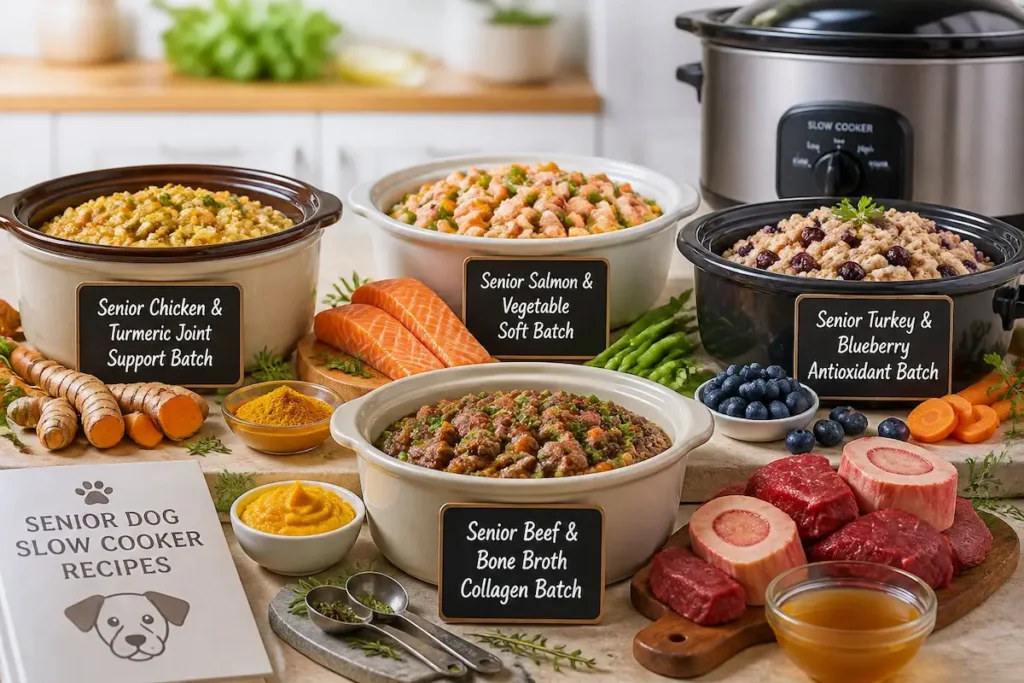
4. Senior Chicken & Turmeric Joint Support Batch
Turmeric’s curcumin alongside black pepper and olive oil delivers the most bioavailable natural anti-inflammatory available in a food format — directly relevant for the joint inflammation that affects most senior dogs.
🥣 Ingredients (makes ~8 cups):
- 2.5 lbs boneless chicken breast
- ½ cup rolled oats (soft texture — ideal for senior dogs)
- 1 cup plain canned pumpkin
- 1 cup finely grated carrot
- ½ cup chopped green beans
- ¼ teaspoon turmeric powder
- Pinch of black pepper (increases curcumin absorption significantly)
- 1 tablespoon olive oil
- 4 cups water
- 2 tablespoons fish oil (added after cooking)
🧑🍳 Instructions:
- Add chicken, oats, carrot, green beans, and water to the slow cooker.
- Cook on LOW for 6–7 hours — the oats create a naturally soft, almost porridge-like texture.
- Remove chicken and shred very finely — smaller, softer pieces for aging teeth.
- Return chicken to the slow cooker and stir pumpkin through evenly.
- Stir in turmeric, black pepper, and olive oil off the heat.
- Cool completely, then add fish oil to each serving before feeding.
🐾 Senior note:
- The oat-pumpkin base in this recipe produces one of the softest textures on this entire list — appropriate for senior dogs with dental issues, missing teeth, or reduced jaw strength.
- The combination of turmeric, fish oil, and pumpkin makes this one of the most therapeutically supportive recipes for aging dogs.
5. Senior Salmon & Vegetable Soft Batch
Salmon’s omega-3s reduce the joint inflammation that makes movement painful for aging dogs — and slow-cooked salmon produces a naturally soft, easily digestible batch that senior digestive systems handle comfortably.
🥣 Ingredients (makes ~7 cups):
- 2 lbs boneless salmon fillets, skin removed
- ½ cup rolled oats
- 1 cup finely chopped cauliflower
- 1 cup grated carrot
- ½ cup chopped green beans
- ½ cup plain canned pumpkin
- 3 cups water
- 2 tablespoons fish oil (added after cooking)
🧑🍳 Instructions:
- Add oats, cauliflower, carrot, green beans, and water to the slow cooker.
- Cook on LOW for 3 hours.
- Place salmon on top of the cooked vegetables.
- Cook on LOW for a further 2 hours until salmon flakes easily.
- Flake salmon and check carefully for bones.
- Stir pumpkin through the entire batch.
- Cool completely, then add fish oil to each serving.
🐾 Senior note: The double omega-3 source in this recipe — salmon and fish oil — provides the highest anti-inflammatory effect of any recipe in this guide. For senior dogs with diagnosed osteoarthritis or significant joint stiffness, this is the rotation recipe to prioritize most frequently.
6. Senior Turkey & Blueberry Antioxidant Batch
Blueberries contain anthocyanins — antioxidants that support cognitive function, which declines in senior dogs in ways that parallel canine cognitive dysfunction.
The combination of cognitive support from blueberries and lean protein from turkey makes this a genuinely targeted senior recipe.
🥣 Ingredients (makes ~8 cups):
- 2.5 lbs ground turkey
- ½ cup blueberries (fresh or frozen)
- ½ cup rolled oats
- 1 cup finely chopped broccoli
- ½ cup grated carrot
- ½ cup plain canned pumpkin
- 4 cups low-sodium chicken broth
🧑🍳 Instructions:
- Sauté turkey in a pan until cooked through. Drain any fat.
- Add turkey, oats, broccoli, carrot, and broth to the slow cooker.
- Cook on LOW for 5–6 hours.
- Add blueberries in the final 30 minutes — they soften but retain some integrity.
- Stir pumpkin through after cooking. Cool completely.
🐾 Senior note: Canine cognitive dysfunction — the dog equivalent of dementia — affects a significant proportion of dogs over age 11. Antioxidant-rich diets have emerging evidence for slowing cognitive decline. Blueberries are the most accessible and concentrated antioxidant addition available in dog food.
7. Senior Beef & Bone Broth Collagen Batch
Bone broth’s collagen content supports joint cartilage, gut lining integrity, and skin health — all areas of concern in senior dogs.
This recipe uses bone broth as the cooking liquid to infuse every cup of the batch with collagen alongside lean beef protein.
🥣 Ingredients (makes ~8 cups):
- 2 lbs lean ground beef
- 1 cup plain canned pumpkin
- ½ cup rolled oats
- 1 cup finely chopped green beans
- ½ cup grated carrot
- 4 cups plain bone broth (no onion, no garlic, no added seasoning — homemade or commercial)
- 1 tablespoon fish oil (added after cooking)
🧑🍳 Instructions:
- Brown beef in a pan and drain fat. Add to the slow cooker.
- Add oats, green beans, carrot, and bone broth.
- Cook on LOW for 5–6 hours.
- Stir pumpkin through after cooking.
- Cool completely, then add fish oil to each serving.
🐾 Senior note:
- Bone broth is available commercially — look for products with no added onion, garlic, salt, or xylitol.
- Homemade bone broth simmered from beef bones for 12–24 hours produces the highest collagen concentration. The gelatin that forms when homemade broth is refrigerated is pure collagen — a visual indicator of quality.
Caring for an older dog? You may also like our Senior Dog Care guide for more tips on gentle feeding, daily comfort, mobility support, and helping senior pups feel their best.
🐕🦺 Large Breed Slow Cooker Dog Food Recipes
Large breeds — generally 50+ lbs — have specific slow cooker needs: bigger batch sizes to make the effort worthwhile, controlled calorie density to prevent the obesity that accelerates joint deterioration, and bone and joint-supporting nutrients that smaller breeds don’t require to the same degree.
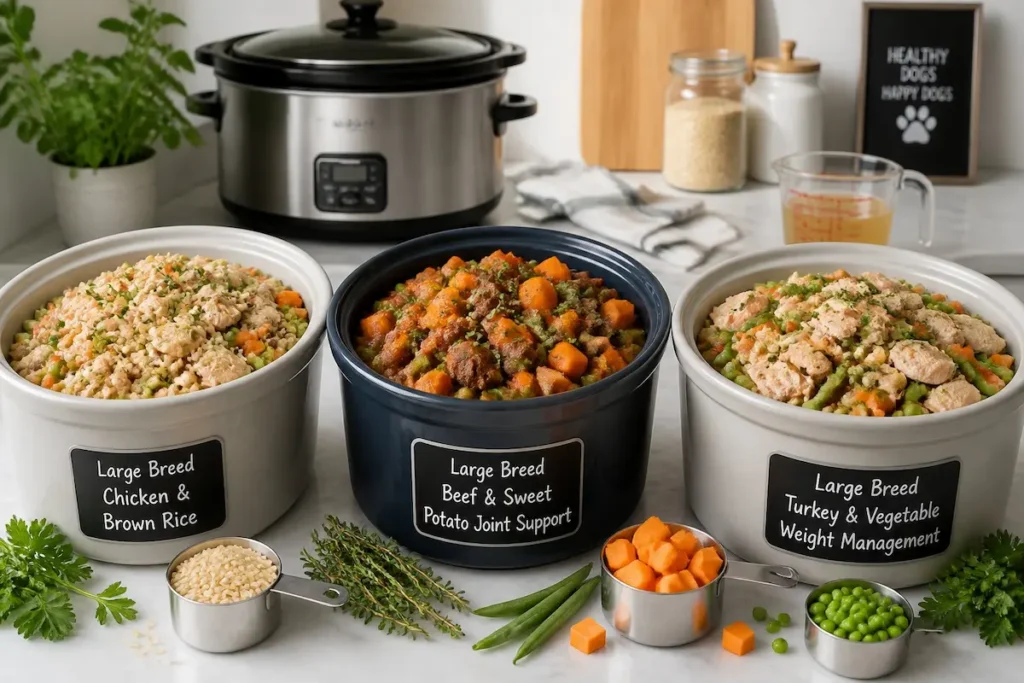
8. Large Breed Chicken & Brown Rice Big Batch
The foundation large breed slow cooker recipe — scaled for a 7-quart slow cooker with a yield appropriate for a full week of feeding for a 60–80 lb dog.
🥣 Ingredients (makes ~14–16 cups):
- 4 lbs boneless, skinless chicken breast
- 1½ cups dry brown rice
- 2 cups chopped carrots
- 2 cups green beans, trimmed
- 1 cup frozen peas
- 1 cup chopped zucchini
- 6 cups low-sodium chicken broth (no onion, no garlic)
- 2 tablespoons olive oil
- 2 tablespoons fish oil (added after cooking)
🧑🍳 Instructions:
- Add chicken, rice, carrots, zucchini, and broth to a 7-quart slow cooker.
- Cook on LOW for 7–8 hours or HIGH for 4–5 hours.
- Add green beans and peas in the final 30 minutes.
- Remove chicken and shred. Return to slow cooker.
- Stir in olive oil. Cool completely.
- Add fish oil to each serving before feeding.
🐾 Large breed note: This batch fills a 7-quart slow cooker to approximately ¾ capacity — the ideal fill level for even cooking without overflow. A 6-quart slow cooker can handle this recipe with the vegetables slightly reduced. Never fill a slow cooker more than ¾ full.
🐟 Nutrition note: Fish oil’s joint-supporting omega-3s are particularly important for large breeds, whose joints carry significantly more load than small breeds. Glucosamine supplement added to each serving is worth discussing with a vet for large breed dogs over 5 years old.
9. Large Breed Beef & Sweet Potato Joint Support Batch
Beef stew meat slow-cooked for 8 hours produces extraordinary tenderness and collagen extraction — the gelatin-rich broth that results provides meaningful joint support for large breeds carrying significant body weight.
🥣 Ingredients (makes ~14–16 cups):
- 4 lbs beef stew meat, cut into small chunks
- 2 large sweet potatoes, peeled and cubed
- 2 cups chopped carrots
- 1 cup chopped green beans
- 1 cup frozen peas
- ½ cup chopped spinach
- 6 cups low-sodium beef broth (no onion, no garlic)
- 2 tablespoons fish oil (added after cooking)
🧑🍳 Instructions:
- Add beef, sweet potato, carrots, and broth to a 7-quart slow cooker.
- Cook on LOW for 8–9 hours — the longer time produces maximum collagen extraction from the stew meat.
- Add green beans and peas in the final 30 minutes.
- Break beef into small pieces with a spoon — it should fall apart with minimal pressure.
- Stir in spinach off the heat until wilted. Cool completely.
- Skim any fat from the surface before portioning. Add fish oil to each serving.
🐾 Large breed note: Stew meat produces significantly more collagen than ground beef — the connective tissue breaks down completely over the long, low cook time, creating a naturally thick, gelatinous broth that distributes through every cup of the batch. This gelatin is the primary joint-support mechanism of this recipe.
10. Large Breed Turkey & Vegetable Weight Management Batch
For large breeds prone to obesity — Labrador Retrievers, Beagles, Basset Hounds, Golden Retrievers — a high-volume, low-calorie-density slow cooker recipe that produces generous portion sizes without the caloric load that drives weight gain.
🥣 Ingredients (makes ~14–16 cups):
- 3.5 lbs ground turkey (99% fat-free)
- 2 cups chopped green beans
- 2 cups chopped zucchini
- 1 cup chopped broccoli
- 1 cup grated carrot
- 1 cup chopped cabbage
- ½ cup plain canned pumpkin
- 5 cups water
🧑🍳 Instructions:
- Brown turkey in batches and drain fat completely. Add to the slow cooker.
- Add green beans, zucchini, broccoli, carrot, cabbage, and water.
- Cook on LOW for 6–7 hours or HIGH for 3–4 hours.
- Stir pumpkin through after cooking for satiety support.
- Cool completely before portioning.
🐾 Large breed note: The high vegetable-to-protein ratio in this recipe is intentional — it produces large, filling portions at significantly lower caloric density than standard recipes.
For a 70 lb overweight Labrador, this batch allows feeding a satisfying 2.5 cup meal while maintaining a caloric deficit for weight loss. Pumpkin’s fiber expands in the stomach, providing genuine satiety between meals.
🐟 Nutrition note: Cabbage adds significant bulk at approximately 22 calories per cup — one of the most effective low-calorie volume fillers available for weight management recipes. Introduce gradually if the dog hasn’t had cabbage before — it can cause gas initially until the digestive system adjusts.
Cooking for a larger pup? You may also like our budget-friendly large dog food guide for lower-cost meal prep ideas, plus our homemade dog food for large dogs recipe roundup for more healthy batch-cooking options.
Life-Stage Nutrition Guide
Puppies (Under 12 Months)
Puppies need 1.5–2x the calories per pound of body weight compared to adult dogs. Feeding guide for slow cooker puppy recipes:
| Puppy Weight | Per Meal | Meals Per Day |
|---|---|---|
| Under 5 lbs | 2–3 tablespoons | 3–4 |
| 5–15 lbs | ¼–½ cup | 3 |
| 15–30 lbs | ½–¾ cup | 3 |
| 30–50 lbs | ¾–1 cup | 3 |
| 50+ lbs (large breed puppy) | 1–1½ cups | 3 |
Large breed puppies specifically should not be overfed — rapid growth in large breeds increases the risk of developmental orthopedic disease. Feed to body condition rather than maximum appetite.
Senior Dogs (7+ Years / 5+ Years for Giant Breeds)
Senior dogs typically need 20–30% fewer calories than they did at peak adulthood, alongside higher-quality protein that’s easier to digest:
| Senior Dog Weight | Per Meal | Meals Per Day |
|---|---|---|
| Under 20 lbs | ¼–½ cup | 2 |
| 20–50 lbs | ½–¾ cup | 2 |
| 50–80 lbs | 1–1½ cups | 2 |
| 80+ lbs | 1½–2 cups | 2 |
Monitor body condition monthly — senior dogs lose muscle mass (sarcopenia) even on appropriate caloric intake. If muscle loss is visible over the spine or hips, increase protein content rather than overall calories.
Large Breeds (50+ lbs)
Large breeds benefit from twice-daily feeding to reduce bloat risk (GDV):
| Large Dog Weight | Per Meal | Meals Per Day |
|---|---|---|
| 50–70 lbs | 1½–2 cups | 2 |
| 70–90 lbs | 2–2½ cups | 2 |
| 90–120 lbs | 2½–3½ cups | 2 |
| 120+ lbs | 3½–5 cups | 2 |
Never feed large breeds once daily — the single large meal is a significant bloat risk factor. Twice daily feeding is a non-negotiable for breeds at elevated GDV risk (Great Danes, German Shepherds, Standard Poodles, Weimaraners).
Slow Cooker Tips for Life-Stage Recipes
1️⃣ Texture adjustment by life stage:
- For puppies and seniors, use the HIGH setting for the first 30 minutes then reduce to LOW — the initial higher heat helps break down proteins and grains to softer textures faster.
- For adult and large breed dogs, LOW throughout produces the best batch cohesion.
2️⃣ Scaling for large breed batches: Always use a 7-quart slow cooker for large breed recipes — a 6-quart risks overflow and uneven cooking with 4+ lb protein batches. Fill to ¾ capacity maximum.
3️⃣ Fish oil timing: Never add fish oil during cooking — add to each individual serving immediately before feeding. Heat and extended storage both degrade omega-3s rapidly.
4️⃣ Puppy portion freezing: Freeze puppy food in very small portions — tablespoon-sized ice cube tray freezing works well for puppies under 10 lbs, producing perfectly sized single-serving portions that thaw quickly.
Storage Guide
- Refrigerator: airtight containers for 4–5 days; fish-based recipes within 3 days
- Freezer: portioned servings for up to 3 months
- Puppy portions: freeze in tablespoon or ¼-cup portions using ice cube trays; thaw in the fridge overnight
- Large breed batches: portion immediately after cooling into daily amounts; refrigerate first 4 days, freeze the rest
- Fish oil: never pre-mix into stored batches; always add fresh at serving
Final Thoughts
Life-stage specific slow cooker dog food is one of the most meaningful upgrades a dog parent can make to a homemade feeding routine.
A puppy eating food designed for their growth phase, a senior dog eating food designed for their joints and digestion, and a large breed eating batches designed for their size — these aren’t marginal improvements.
They’re the difference between generic homemade food and food that actively supports where the dog is right now.
Start with the recipe that matches the dog’s current life stage. Set the slow cooker before work. Come home to a week of genuinely appropriate, genuinely nourishing food.
Every life stage deserves its own recipe. These 10 deliver exactly that. 🙂