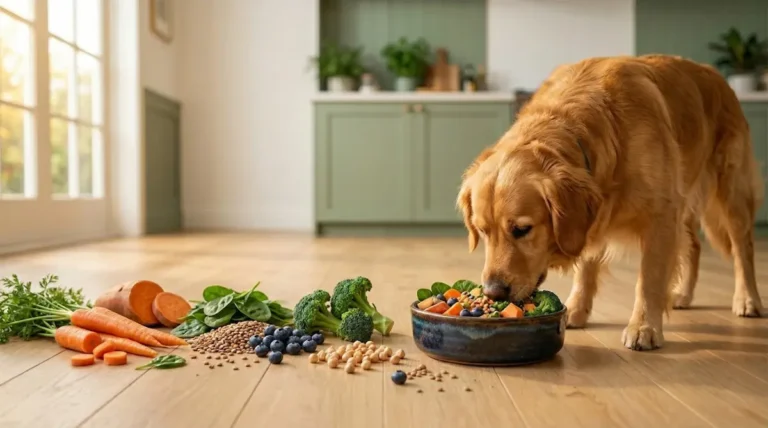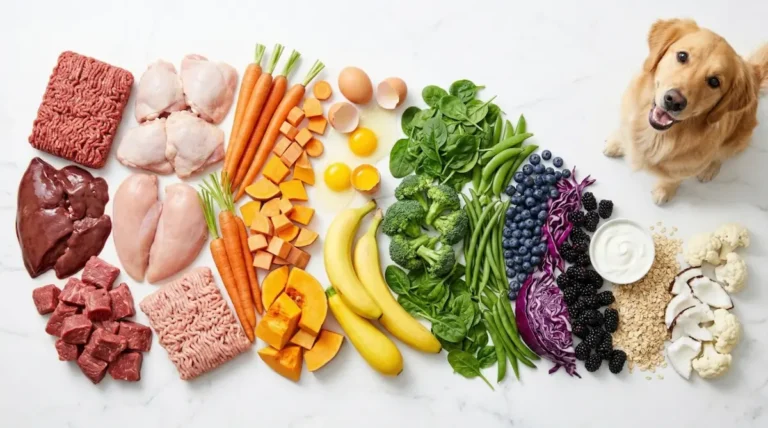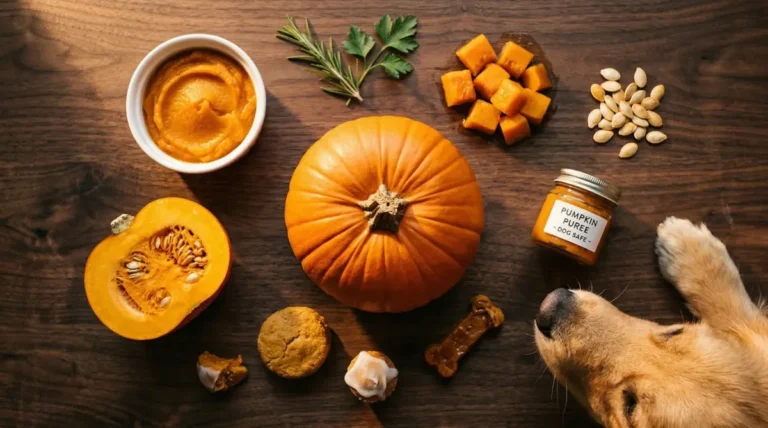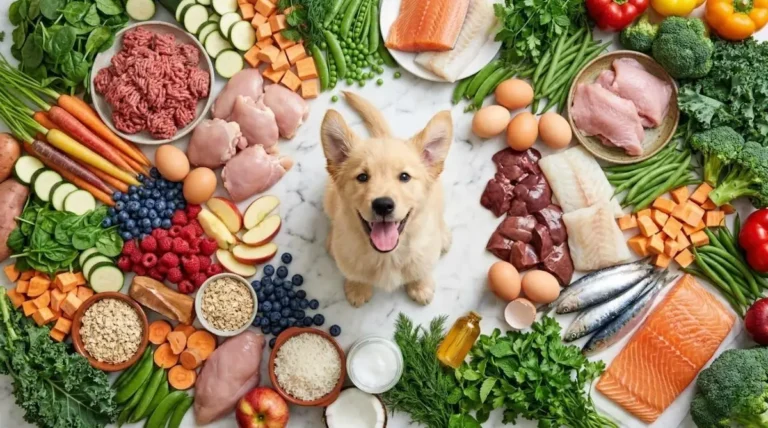
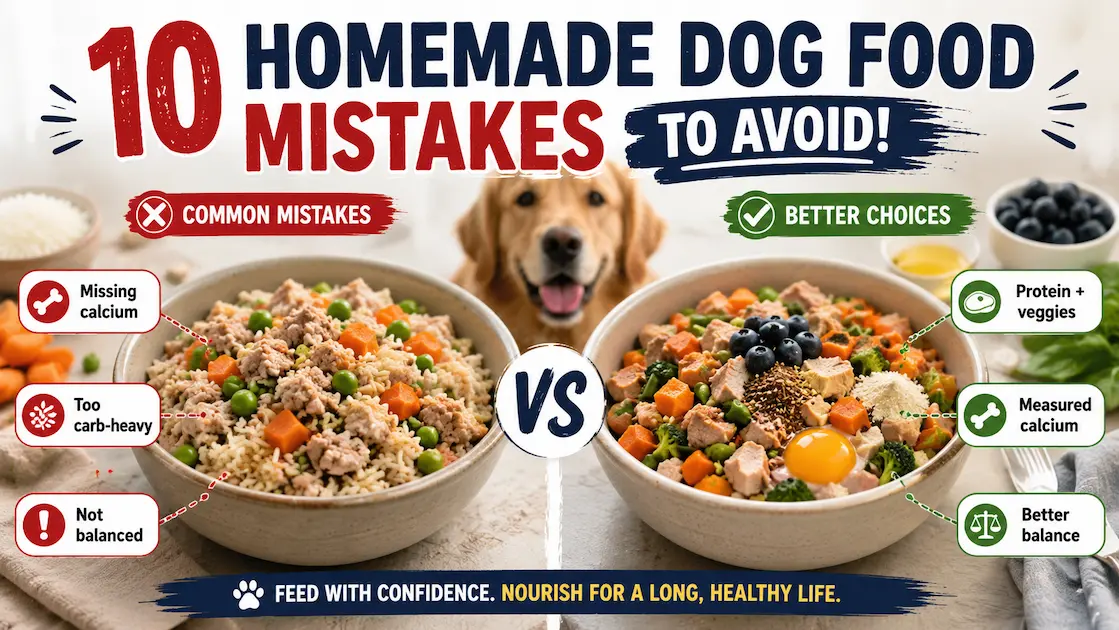
Making homemade dog food gives you more control over ingredients, textures, and what goes into your dog’s bowl.
But a meal can look fresh and healthy without being nutritionally complete. Common homemade dog food mistakes often come from unbalanced recipes, guessed portions, unsafe ingredients, or supplements added without a clear plan.
Here are 10 of the most common mistakes in homemade dog food, why they matter, and how to fix them.
🐾 Quick Look: 10 Common Homemade Dog Food Mistakes
| Homemade Dog Food Mistake | Quick Fix |
|---|---|
| Assuming meat + vegetables makes a complete meal | Use a properly balanced recipe |
| Forgetting calcium | Include the calcium source specified for the recipe |
| Rotating proteins instead of nutrients | Rotate well-constructed meals, not just meats |
| Feeding too much liver | Use organ meats in appropriate proportions |
| Adding supplements at random | Supplement the whole recipe, not individual ingredients |
| Eyeballing portions | Consider calories, body condition, and activity |
| Switching diets too quickly | Transition gradually when appropriate |
| Using unsafe human ingredients | Keep dog food plain and check every ingredient |
| Feeding one simple recipe forever | Know whether the meal is complete or supplemental |
| Ignoring storage and food safety | Cool, portion, refrigerate, freeze, and thaw safely |
10 Common Homemade Dog Food Mistakes to Avoid
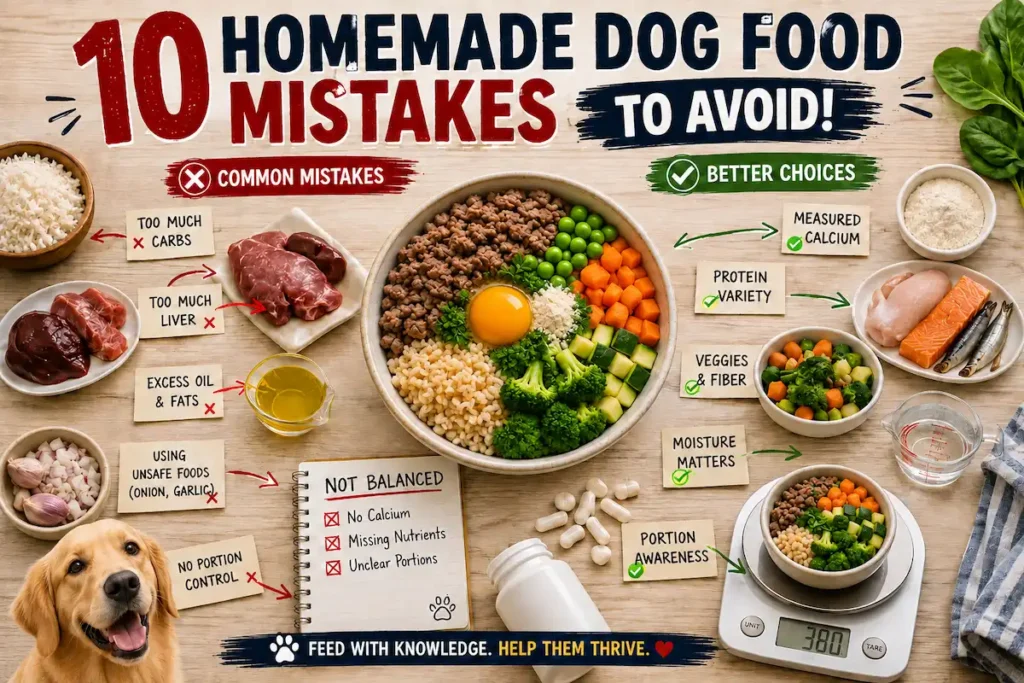
1. 🥩 Mistake: Assuming Meat + Vegetables Makes a Complete Dog Food
This may be the most common homemade dog food mistake of all.
A bowl made with ground turkey, brown rice, carrots, and peas certainly looks wholesome. It provides protein, carbohydrates, moisture, fiber, and several vitamins and minerals.
But that does not automatically make it a complete long-term diet.
✔️ Dogs need the right balance of many nutrients, including:
- Protein
- Essential amino acids
- Dietary fat
- Essential fatty acids
- Calcium
- Phosphorus
- Zinc
- Copper
- Iodine
- Vitamin D
- Vitamin E
- Other vitamins and trace minerals
A homemade meal can contain plenty of nutritious ingredients and still fall short in one or more of these areas.
✅ How to Fix It
If homemade dog food will be your dog’s primary long-term diet, start with a recipe that has been specifically formulated to meet canine nutritional needs.
Do not assume that adding more vegetables automatically improves balance.
A better way to think about homemade feeding is:
Healthy ingredients are the building blocks. Nutritional balance comes from how those ingredients work together.
For occasional homemade meals or toppers, the situation is different because the rest of the diet may already be providing complete nutrition.
That distinction becomes very important later in this article.
2. 🦴 Mistake: Forgetting a Proper Calcium Source
Many homemade dog food recipes are centered around meat.
Chicken, turkey, beef, lamb, fish, and other proteins can all be useful ingredients. However, meat is naturally much higher in phosphorus than calcium.
That creates a problem if the recipe does not include an appropriate calcium source.
Calcium supports far more than bones. It also plays important roles in muscle contraction, nerve function, and other normal body processes.
Growing puppies are especially sensitive to inappropriate mineral balance because their bones are still developing.
⚖️ Why Calcium and Phosphorus Matter
Homemade diets should not simply contain “some calcium.”
The amount has to make sense in relation to the rest of the recipe, particularly phosphorus.
This is why randomly adding a spoonful of eggshell powder is not the best approach.
Eggshell powder can be used as a calcium source in properly designed homemade dog food recipes, but the correct amount depends on the recipe.
✅ How to Fix It
Use the calcium source and quantity specified by the recipe you are following.
Possible calcium sources used in formulated homemade diets may include:
- Finely prepared eggshell calcium
- Calcium carbonate
- Certain canine mineral supplements
- Other veterinarian-formulated calcium sources
Avoid improvising the amount.
If your recipe has no obvious calcium source at all, that is a strong sign that you should review the formulation before using it as a complete long-term diet.
3. 🔄 Mistake: Confusing Protein Rotation With Nutritional Balance
Protein rotation sounds like this:
| Monday | Tuesday | Wednesday | Thursday |
|---|---|---|---|
| Chicken | Turkey | Beef | Salmon |
That may provide variety, but variety alone does not guarantee nutritional balance.
Three different meat-based bowls can still be deficient in the same nutrient.
For example, swapping chicken for beef does not automatically solve a missing calcium source, iodine deficiency, or inadequate vitamin E.
🥩 Protein Variety Is Still Useful
This does not mean protein rotation is pointless.
✅ Using different proteins can provide:
- Different flavors and textures
- Different fat profiles
- More meal variety
- Options for picky dogs
- A broader range of naturally occurring nutrients
Fish such as salmon or sardines can also contribute omega-3 fatty acids that may support skin and coat health.
Less common proteins such as venison, rabbit, or duck can provide additional variety when appropriate.
The key is understanding that protein variety and nutritional completeness are two separate things.
If your dog gets bored easily, rotating proteins and textures can also help make meals more appealing, especially for dogs that tend to be picky eaters.
✅ How to Fix It
Instead of rotating random proteins inside the same basic bowl, rotate properly constructed meals.
Think:
Balanced turkey recipe → balanced beef recipe → balanced fish recipe
rather than:
Turkey + vegetables → beef + vegetables → chicken + vegetables
The first approach changes ingredients while preserving nutritional intent.
4. 🫀 Mistake: Feeding Too Much Liver or Organ Meat
Organ meats are nutrient dense, which is exactly why they can be valuable in homemade dog food.
✔️ Liver, for example, provides nutrients such as:
- Vitamin A
- Iron
- Copper
- B vitamins
- Protein
But “nutrient dense” does not mean unlimited.
A common homemade feeding mistake is adding a large amount of liver because it is considered a superfood.
Over time, excessive liver intake can provide excessive amounts of certain nutrients, particularly vitamin A.
🥣 More Is Not Always Better
This is a useful principle for homemade dog food in general.
More fish oil is not automatically better.
More liver is not automatically better.
More calcium is not automatically better.
More supplements are not automatically better.
Nutrients work best when they are provided in appropriate amounts.
✅ How to Fix It
Use liver and other organ meats in the amounts specified by a complete recipe rather than estimating by eye.
If you are batch cooking, weigh ingredients before combining them.
That makes it much easier to keep organ meat portions consistent from batch to batch.
5. 💊 Mistake: Adding Supplements “Just in Case”
Homemade dog food often does require specific nutrient sources or supplements.
The mistake is assuming that adding several supplements independently will automatically make the meal healthier.
🐾 Owners may add combinations such as:
- Fish oil
- Calcium powder
- Kelp
- Multivitamins
- Zinc
- Vitamin D
- Vitamin E
- Joint supplements
without considering what the base recipe already provides.
This can create excesses just as easily as deficiencies.
🐟 Take Fish Oil as an Example
Fish oil is often used as a source of EPA and DHA omega-3 fatty acids.
These fats may support:
- Skin and coat health
- Normal inflammatory balance
- Joint health
- Overall dietary fat quality
But the appropriate amount depends on the dog and the rest of the diet.
Pouring a large amount of oil over every meal can also increase calories quickly.
If skin and coat support is one of your goals, you can also explore homemade meal ideas built around omega-3-rich ingredients and other skin-friendly foods.
🌿 What About Kelp?
Kelp is sometimes added as an iodine source.
However, iodine content can vary significantly between products.
This is another reason why supplements should not simply be added based on a list of “healthy things dogs need.”
✅ How to Fix It
A useful rule is:
Supplement the recipe, not your assumptions.
Look at the complete meal first.
Then provide only the supplements or nutrient sources the formulation actually requires, in the correct amounts.
6. 🍽️ Mistake: Eyeballing Homemade Dog Food Portions
One scoop for a small dog.
Two scoops for a medium dog.
Three scoops for a large dog.
It sounds convenient, but homemade dog food does not work that neatly.
The calorie content of two bowls that look almost identical can be dramatically different.
🔥 Same Bowl Size Does Not Mean Same Calories
Consider these two homemade dog food bowls.
🐾 Bowl A
- Lean ground turkey
- Pumpkin
- Zucchini
- Green beans
🐾 Bowl B
- Higher-fat ground beef
- Whole egg
- Rice
- Added oil
Both bowls may occupy roughly the same amount of space.
But Bowl B could contain significantly more calories because fat and oil are calorie dense.
🐕 Portion Needs Also Vary by Dog
The appropriate amount of food depends on factors such as:
- Body weight
- Body condition
- Age
- Activity level
- Neuter status
- Life stage
- Recipe calorie density
- Individual metabolism
Two 40-pound dogs may not need exactly the same number of calories.
A highly active young dog and a sedentary senior can have very different energy needs.
✅ How to Fix It
Start with an appropriate calorie target and calculate portions based on the recipe.
Then monitor your dog.
Useful things to watch include:
- Body weight
- Waist definition
- Rib coverage
- Energy
- Hunger
- Stool quality
Adjust portions as your dog’s condition changes.
This is much more reliable than filling the same bowl to the same line every day.
7. 🐶 Mistake: Switching to Homemade Dog Food Overnight
Your dog smells the fresh turkey, rice, and vegetables and suddenly acts like kibble has never existed.
It can be tempting to switch completely on day one.
For some dogs, however, a sudden dietary change may contribute to:
- Loose stool
- Gas
- Changes in stool frequency
- Temporary digestive discomfort
This is especially relevant if the new diet contains different levels of fat, fiber, or moisture.
✅ How to Fix It
When appropriate, transition gradually.
A simple example might look like this:
| Days | Old Food | New Homemade Food |
|---|---|---|
| Days 1 to 2 | 75% | 25% |
| Days 3 to 4 | 50% | 50% |
| Days 5 to 6 | 25% | 75% |
| Day 7+ | 0% | 100% |
This is only a general example.
Some dogs may need a slower transition.
If your dog has a sensitive stomach or has previously struggled with diet changes, go more gradually.
For more sensitive dogs, ingredients such as pumpkin, lean turkey, white fish, or easily digestible carbohydrates may be useful in appropriate recipes because they can provide gentle nutrition without making meals excessively rich.
Pumpkin is also a useful ingredient to explore when you want to add moisture and fiber to homemade meals without making them overly rich.
8. 🚫 Mistake: Assuming Healthy Human Food Is Safe for Dogs
Homemade dog food is usually prepared in the same kitchen where human meals are made.
That creates one very common problem.
A food can be completely normal for people and inappropriate or dangerous for dogs.
⚠️ Ingredients to Watch
Foods and ingredients that should generally be kept out of homemade dog meals include:
- Onions
- Grapes
- Raisins
- Chocolate
- Xylitol-containing products
- Macadamia nuts
- Alcohol
- Cooked bones
Garlic is also not something to casually add to homemade dog food simply because a human recipe includes it.
Highly seasoned sauces, gravies, marinades, and packaged mixes can contain ingredients you may not notice at first glance.
If you are unsure which produce belongs in the bowl, it helps to keep a simple list of dog-safe vegetables you can use for meals, toppers, and treats.
🍲 A Common Kitchen Mistake
Imagine making a large pot of beef stew.
The beef, carrots, potatoes, and green beans may all look like perfect dog-food ingredients.
Then onion, garlic, seasoning mix, and broth are added.
Now the same stew is no longer an appropriate dog meal.
✅ How to Fix It
One of the easiest habits is:
Separate your dog’s portion before seasoning the human meal.
Keep homemade dog food simple.
When using packaged ingredients such as broth, peanut butter, yogurt, or canned foods, read the label instead of assuming the product is dog-safe.
9. 🥘 Mistake: Feeding One Simple Internet Recipe Forever
Recipes such as:
Chicken + rice + carrots
or
Ground turkey + sweet potato + peas
can be useful meal ideas.
But the purpose of the recipe matters.
A simple homemade meal is not automatically designed to serve as a dog’s only food for months or years.
📋 Not Every Homemade Dog Food Recipe Has the Same Job
| Type of Homemade Food | Typical Role |
|---|---|
| Complete homemade diet | Designed for long-term feeding when properly formulated |
| Homemade topper | Adds fresh food or variety to a complete diet |
| Occasional homemade meal | Used periodically rather than as the full diet |
| Simple short-term meal | Used temporarily when appropriate |
| Treat or enrichment food | Adds enjoyment, training value, or mental enrichment |
Understanding this difference prevents a lot of homemade dog food mistakes.
🥄 Homemade Food as a Topper
Using homemade food as a topper can be a practical option for owners who want more fresh ingredients without replacing the dog’s entire balanced diet.
Examples might include a small amount of:
- Cooked lean turkey
- Pumpkin
- Green beans
- Egg
- Sardines packed appropriately
- Plain cooked vegetables
Pumpkin can contribute fiber that may support normal digestion and stool consistency.
Sardines can provide protein and omega-3 fats that may support skin and coat health.
Eggs provide protein along with several micronutrients.
The important part is keeping toppers appropriately portioned so they do not gradually replace too much of the nutritionally complete base diet.
✅ How to Fix It
Before using any homemade dog food recipe, ask:
What is this recipe designed to do?
Is it:
- A complete diet?
- A topper?
- An occasional meal?
- A treat?
- A short-term recipe?
If the recipe does not clearly answer that question, do not automatically assume it is suitable as your dog’s only long-term food.
10. ❄️ Mistake: Meal Prepping Without a Storage Plan
Batch cooking homemade dog food can save a huge amount of time.
A single cooking session can produce several days or even weeks of meals.
But once cooked food is prepared in large quantities, storage becomes part of feeding safely.
🚫 Common mistakes include:
- Leaving cooked food at room temperature too long
- Storing an entire large batch in one container
- Keeping refrigerated food longer than appropriate
- Repeatedly warming and cooling the same container
- Thawing food unsafely
- Cross-contaminating cooked food with raw meat utensils
✅ A Better Meal Prep Routine
A simple workflow is:
Cook → Cool → Portion → Refrigerate or Freeze → Thaw Safely → Serve
Portioning meals before freezing makes homemade feeding much easier.
Instead of thawing a huge container, you can thaw only what your dog needs.
For dogs that enjoy moisture-rich meals, adding an appropriate amount of water during serving can also increase moisture intake.
🧊 Practical Storage Habit
Label freezer containers with:
- Recipe name
- Preparation date
- Portion amount
This becomes especially useful when you rotate several homemade dog food recipes.
If you batch cook regularly, a simple storage routine can make portioning, freezing, thawing, and serving homemade meals much easier.
⭐ Bonus Mistake: Following Food Trends Instead of Your Dog’s Needs
Dog food trends change constantly.
One year everyone talks about grain-free diets.
Then it is high-protein food.
Then raw feeding.
Then novel proteins.
Then low-fat meals.
Then superfood bowls packed with ten ingredients.
None of these approaches is automatically right for every dog.
🐕 Start With the Dog, Not the Trend
A highly active adult dog may need something very different from:
- An overweight dog
- A senior dog
- A growing puppy
- A picky eater
- A dog with a sensitive stomach
- A dog that requires a veterinarian-directed therapeutic diet
For example, a calorie-dense meal that works well for an active dog may make portion control difficult for a dog that needs weight management.
A soft, moisture-rich bowl may be easier for some senior dogs to eat.
Pumpkin or certain cooked vegetables can add fiber and volume.
Fish such as salmon or sardines may add omega-3 fats that support skin and coat health.
The right ingredient depends on the role you need it to play.
✅ How to Fix It
Before changing your dog’s diet because of something you saw online, ask:
What practical need am I trying to support?
That question is much more useful than asking which ingredient is currently popular.
🥣 How to Build a Better Homemade Dog Food Routine
Avoiding homemade dog food mistakes does not require making every meal complicated.
A good routine can actually be quite simple.
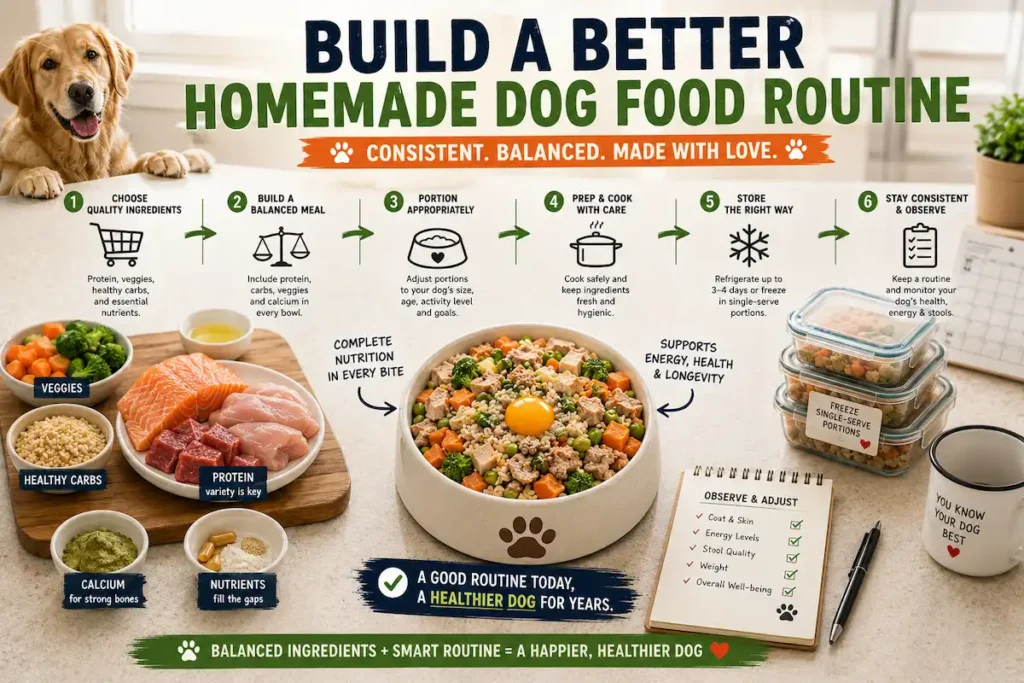
1. Decide What the Homemade Food Is For
First determine whether the food will be:
- Your dog’s complete diet
- A topper
- An occasional meal
- A treat
- A temporary recipe
This decision affects almost everything else.
2. Start With a Properly Designed Recipe
If homemade food will replace a complete commercial diet, nutrition becomes much more important.
Choose a recipe designed for that purpose rather than combining ingredients based only on appearance.
3. Measure Ingredients
A kitchen scale makes homemade feeding much more consistent.
This is particularly useful for:
- Meat
- Organ meat
- Oils
- Supplements
- Calcium sources
- Large batch recipes
4. Use Supplements Exactly as Intended
Do not increase supplement amounts because you think extra nutrients will provide extra benefits.
Stick to the formulation.
5. Portion for Your Dog
Consider calorie density, activity, body condition, and life stage.
Do not use bowl volume alone.
6. Monitor and Adjust
A diet is not something you calculate once and ignore forever.
Watch your dog’s:
- Weight
- Body condition
- Stool
- Appetite
- Energy
- Coat condition
Changes can help tell you when portions or the overall feeding plan need to be reassessed.
✅ Simple Homemade Dog Food Checklist
Before serving a homemade meal regularly, ask yourself:
If several of these questions are difficult to answer, the recipe may need another look.
🩺 When Professional Nutrition Guidance Is Especially Important
Some dogs have less room for trial and error than others.
Professional guidance is especially valuable when preparing long-term homemade diets for:
- Puppies
- Pregnant or lactating dogs
- Dogs with chronic medical conditions
- Dogs requiring therapeutic diets
- Dogs with significant food intolerances
- Dogs with complex calorie or nutrient requirements
Growing puppies deserve particular attention because inappropriate calcium, phosphorus, calorie, or mineral levels can be much more consequential during development.
A veterinarian or veterinary nutrition professional can also help evaluate whether a recipe is appropriate for long-term feeding rather than just an occasional meal.
❓ Frequently Asked Questions
Is Homemade Dog Food Healthier Than Kibble?
Not automatically.
Homemade food offers several advantages, including ingredient control, freshness, customizable textures, and the ability to include foods your dog enjoys.
However, a commercial food that is nutritionally complete may be better balanced than a poorly formulated homemade diet.
The quality of homemade dog food depends on the recipe, ingredients, portions, and how consistently it is prepared.
Can Dogs Eat Homemade Dog Food Every Day?
Yes, homemade dog food can be fed every day when the diet is designed to provide appropriate nutrition for the individual dog.
The important distinction is whether the recipe is intended as a complete diet or simply a meal idea.
A bowl of meat, rice, and vegetables can be perfectly reasonable as an occasional meal or topper while still being unsuitable as the dog’s only long-term food.
Do Homemade Dog Food Recipes Need Supplements?
Many complete homemade dog food recipes require specific nutrient sources or supplements because it can be difficult to provide every essential vitamin and mineral through commonly used whole foods alone.
The exact supplements depend on the recipe.
That is why copying a generic supplement list from one homemade diet to another is not a reliable approach.
Can I Use Homemade Dog Food as a Topper?
Yes.
For many dog parents, using homemade food as a topper is one of the easiest ways to add fresh ingredients without formulating an entire complete diet from scratch.
Possible topper ingredients include small portions of plain cooked meat, pumpkin, egg, dog-safe vegetables, or appropriate fish.
Keep topper portions moderate so the dog’s nutritionally complete base food continues to make up most of the diet.
🐾 Final Thoughts
Homemade dog food does not have to be complicated, but it should be intentional.
The biggest homemade dog food mistakes usually happen when a healthy-looking ingredient is mistaken for a complete diet, portions are guessed, supplements are added without a plan, or a simple recipe is used for a purpose it was never designed to serve.
Start by deciding what the meal is meant to do. Use appropriate ingredients, measure consistently, pay attention to nutritional balance, and monitor how your dog responds over time.
A homemade bowl can be fresh, enjoyable, and practical.
The goal is to make sure it is also appropriate for the dog eating it.