
Vegetables can be a simple way to add variety, fiber, moisture, and extra nutrients to your dog’s meals.
Some are especially useful as low-calorie treats. Others work better for picky eaters because they are naturally sweeter or softer. A few are easier for senior dogs to chew, while watery vegetables can be helpful when you want a more hydrating snack.
The key is choosing dog-safe vegetables and serving them in a way that fits your dog’s size, age, appetite, and everyday needs.
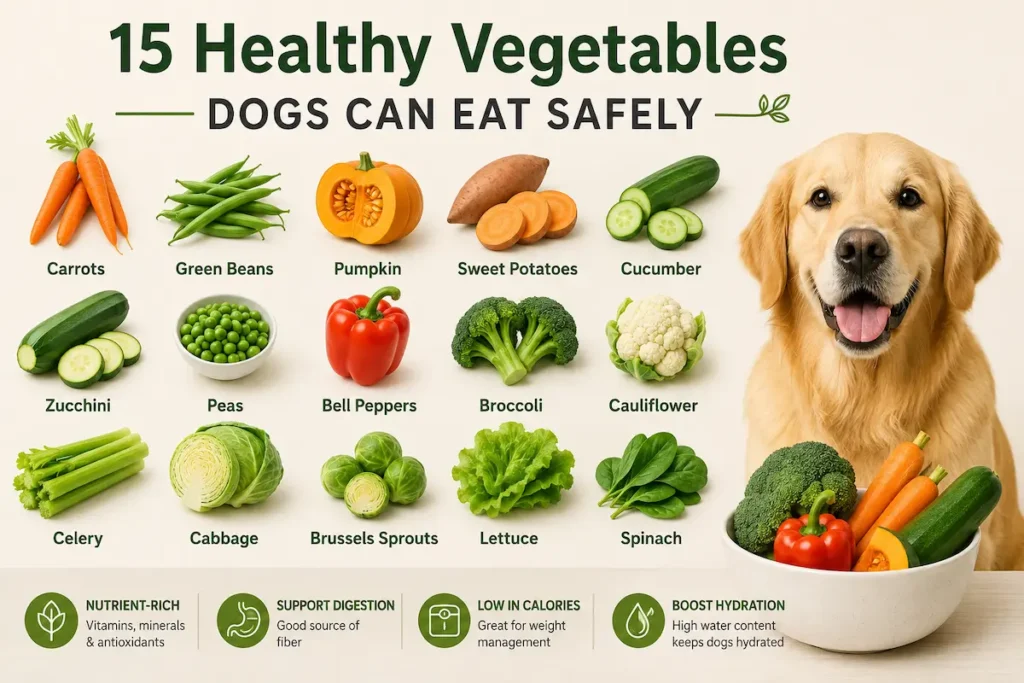
Here are 15 of the best vegetables for dogs, what each one may support, and the easiest ways to serve them.
Quick Guide: Which Vegetable Is Best for Your Dog?
| Your Dog May Need… | Good Vegetables to Try |
|---|---|
| A low-calorie snack | Green beans, cucumber, zucchini, celery |
| More fiber | Pumpkin, sweet potato, carrots |
| A more tempting meal | Pumpkin, sweet potato, peas |
| A softer option for senior dogs | Pumpkin, cooked carrots, sweet potato, zucchini |
| A crunchy training treat | Carrots, green beans, bell peppers |
| Extra hydration | Cucumber, zucchini, lettuce |
| More variety in homemade meals | Carrots, peas, zucchini, green beans |
| Help making meals feel more filling | Green beans, zucchini |
Vegetables should usually be treated as extras, toppers, or small parts of a balanced meal, not as a replacement for complete dog food.
🌿 15 Healthy Vegetables Dogs Can Eat Safely
1. Carrots
Carrots are one of the easiest vegetables to share with dogs.
They provide fiber and beta-carotene while staying relatively low in calories. Their naturally sweet flavor also makes them more appealing than many leafy vegetables.
Why carrots may be a good fit:
- Dogs that need lower-calorie treats: Small carrot pieces can replace some higher-calorie biscuits.
- Dogs that enjoy crunch: Raw carrots offer a satisfying texture.
- Picky dogs: Their mild sweetness may be more appealing than bitter vegetables.
- Senior dogs: Cooked carrots become soft and easy to chew.
- Training: Tiny chopped pieces can work as simple food rewards.
Dogs can eat carrots raw or cooked. For small dogs, puppies, senior dogs, or dogs that gulp food, chop them into small pieces or steam them first.
2. Green Beans
Green beans are especially useful when you want to add volume without adding many calories.
They contain fiber and have a mild flavor that mixes easily into normal meals.
Why green beans may be a good fit:
- Dogs managing their weight: They add bulk while staying relatively light.
- Dogs that always seem hungry: A small amount may make meals feel more substantial.
- Dogs that like crunchy snacks: Fresh or lightly cooked beans work well.
- Meal-prep dogs: They combine easily with many homemade recipes.
Fresh, frozen, or steamed green beans are good choices.
Plain canned green beans can also work, but choose no-salt-added versions when possible.
Avoid green beans prepared with butter, sauces, onions, or garlic.
3. Pumpkin
Pumpkin is one of the most versatile vegetables you can keep on hand for dogs.
It is soft, naturally flavorful, easy to mix into meals, and provides fiber and moisture.
Why pumpkin may be a good fit:
- Picky eaters: Its smell, sweetness, and creamy texture can make an ordinary meal more appealing.
- Senior dogs: Soft pumpkin requires very little chewing.
- Dogs that need more fiber: A small spoonful is an easy way to add fiber.
- Dogs that prefer wet or soft meals: Pumpkin changes both texture and moisture.
- Dogs bored with dry food: It works well as a simple topper.
Use plain cooked pumpkin or 100% pure canned pumpkin.
Avoid pumpkin pie filling, which may contain sugar and spices.
If your dog loves pumpkin, you can also use it as part of a homemade meal rather than only as a topper. See our Pumpkin Dog Food Recipes: 12 Easy Homemade Meals for more ideas.
4. Sweet Potatoes
Sweet potatoes are naturally sweet and become very soft after cooking, which makes them especially dog-friendly.
They also provide fiber and beta-carotene.
Why sweet potatoes may be a good fit:
- Picky dogs: The sweet flavor can make meals more tempting.
- Senior dogs: Mashed sweet potato is soft and easy to eat.
- Dogs that prefer softer textures: It blends easily with meat and other ingredients.
- Active dogs: It is more substantial than watery vegetables such as cucumber.
- Meal prep: Cooked sweet potato stores and portions easily.
Always cook sweet potatoes before serving them.
Steam, boil, or bake them plain, then mash or cut them into bite-size pieces.
Because sweet potatoes contain more calories and carbohydrates than vegetables like cucumber or zucchini, portions still matter.
5. Cucumbers
Cucumber is one of the lightest vegetables you can give your dog.
It is made mostly of water, which makes it especially useful as a refreshing snack.
Why cucumber may be a good fit:
- Dogs managing their weight: Very low-calorie compared with many treats.
- Dogs that need extra hydration: The high water content makes it a refreshing option.
- Hot-weather snacking: Chilled cucumber pieces can be especially appealing.
- Dogs that like crunchy textures: It offers plenty of crunch without much heaviness.
Wash cucumber well and slice it into pieces appropriate for your dog’s size.
The peel is generally fine, although peeling some or all of it may make cucumber easier for sensitive dogs to digest.
6. Zucchini
Zucchini is mild, soft when cooked, and low in calories.
It is also easy to mix into homemade meals because it does not overpower other ingredients.
Why zucchini may be a good fit:
- Weight-conscious dogs: It adds meal volume without many calories.
- Dogs that need more moisture: Zucchini naturally contains plenty of water.
- Senior dogs: Lightly cooked zucchini becomes very soft.
- Sensitive or picky dogs: Its mild flavor is less intense than many green vegetables.
- Homemade meal prep: It pairs well with chicken, turkey, beef, and fish.
Dogs can eat zucchini raw or cooked.
For meal prep, lightly steaming or sautéing it in a dry pan without seasoning can make it easier to mix into food.
7. Peas
Peas are small but nutrient-dense, providing fiber, vitamins, minerals, and some plant protein.
Their naturally sweet flavor also makes them surprisingly popular with many dogs.
Why peas may be a good fit:
- Picky eaters: Their sweetness and small size can make meals more interesting.
- Small dogs: Individual peas are already conveniently sized.
- Homemade meals: They add color, texture, and variety.
- Training: A few thawed peas can work as tiny rewards for dogs that enjoy them.
Fresh or frozen peas are usually the easiest choice.
Garden peas, snow peas, and sugar snap peas can all be offered in moderation.
Skip heavily salted canned peas.
Some dogs may become gassy after eating peas, so introduce them gradually.
8. Bell Peppers
Red, yellow, orange, and green bell peppers are all safe for dogs when served plain.
They provide several vitamins and antioxidants, while their crunchy texture gives meals a different feel.
Why bell peppers may be a good fit:
- Dogs that get bored with repetitive treats: They provide a different texture and flavor.
- Picky dogs: Red and orange peppers tend to taste sweeter.
- Dogs that enjoy crunchy treats: Raw pieces can work well.
- Meal rotation: Their color can make homemade meals more varied and visually appealing.
Remove the stem and seeds, then cut the pepper into manageable pieces.
Raw is fine for many dogs, while steaming makes peppers softer for puppies or senior dogs.
Do not confuse bell peppers with hot peppers. Jalapeños and chili peppers are not suitable dog snacks.
9. Broccoli
Broccoli can be fed to dogs in modest amounts.
It provides fiber and several nutrients, but it is better as an occasional extra than as a large part of a meal.
Why broccoli may be a good fit:
- Dogs that need vegetable variety: A few florets can change up the usual rotation.
- Dogs that enjoy crunch: Raw stalks or florets can provide texture when cut safely.
- Homemade meals: Small cooked pieces mix easily into food.
Broccoli is less ideal for dogs with easily upset stomachs because larger amounts may cause gas or digestive discomfort.
If your dog is sensitive, zucchini, pumpkin, or cooked carrots are usually gentler first choices.
10. Cauliflower
Cauliflower is another low-calorie vegetable that can be offered in small amounts.
It provides fiber and works raw or cooked.
Why cauliflower may be a good fit:
- Weight-conscious dogs: It is relatively light.
- Dogs that need more vegetable variety: It offers a different texture from carrots or green beans.
- Dogs eating homemade meals: Small cooked pieces are easy to mix in.
Like broccoli, cauliflower can cause gas if your dog eats too much.
Start with a small portion, especially for sensitive dogs.
11. Celery
Celery is crisp, watery, and low in calories.
Some dogs love the crunch, while others are completely uninterested in it.
Why celery may be a good fit:
- Dogs managing their weight: It is a light alternative to calorie-dense treats.
- Dogs that enjoy chewing: The crunchy texture can make snack time more satisfying.
- Hot-weather dogs: Its water content makes it refreshing.
- Dogs that need treat variety: It provides a very different texture from soft treats.
Wash celery thoroughly and cut it into small pieces.
For small dogs or older dogs, removing tough strings or slicing it thinly can make it easier to eat.
12. Cabbage
Dogs can eat several types of cabbage, including green and red cabbage, in moderation.
It provides fiber and can add variety to cooked homemade meals.
Why cabbage may be a good fit:
- Dogs that need more meal variety: A little cooked cabbage changes up the vegetable rotation.
- Dogs eating lower-calorie meals: It adds bulk without being particularly calorie-dense.
- Dogs that prefer soft food: Lightly cooked cabbage becomes easier to chew.
Cabbage can cause gas, so introduce it gradually.
Finely chopping and cooking it can also make it easier to digest.
13. Brussels Sprouts
Brussels sprouts are safe for dogs, but they are best served in relatively small portions.
They provide fiber and several nutrients, yet they are well known for causing gas.
Why Brussels sprouts may be a good fit:
- Dogs that tolerate cruciferous vegetables well: They can add more variety.
- Homemade meal rotation: Small cooked pieces can be mixed with other foods.
- Dogs that enjoy softer vegetables: Steaming makes them tender.
They are generally not my first pick for dogs with sensitive stomachs.
For those dogs, pumpkin, zucchini, or cooked carrots are usually easier choices.
14. Lettuce
Lettuce is not the most nutrient-dense option on this list, but its high water content and low calorie count can still make it useful.
Romaine, iceberg, and other plain lettuces can be offered in small amounts.
Why lettuce may be a good fit:
- Dogs managing their weight: Very light compared with many commercial treats.
- Dogs that enjoy crisp textures: Some dogs like tearing through crunchy leaves.
- Dogs that could use a more hydrating snack: Lettuce contains plenty of water.
Wash lettuce well and chop or tear it into manageable pieces.
Do not share dressed salads, since they may contain onion, garlic, cheese, sauces, raisins, or other ingredients you do not want your dog eating.
15. Spinach
Spinach can be eaten by many healthy dogs in small amounts, but it is not a vegetable I would make a major everyday ingredient.
It contains oxalates, so dogs with certain kidney or urinary concerns may need to avoid or limit it.
Why spinach may be a good fit:
- Healthy dogs needing occasional leafy-green variety: A small amount can diversify meals.
- Homemade meal rotation: Finely chopped spinach can be mixed into food without taking over the meal.
For most dogs, easier everyday vegetables such as carrots, green beans, pumpkin, or zucchini are more practical choices.
If your dog has kidney, bladder, or urinary issues, talk with your veterinarian before adding spinach regularly.
🥦 Raw or Cooked Vegetables: Which Is Better for Dogs?
Both can work.
The best choice depends on the vegetable and your dog.
✔️ Vegetables that are commonly easy to serve raw include:
- Carrots
- Cucumbers
- Bell peppers
- Green beans
- Celery
- Zucchini
✔️ Vegetables that are often easier when cooked include:
- Pumpkin
- Sweet potatoes
- Brussels sprouts
- Cabbage
- Broccoli
- Cauliflower
Cooking can be particularly useful for senior dogs, small dogs, puppies, and dogs with dental limitations, because it softens the texture.
Steaming, boiling, or baking are usually the simplest methods.
Keep vegetables plain. Your dog does not need butter, salt, garlic, onion, sauces, or seasoning.
😋 Best Vegetables for Picky Dogs
Picky eaters often respond better to vegetables that are naturally sweeter, softer, or more aromatic.
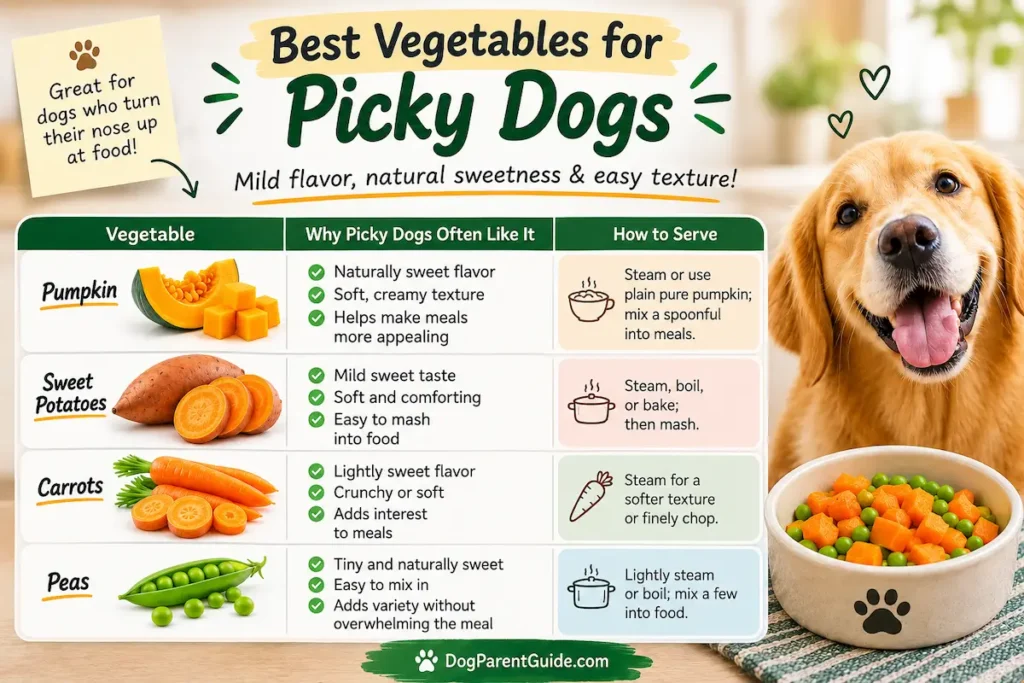
Good options include:
Pumpkin
Pumpkin has a creamy texture and noticeable aroma, so a spoonful mixed into dry food can change the entire meal.
Sweet Potato
Sweet potato has a naturally sweet taste that many dogs find more appealing than green vegetables.
Cooked Carrots
Cooking brings out more sweetness and creates a softer texture.
Peas
Peas are small, slightly sweet, and easy to mix through meat or wet food.
If your dog frequently walks away from dinner, try changing texture and aroma rather than constantly introducing completely new foods.
Our Homemade Dog Food for Picky Eaters guide has more ideas for making meals more appealing without overcomplicating them.
🐾 Best Vegetables for Senior Dogs
Senior dogs may have different priorities than younger adults.
Some have worn teeth, reduced chewing ability, lower calorie needs, or simply prefer softer food.
Good vegetables for older dogs include:
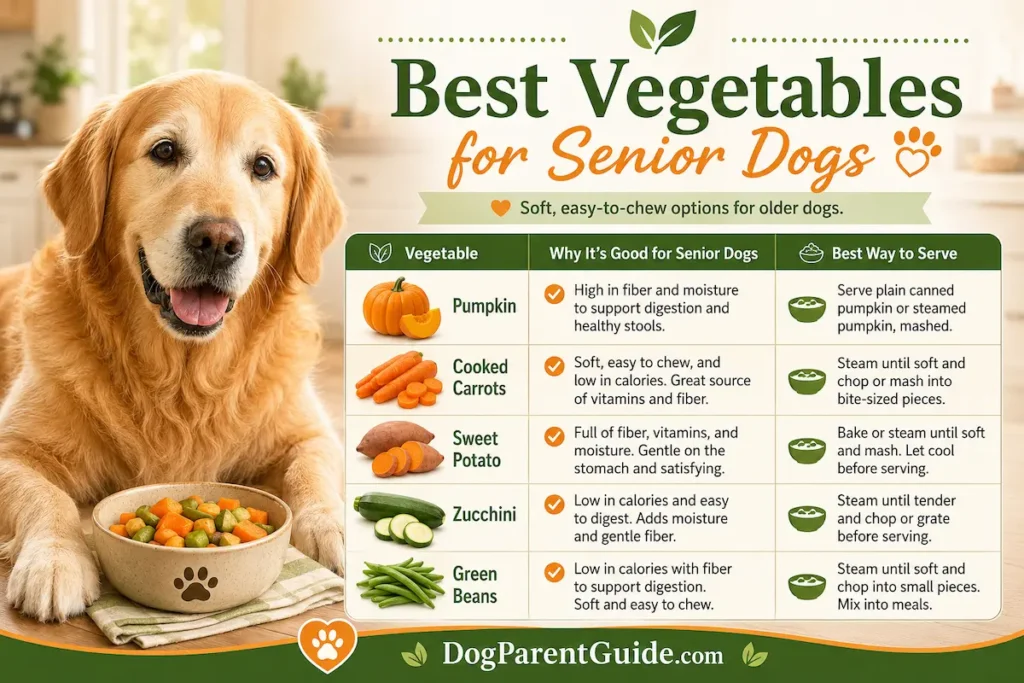
Pumpkin
Soft, moist, and easy to mix into almost any meal.
Cooked Carrots
They retain their mild sweetness but become much easier to chew.
Sweet Potato
Mashed sweet potato creates a smooth texture that works particularly well in softer homemade meals.
Zucchini
Cooked zucchini is light, moist, and easy to eat.
Green Beans
Chopped cooked green beans can add fiber without dramatically increasing calories.
For older dogs, the preparation method often matters as much as the vegetable itself. A vegetable they once enjoyed raw may become much easier to eat when steamed and finely chopped.
⚖️ Best Vegetables for Dogs Managing Their Weight
Vegetables can be useful when you want to replace some higher-calorie snacks with lighter alternatives.
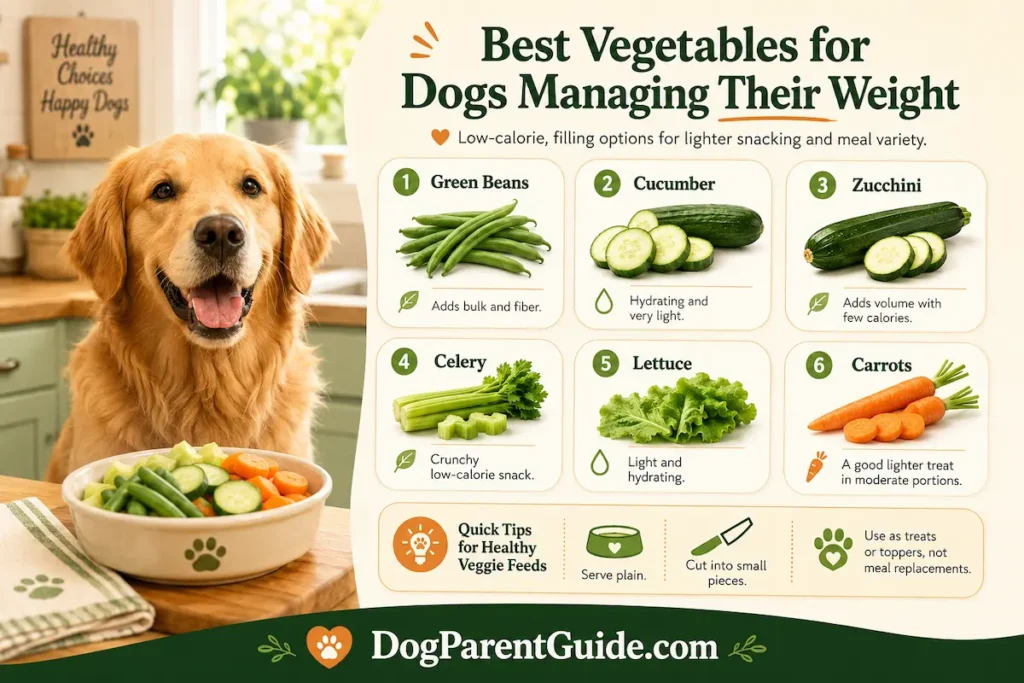
Good options include:
- Green beans
- Cucumber
- Zucchini
- Celery
- Lettuce
- Carrots in moderate portions
Green beans and zucchini are especially useful because they can add bulk to a meal.
Cucumber and celery work better as refreshing snacks.
Carrots are still relatively light, but they are naturally sweeter and slightly more calorie-dense than watery vegetables.
Do not replace a large percentage of complete dog food with vegetables simply to reduce calories. Your dog still needs appropriate amounts of protein, fats, vitamins, minerals, and other nutrients.
For more complete meal ideas with a lighter calorie profile, see our Low Fat Dog Food Recipes guide.
🥣 Best Vegetables for Homemade Dog Food
If you cook for your dog, some vegetables are much easier to work with than others.
The most versatile choices include:
- Carrots
- Green beans
- Zucchini
- Pumpkin
- Sweet potato
- Peas
These vegetables pair easily with common proteins such as chicken, turkey, beef, salmon, and white fish.
They also offer useful differences in texture:
- Pumpkin for creamy meals
- Sweet potato for softer and more filling meals
- Green beans for fiber and volume
- Zucchini for moisture
- Carrots for sweetness and texture
- Peas for small bursts of flavor and variety
Just remember that meat plus vegetables is not automatically a complete homemade dog food.
If you want to explore more plant-forward meal ideas, our Vegan Dog Food Recipes guide has more combinations built around dog-friendly plant ingredients.
A long-term homemade diet must also provide appropriate levels of calcium, essential fatty acids, vitamins, minerals, and other nutrients.
How Much Vegetables Can Dogs Eat?
More vegetables are not automatically better.
If your dog already eats complete and balanced commercial food, vegetables should generally remain a small part of their total daily intake.
A commonly used guideline is to keep all treats and extras combined at around 10% or less of daily calories.
When trying a new vegetable, start with a small bite or two.
Watch for:
- Loose stool
- Vomiting
- Excessive gas
- Bloating
- Itching
- Any unusual reaction
If everything looks normal, you can gradually offer a little more.
Dogs on prescription diets or with medical conditions may need different limits, so ask your veterinarian before making major changes.
⚠️ Vegetables Dogs Should Avoid
Some foods we think of as vegetables can be unsafe for dogs.
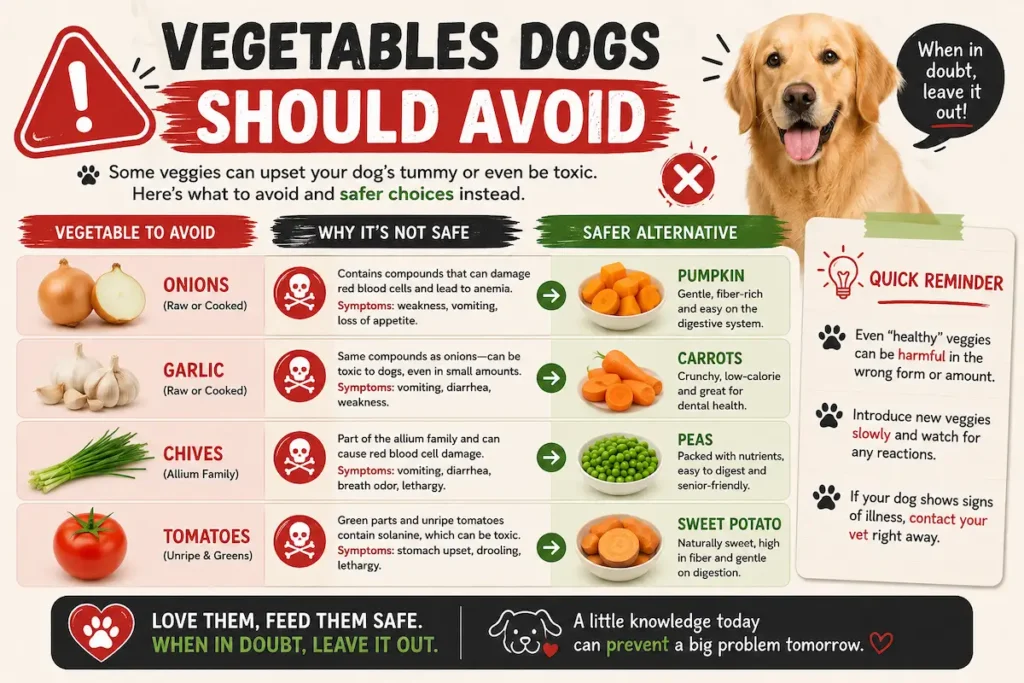
Onions
Onions belong to the Allium family and can damage a dog’s red blood cells.
Avoid raw, cooked, dried, and powdered forms.
Garlic
Garlic is also part of the Allium family and should not be deliberately added to dog food.
This includes garlic powder hidden in seasoning blends.
Chives and Leeks
These are Allium vegetables too and should be avoided.
Wild Mushrooms
Some wild mushrooms are highly toxic, and they can be difficult to identify accurately.
Do not let dogs eat mushrooms growing in yards, parks, or woodland areas.
Raw or Green Potatoes
Cooked plain potatoes can be offered occasionally, but raw potatoes, green potatoes, and potato sprouts may contain higher amounts of solanine.
Green Tomatoes and Tomato Plants
Ripe tomato flesh in small amounts is generally less concerning, but green tomatoes and the leaves and stems of tomato plants contain higher levels of potentially harmful compounds.
If you want a broader kitchen reference, see our 50 Human Foods Dogs Can and Cannot Eat guide before sharing leftovers from your plate.
✅ 5 Rules for Serving Vegetables Safely
1. Keep Them Plain
Avoid salt, butter, sauces, onion, garlic, and heavy seasoning.
2. Cut Them to the Right Size
Large hard pieces can become choking hazards, especially for small dogs.
3. Introduce One New Vegetable at a Time
This makes it much easier to identify the cause if your dog develops an upset stomach.
4. Start With Small Portions
Suddenly adding a lot of fiber can cause gas or loose stool.
5. Match the Texture to Your Dog
A young dog may enjoy raw carrots.
A senior dog may do much better with steamed and chopped carrots.
A picky dog may prefer mashed pumpkin.
The healthiest vegetable is not very useful if your dog cannot comfortably chew it or simply refuses to eat it.
So, What Are the Best Vegetables for Dogs?
If you want a simple place to start, keep these six in mind:
Carrots for crunchy treats.
Green beans for low-calorie meal volume.
Pumpkin for soft texture, fiber, and picky eaters.
Sweet potatoes for a naturally appealing and filling option.
Cucumber for hydration and light snacks.
Zucchini for moisture, mild flavor, and homemade meals.
You do not need to feed your dog every vegetable on this list.
Choose two or three that match your dog’s preferences and practical needs, then rotate them occasionally for variety.
A picky dog may care most about flavor and texture. A senior dog may benefit more from vegetables that are soft and easy to chew. A dog watching their weight may do better with watery, lower-calorie options.
The best choice is the one that is safe, appropriately portioned, and actually works for your dog.