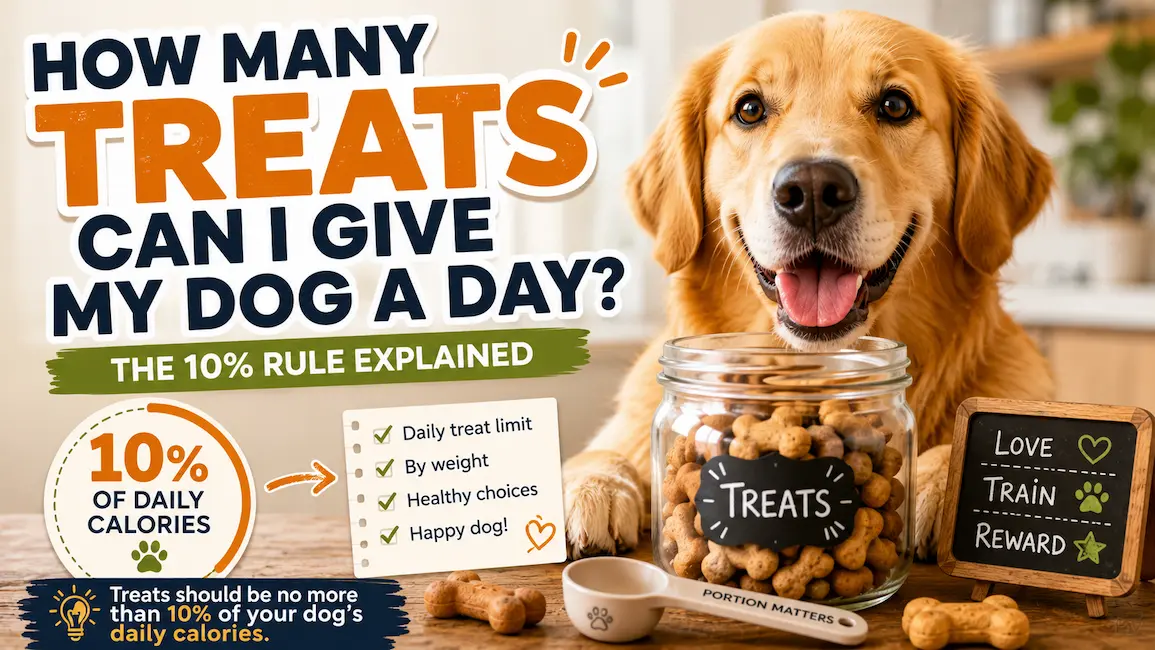
| A useful general guideline is to keep treats and other extras at no more than about 10% of your dog’s total daily calories. The remaining 90% or more should come from a complete and balanced diet appropriate for your dog. |
Both the World Small Animal Veterinary Association (WSAVA) and the American Animal Hospital Association (AAHA) use this 10% guideline when discussing treats and extras.
But that does not mean every dog should get the same number of treats. A tiny training treat may contain only a few calories, while one larger biscuit or chew can use up much more of the same daily allowance.
So the better question is:
How many treat calories can your dog have each day, and how many of their usual treats fit into that amount?
Use the calculator below to estimate it.
🧮 Dog Treat Calculator: How Many Treats Can Your Dog Have?
The easiest way to estimate your dog’s treat allowance is to start with their total daily calorie needs.
Use this simple formula:
Daily calories × 10% = approximate daily treat calorie limit
🎯 For example, if your dog eats about 600 calories per day:
600 × 0.10 = 60 calories from treats
If the treats you use contain 5 calories each:
60 ÷ 5 = about 12 treats
If those treats contain 15 calories each instead:
60 ÷ 15 = about 4 treats
Same dog. Same daily calorie allowance. Very different number of treats.
Dog Treat Calculator
Step 1: Enter your dog’s weight
Step 2: Estimate your dog’s daily calorie needs
Step 3: Enter the calories per treat
Your result can show:
- Estimated daily calorie needs
- Approximate maximum calories from treats
- Approximate number of those treats per day
Example Result
Estimated daily calories: 540 kcal
Suggested treat budget: up to about 54 kcal
Calories per treat: 6 kcal
Approximate number of treats: 9 per day
These numbers are estimates, not a prescription. A dog’s actual energy needs can vary considerably based on age, body condition, activity level, breed, neuter status, environment, and health.
WSAVA notes that calculated calorie requirements are only starting estimates and individual dogs may need substantially more or less than a formula predicts.
If your veterinarian has already given your dog a daily calorie target, use that number instead of a general estimate.
And if you are also trying to figure out your dog’s main meal portions, see our How Much Homemade Dog Food to Feed Your Dog (Free Calculator!) guide.
🦴 What Is the 10% Rule for Dog Treats?
The 10% rule means that treats and extras should generally contribute no more than about 10% of your dog’s total daily calories.
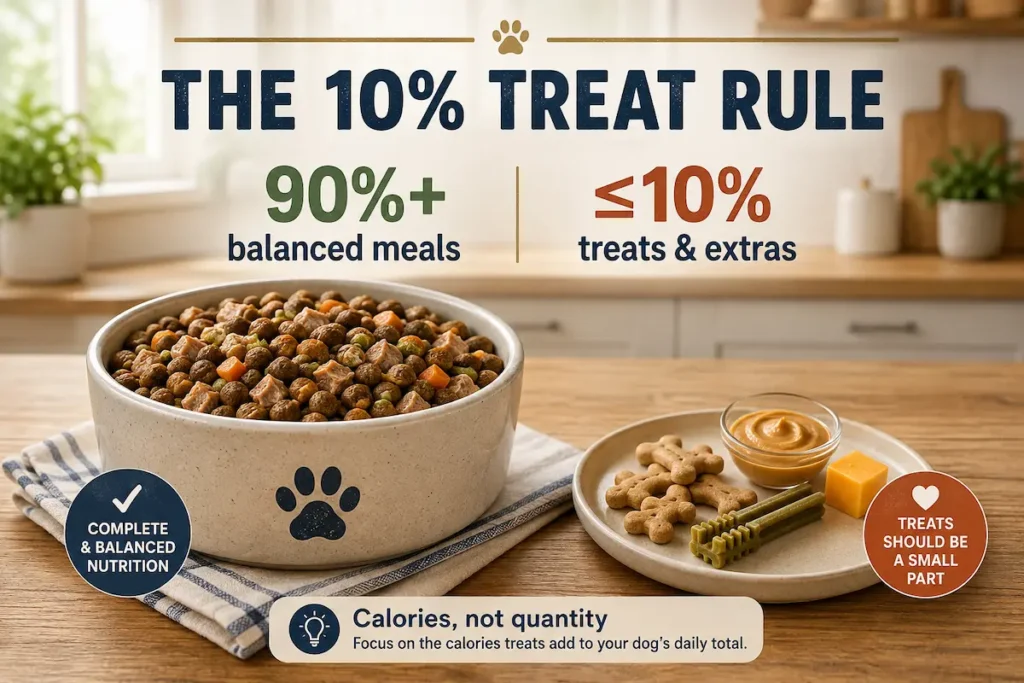
It does not mean:
- 10% of the food bowl by volume
- 10% of your dog’s body weight
- 10 treats per day
- one treat for every nine bites of regular food
It is specifically about calories.
The reason is not simply weight control. When too many calories come from treats, those extras can begin replacing the nutrients your dog should be getting from a complete and balanced main diet.
AAHA recommends keeping complete and balanced food at 90% or more of total calorie intake while limiting treats and other foods to 10% or less.
Think of the 10% as a treat budget, not a target you need to reach.
Your dog does not need to use all of it every day.
What Counts Toward the 10%?
This is where dog parents often underestimate how many extras their dog is actually eating.
Your daily treat budget may include:
- packaged dog treats
- homemade dog treats
- training rewards
- dental chews
- edible chews
- cheese used for pills
- peanut butter
- meat scraps
- table food
- toppers added just for flavor
- food inside enrichment toys
- lick-mat ingredients
- snacks handed out by other family members
AAHA specifically recommends considering snacks, toppers, scraps, medication foods, and even calorie-containing supplements when assessing a pet’s total extra calorie intake.
So if your dog gets a dental chew in the morning, cheese during medication time, several training treats in the afternoon, and peanut butter in a Kong at night, those are not four separate allowances.
They all come from the same daily calorie budget.
🐕 How Many Treat Calories Can a Dog Have Per Day by Weight?
Dog weight gives you a useful starting point, although weight alone cannot tell you your dog’s exact calorie needs.
WSAVA provides estimated maximum treat calories for healthy adult dogs in ideal body condition based on body weight.
| Dog Weight | Approx. Maximum Calories From Treats Per Day |
|---|---|
| 4–5 lb | 14 kcal |
| 9 lb | 24 kcal |
| 13 lb | 32 kcal |
| 18 lb | 40 kcal |
| 22 lb | 47 kcal |
| 33 lb | 64 kcal |
| 44 lb | 79 kcal |
| 55 lb | 94 kcal |
| 66 lb | 108 kcal |
| 77 lb | 121 kcal |
| 88 lb | 134 kcal |
| 99 lb | 146 kcal |
These are reference numbers, not individualized feeding recommendations.
A very active 45-pound dog and a sedentary 45-pound dog may have different energy needs. So may a growing puppy, senior dog, underweight dog, or dog that needs weight management.
The table is most useful for showing something else:
🐾 Small dogs have very little room for high-calorie treats.
A snack that seems tiny to you can represent a meaningful percentage of a 10-pound dog’s entire day.
🍪 What Does a Daily Treat Allowance Actually Look Like?
Calories can feel abstract, so imagine a dog with a 60-calorie daily treat budget.
There are many ways those 60 calories could be used.
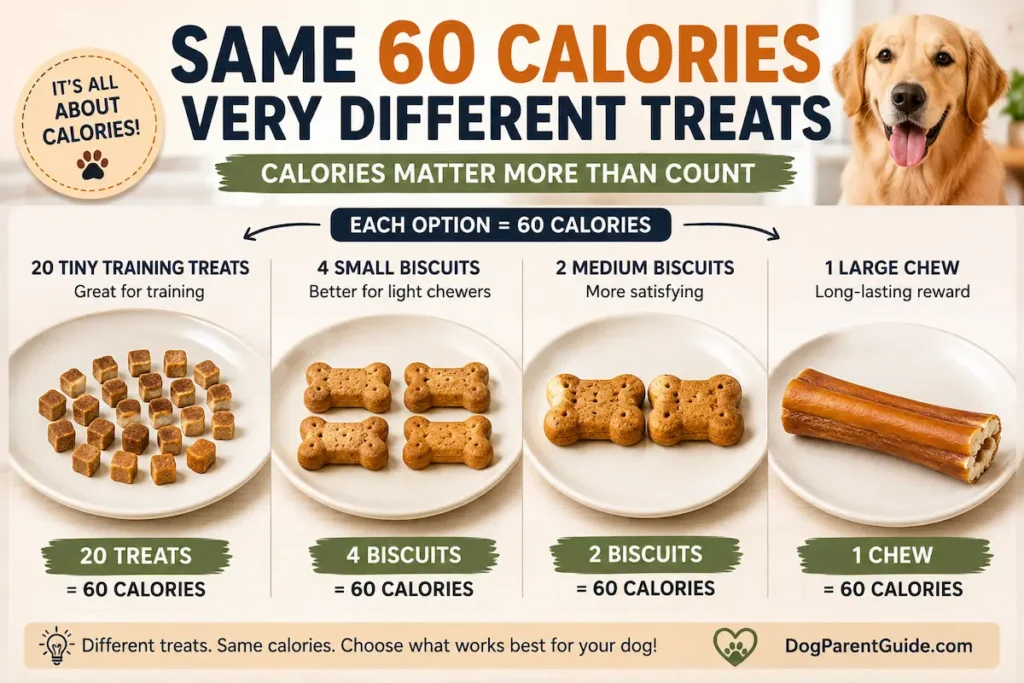
Option 1: Tiny Training Treats
If each treat contains 3 calories:
20 treats = 60 calories
This can work well for training because the dog gets many reward events without receiving large pieces of food.
Option 2: Regular Biscuits
If each biscuit contains 15 calories:
4 biscuits = 60 calories
The dog receives far fewer individual rewards even though the total calories are identical.
Option 3: One Larger Chew
A larger edible chew may use most or all of that 60-calorie allowance by itself.
That means adding several biscuits afterward could push the day well beyond the planned treat budget.
Option 4: Mixed Rewards
You might divide the allowance between:
- several tiny training treats
- a few blueberries
- a small piece of cooked chicken
- a little food inside an enrichment toy
The exact mix is flexible.
What matters most is the total amount, not how many individual pieces your dog sees.
📏 Treat Portions for Small, Medium, and Large Dogs
One reason “How many treats can dogs have?” has no universal answer is that a treat that works perfectly for one dog may be oversized for another.
Small Dogs
Small dogs have the least room for calorie-dense extras.
A full biscuit designed for a larger dog may be several rewards’ worth of calories for a toy breed.
Instead of automatically buying “small dog treats,” also check the calories per piece.
You can often:
- break treats into halves or quarters
- choose tiny training rewards
- use small pieces of dog-safe vegetables
- reserve richer treats for occasional high-value rewards
A dog does not need a large piece to understand that they were rewarded.
Medium Dogs
Medium-sized dogs generally have a little more flexibility, but calories can still accumulate quickly when several types of treats are used in one day.
The most common problem is not one biscuit.
It is the biscuit plus training rewards plus cheese plus a chew plus whatever fell from the dinner table.
Keeping a simple mental or physical “treat budget” can help.
Large Dogs
Large dogs need more total calories, so their treat allowance is usually larger as well.
However, products marketed to large dogs are often larger and higher in calories too.
Do not assume that a large chew is automatically an appropriate daily snack just because your dog is large.
Check the calorie information when available and account for the rest of the day’s extras.
🎓 How Many Training Treats Can You Give a Dog?
Training is where counting individual treats becomes particularly unhelpful.
A productive training session may involve dozens of rewards.
If you used a full biscuit every time your dog responded correctly, the calorie total could become enormous.
Instead, training rewards should usually be small enough to eat quickly and continue working.
For many dogs, a tiny piece is all that is needed.
If you prefer making small rewards at home, try these homemade dog training treats that are easier to portion for frequent sessions.
Make Each Treat Smaller
One commercial treat can often become several training rewards.
Soft treats are especially easy to tear into small pieces before a session.
For a small dog, a reward may be tiny. Larger dogs do not necessarily need a large reward either; the value of the reward comes from taste and timing, not size alone.
Use Part of the Main Meal
If your dog happily works for their normal food, set aside part of their measured daily meal and use those pieces during training.
Because the food was already included in the day’s meal portion, you are not constantly adding extra calories on top.
AAHA specifically suggests separating out some of a dog’s regular kibble to use as treats when managing daily calorie intake.
Mix High- and Lower-Calorie Rewards
Not every behavior requires the most exciting reward you own.
You might use:
- regular food for easy repetitions
- tiny training treats for moderate-value rewards
- a very small piece of chicken or another high-value food for harder behaviors
This can stretch your calorie budget while keeping training motivating.
Account for Heavy Training Days
If your dog has consumed a meaningful amount of extra food during a long training day, their meals may need to be adjusted so total calorie intake stays appropriate.
Do not simply slash a complete meal at random, especially for puppies or dogs with special dietary needs.
The goal is to plan the day’s food as a whole.
🦷 Do Dental Chews Count as Treats?
Yes.
A dental chew may serve a purpose beyond being a snack, but it still provides calories.
Depending on the product and size, one chew can use a significant portion of a smaller dog’s daily treat allowance.
The same thinking applies to many edible chews.
Before adding one to your dog’s daily routine, look for calorie information on the package or manufacturer’s website when available.
Then ask:
If my dog eats this chew today, how much of the treat budget is left afterward?
That simple question can prevent the common situation where a dog receives a daily chew plus a full assortment of regular treats without anyone realizing how many calories the extras contain.
🥜 Hidden Treat Calories Can Add Up Fast
Some of the highest-calorie rewards do not look especially large.
AAHA provides examples that illustrate how quickly common human foods can add up: a tablespoon of peanut butter may contain around 94 calories, while a one-inch cube of cheddar can contain around 68 calories. Exact values vary by product and portion.
For a large dog, that may fit into the day with some planning.
For a 10-pound dog, it can overwhelm the entire treat budget.
Foods to pay particular attention to include:
Peanut Butter
Peanut butter is useful for stuffing toys, hiding medication, or creating high-value enrichment, but it is calorie-dense.
Measure it rather than filling a toy by eye.
Always choose a dog-safe product without xylitol, which is toxic to dogs. WSAVA lists xylitol among foods and ingredients that should not be given to dogs.
Cheese
A tiny cheese cube can be a great high-value training reward, but multiple cubes can add considerable calories.
Cutting cheese into very small pieces makes it easier to use sparingly.
Meat and Jerky
Lean cooked meats can work well as high-value rewards, especially for picky dogs, but dried meat products may be surprisingly calorie-dense because much of the water has been removed.
Table Scraps
A few bites from several family members are difficult to track.
If everyone rewards the dog independently, it can help to place the day’s allowed treats in one container each morning. Once the container is empty, the treat budget is done.
This idea is also included in AAHA’s weight-management recommendations.
🥕 Lower-Calorie Treat Ideas
When you want to give your dog more individual rewards without using many calories, small pieces of lower-calorie foods can be useful.
Options may include:
Cucumber
Cucumber contains a lot of water and can make a refreshing, light reward.
Cut it into pieces appropriate for your dog’s size.
Green Beans
Plain green beans can provide a crunchy reward with relatively few calories.
Serve them plain rather than with butter, salt, sauces, onion, or garlic.
Carrots
Small carrot pieces provide crunch and work well for dogs that enjoy firmer textures.
For tiny dogs or dogs that struggle with hard foods, use appropriately sized or softened pieces.
Zucchini
Plain zucchini can be sliced into small training-sized pieces and is another relatively light option.
Blueberries
A few blueberries are easy to portion and can be convenient for small rewards.
Apple
Small pieces of apple can offer sweetness and crunch.
Remove the core and seeds before serving.
AAHA includes foods such as green beans, carrots, cucumber, zucchini, apple, and banana among lower-calorie snack ideas for dogs.
Even low-calorie foods still contain calories, however.
They should be part of the daily total rather than treated as unlimited “free foods.”
And introduce unfamiliar foods gradually, especially if your dog has a sensitive stomach.
If you use vegetables as rewards, our guide to the best vegetables for dogs can help you choose safe options and see what each one may support.
🏠 How Do You Calculate Calories in Homemade Dog Treats?
Homemade treats can be a great way to control ingredients and customize texture or size.
But homemade does not automatically mean low-calorie.
Ingredients frequently used in homemade dog treats, such as peanut butter, oats, cheese, eggs, coconut products, or meat, can make a recipe fairly energy-dense.
For more ideas you can portion into smaller pieces, browse our homemade dog treats recipes.
If you want to estimate how many homemade treats fit into your dog’s daily allowance, calculate the calories for the whole batch first.
Then use:
Total calories in recipe ÷ number of finished treats = approximate calories per treat
Example
Suppose a homemade dog biscuit recipe contains approximately:
1,200 calories total
and produces:
60 biscuits
Then:
1,200 ÷ 60 = about 20 calories per biscuit
For a dog with a 60-calorie treat budget, that would mean roughly:
3 biscuits = 60 calories
But if you cut the same dough into 120 tiny training treats:
1,200 ÷ 120 = about 10 calories each
The ingredients did not change.
Only the portion size did.
This is why making smaller treats is one of the easiest ways to make homemade recipes work better for training.
⚖️ When Might Your Dog Need Fewer Treats?
The 10% guideline is a general maximum, not a requirement.
Some dogs may do better with less.
You may want to reassess your dog’s extras if:
- their weight is gradually increasing
- their activity level has recently decreased
- they regularly leave part of their main meals uneaten
- they receive many calories during training
- multiple family members give treats
- they get daily chews, toppers, or enrichment foods
- your veterinarian has prescribed a specific calorie target
- your dog is on a veterinary therapeutic diet
Dogs with medical conditions, food sensitivities, or prescription diets may also require specific treat choices. WSAVA recommends discussing suitable treats with your veterinary healthcare team in those situations.
🚩 Signs Your Dog May Be Getting Too Many Treats
You do not need to count every crumb obsessively.
But your dog’s overall feeding pattern can tell you when extras deserve another look.
Possible signs include:
Gradual Weight Gain
Extra calories are still calories, even when they come in tiny packages.
If your dog’s body condition is changing over time, treats are one of several parts of the diet worth reviewing.
Less Interest in Regular Meals
A dog who fills up on snacks may become less interested in nutritionally balanced meals.
This can be especially noticeable when rich treats are offered throughout the day.
Frequent Begging
Dogs quickly learn which behaviors produce food.
If treats are handed out whenever your dog stares, paws, whines, or follows someone into the kitchen, snack opportunities can multiply without anyone intentionally deciding to feed more.
Digestive Upset
Large quantities of unfamiliar, rich, or fatty treats can contribute to loose stool or stomach upset in some dogs.
Introduce new treats gradually and keep portions reasonable.
Persistent digestive problems deserve veterinary attention rather than assuming treats are always the cause.
Treats Are Replacing Real Meals
This is the biggest nutritional concern.
A balanced diet is designed to supply appropriate nutrients in the right proportions.
Treats usually are not.
If snacks become a substantial portion of what your dog eats, overall nutrient balance can suffer even when total calories appear reasonable.
🐶 How Many Treats Should Puppies Have?
Treats can be extremely useful with puppies because so much learning happens during the first months of life.
But puppies are also growing, which means the nutrition in their main diet matters enormously.
Keep rewards very small so you can reinforce lots of good behavior without filling your puppy up before meals.
For frequent training:
- use tiny pieces
- use some of the puppy’s regular food
- save richer rewards for difficult behaviors
- include all training food when considering the day’s total intake
Avoid allowing treats to displace a complete and balanced puppy diet.
If you have a large-breed puppy or are unsure how much your puppy should eat while growing, individualized veterinary guidance is especially useful.
Because growing puppies have different nutrition needs, you can also see our homemade puppy food recipes for age-appropriate meal ideas.
👴 What About Treats for Senior Dogs?
Age by itself does not determine a dog’s treat allowance.
Some senior dogs remain extremely active, while others need fewer calories than they did when younger.
The most useful approach is to base treats on the senior dog’s current calorie needs and body condition, not simply their previous routine.
Texture may also become important.
Some older dogs may prefer:
- softer homemade treats
- tiny pieces of cooked lean meat
- moist training treats
- soft vegetable pieces
If chewing becomes difficult or your dog suddenly changes eating habits, have the underlying reason evaluated rather than simply switching foods.
For meal ideas that consider texture and changing calorie needs, see our senior dog food recipes.
✅ A Simple Daily Treat Checklist
Before giving another snack, quickly ask:
- Have I counted today’s training treats?
- Did my dog already get a dental or edible chew?
- Did I use cheese, peanut butter, or another food for medication?
- Are there calories in today’s Kong, lick mat, or topper?
- Do I know roughly how many calories are in this treat?
- Could I break this reward into smaller pieces?
- Is most of my dog’s nutrition still coming from balanced meals?
You do not need perfect calorie accounting every day.
The goal is simply to stop treats from becoming an invisible second diet.
🦴 So, How Many Treats Can You Give Your Dog?
There is no universal number of treats that is right for every dog.
Instead, start with your dog’s daily calorie needs and keep all treats and extras at roughly 10% or less of that total.
Then look at the calories in the specific rewards you use.
One dog might comfortably receive 20 tiny training treats within that allowance, while another could use nearly the same number of calories on one large chew.
That is why calories matter more than treat count.
Keep portions small, count the extras that are easy to forget, and let your dog’s complete and balanced main diet do most of the nutritional work.
And if you are feeding homemade meals and are not sure how much belongs in the bowl itself, use our How Much Homemade Dog Food to Feed Your Dog (Free Calculator!) to estimate an appropriate starting portion.