
Bacon is not health food — for humans or dogs. That’s not a controversial statement, and this article isn’t going to pretend otherwise.
But bacon is also one of the most motivating, most exciting, most “drop everything and come running” ingredients a dog can encounter, which makes it genuinely useful in specific, intentional circumstances.
The key word in the title of this article is special occasion. These bacon dog treat recipes are built for birthdays, gotcha days, milestone training moments, and the occasional “you survived the vet visit” reward — not for Tuesday afternoon snacking.
Used intentionally, in appropriate quantities, with the right preparation, bacon treats are a completely legitimate part of a dog’s life. Used carelessly, they’re a pancreatitis risk and a sodium problem.
This guide covers both sides honestly — the recipes, the joy, and the real limits. 🙂
Are Bacon Dog Treats Safe for Dogs?
Bacon dog treats can be safe for healthy adult dogs when served occasionally and in small portions. Because bacon is high in fat and sodium, it should be reserved for special occasions rather than everyday treats.
Dogs with pancreatitis, kidney disease, heart disease, or sodium-restricted diets should avoid bacon treats unless approved by a veterinarian.
Before You Start: Choosing Bacon For Dog Treats
All recipes in this guide use plain bacon only.
❌ Avoid:
- Maple bacon
- Peppered bacon
- Hickory-smoked bacon
- Applewood bacon
- Flavored bacon varieties
These products often contain added sugars, spices, smoke flavorings, and preservatives that aren’t ideal for dogs.
For every recipe below, choose the plainest bacon available and drain excess grease thoroughly after cooking.
6 Homemade Bacon Dog Treat Recipes
If you’re only going to try one recipe from this list, start with the Baked Bacon & Egg Biscuits. They’re one of the more balanced options thanks to the added protein from eggs and the reduced grease from baking.
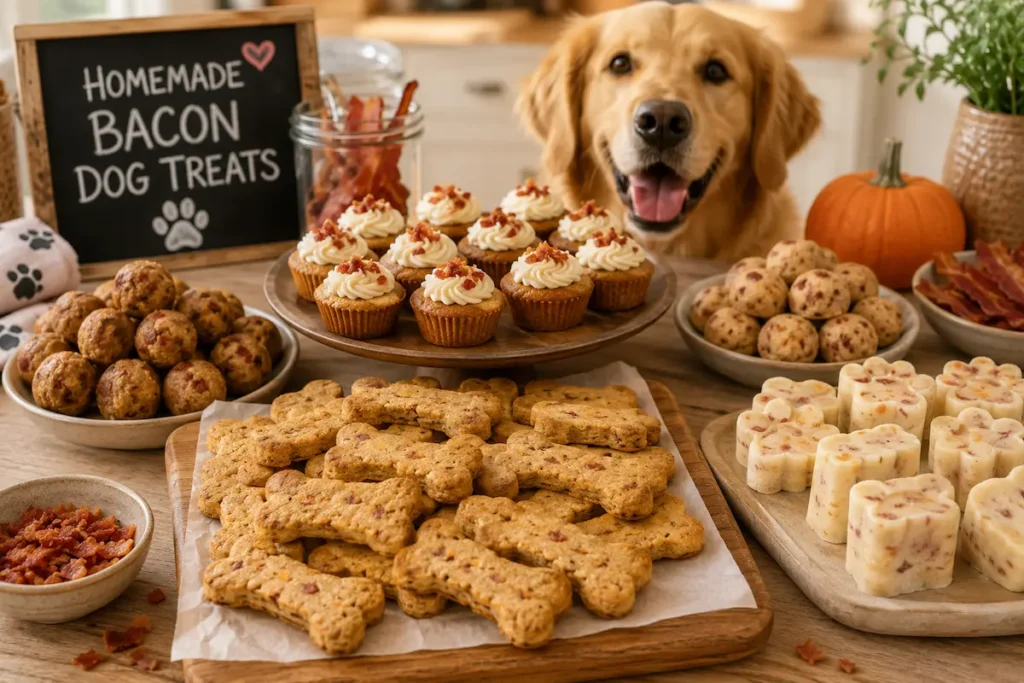
1. Baked Bacon & Egg Biscuits
The most balanced bacon treat on the list — eggs moderate the fat and sodium content while delivering complete protein, and the baked format renders out additional grease during cooking.
A genuinely celebratory treat that’s more forgiving than pure bacon recipes.
Baked Bacon & Egg Biscuits
Crunchy homemade biscuits for special occasions
Ingredients
4 strips plain bacon
2 eggs
1½ cups whole wheat flour
¼ cup plain Greek yogurt
1 tbsp water (if needed)
Instructions
Preheat oven to 350°F (175°C) and line a baking sheet with parchment.
Cook bacon until fully cooked, then drain well and let cool completely.
Finely crumble the bacon and mix with the eggs and yogurt.
Add flour and mix into a firm dough. Add water if needed.
Roll to ¼-inch thickness and cut into shapes.
Bake for 18–20 minutes until golden and firm.
Cool completely on a wire rack before serving.
💡 Storage Tip: Bacon makes these biscuits more perishable than most homemade dog treats. Refrigerate for up to 5 days or freeze for up to 2 months.
2. Bacon & Peanut Butter Training Bites
Bacon’s irresistible aroma combined with peanut butter’s rich flavor makes these some of the most rewarding homemade training treats a dog can get.
Their small size is perfect for training sessions, and IMO they’re the most effective high-value treats on this entire list.
Bacon & Peanut Butter Training Bites
Tiny high-value treats for focused training
Ingredients
3 strips plain bacon
¼ cup xylitol-free peanut butter
1 egg
1 cup oat flour
2 tbsp plain Greek yogurt
Instructions
Preheat oven to 325°F (165°C) and line a baking sheet.
Cook bacon until fully done, then drain well and crumble very finely.
Mix peanut butter, egg, and yogurt until smooth.
Add crumbled bacon and oat flour. Mix into a firm, slightly sticky dough.
Roll into ½-inch balls, place on the baking sheet, and flatten slightly.
Bake for 14–16 minutes until set and firm.
Cool completely before using.
💡 Training Tip: Use these for recall training, difficult distractions, or other high-value reward moments.
💡 Storage Tip: Freeze extras for up to 2 months.
3. No-Bake Bacon & Sweet Potato Balls
A softer, faster bacon treat that skips the oven entirely — the sweet potato naturally binds the mixture and the bacon provides flavor and smell without dominating the nutritional profile. These work particularly well as a birthday treat format. 🙂
No-Bake Bacon & Sweet Potato Balls
Soft, no-bake treats for special occasions
Ingredients
3 strips plain bacon
½ cup mashed sweet potato
1 cup rolled oats
1 tbsp plain Greek yogurt
Instructions
Cook bacon until fully done, then drain thoroughly and let cool.
Finely crumble the cooled bacon.
Mix mashed sweet potato and yogurt until smooth.
Add bacon and rolled oats. Mix until a firm, rollable dough forms.
If needed, add extra oats 1 tablespoon at a time.
Roll into 1-inch balls and place on a parchment-lined tray.
Refrigerate for 1 hour before serving.
💡 Texture Tip: Add extra oats if the mixture feels too wet to roll.
🎉 Birthday Tip: These soft treats are perfect for dog birthdays and special celebrations.
💡 Storage Tip: Freeze extras for up to 2 months.
4. Bacon & Cheddar Celebration Biscuits
The most festive-looking recipe on the list — the combination of bacon and cheddar in a golden biscuit is visually impressive and smells extraordinary fresh from the oven.
For dog birthday parties or multi-dog gatherings, these are the treats that make every dog in the room pay attention.
Bacon & Cheddar Celebration Biscuits
Cheesy baked biscuits for birthdays and celebrations
Ingredients
3 strips plain bacon
½ cup grated cheddar cheese
1 egg
1½ cups whole wheat flour
¼ cup plain Greek yogurt
2 tbsp low-sodium chicken broth
Instructions
Preheat oven to 350°F (175°C) and line a baking sheet.
Cook bacon, drain thoroughly, and crumble finely.
Mix egg, yogurt, and chicken broth until combined.
Add bacon and cheddar cheese.
Add flour and mix into a firm dough.
Roll to ¼-inch thickness and cut into shapes.
Bake for 18–20 minutes until golden and firm.
Cool completely before serving.
🎉 Celebration Tip: Bone and star cookie cutters make these biscuits extra festive for birthdays and special occasions.
💡 Storage Tip: Freeze extras for up to 2 months.
💡 Portion note: Cheese adds additional fat and sodium to an already indulgent recipe — these are firmly in the “small piece, special occasion” category. One or two biscuits per dog per celebration is the appropriate approach, not a bowl left out for casual snacking.
5. Frozen Bacon & Yogurt Pops
A frozen format for warm-weather celebrations — bacon flavor in a cooling, probiotic-rich yogurt base that delivers the indulgent smell dogs love with a slightly more forgiving fat profile than baked bacon treats.
Frozen Bacon & Yogurt Pops
Cool creamy pops for warm-weather celebrations
Ingredients
2 strips plain bacon
1 cup plain Greek yogurt
¼ cup plain canned pumpkin
1 tbsp xylitol-free peanut butter
Instructions
Cook bacon until fully done, then drain extremely well.
Let bacon cool, then crumble into very fine pieces.
Mix yogurt, pumpkin, and peanut butter until smooth.
Fold in the crumbled bacon.
Pour into silicone molds or an ice cube tray.
Freeze for at least 4 hours or overnight.
Pop out and serve immediately.
❄️ Freezer Tip: Silicone molds make these pops easier to remove after freezing.
💡 Storage Tip: Store extras in a freezer-safe bag for up to 2 months.
💡 Nutrition Note: Pumpkin helps thicken the mixture while adding fiber, and plain Greek yogurt contributes probiotics that support digestive health.
6. Bacon-Topped Birthday Pupcake
The celebration recipe — a properly made pupcake with a small amount of bacon as a topping rather than a primary ingredient. This gets the bacon onto the birthday treat in the most visually impressive, most portion-controlled way possible.
Bacon-Topped Birthday Pupcake
Mini pumpkin pupcakes with a tiny bacon topping
Ingredients
2 strips plain bacon
cooked and crumbled, topping only
½ cup plain canned pumpkin
2 eggs
¼ cup xylitol-free peanut butter
1½ cups whole wheat flour
1 tsp baking powder
¼ cup water
Frosting
4 oz plain cream cheese, softened
1 tbsp honey
Instructions
Preheat oven to 350°F (175°C) and line a mini muffin tin.
Cook bacon, drain thoroughly, crumble finely, and set aside for topping.
Mix pumpkin, eggs, peanut butter, and water together.
Add flour and baking powder. Mix until just combined.
Spoon into muffin cups, filling each about ¾ full.
Bake for 14–16 minutes, until a toothpick comes out clean.
Cool completely before frosting.
Mix cream cheese and honey until smooth, then pipe or dollop onto pupcakes.
Sprinkle a small pinch of crumbled bacon on top.
🎂 Birthday Tip: Keep the bacon as a tiny topping so it adds aroma and excitement without taking over the whole treat.
💡 Storage Tip: Keep frosted pupcakes refrigerated for up to 3 days, or store unfrosted pupcakes at room temperature for up to 5 days.
💡 Related Articles:
Quick Reference Guide: All 6 Recipes
| Recipe | Format | Prep Time | Cook Time | Best For |
|---|---|---|---|---|
| Bacon & Egg Biscuits | Baked | 15 min | 19 min | Balanced, everyday special occasion |
| Bacon & PB Training Bites | Baked | 12 min | 15 min | High-value training moments |
| Bacon & Sweet Potato Balls | No-bake | 10 min | 1 hr chill | Birthday treats, soft format |
| Bacon & Cheddar Biscuits | Baked | 15 min | 19 min | Celebrations, multi-dog events |
| Frozen Bacon & Yogurt Pops | Frozen | 8 min | 4+ hrs freeze | Warm weather, birthdays |
| Bacon-Topped Birthday Pupcake | Baked | 15 min | 15 min | Birthday centerpiece |
The Honest Guide to Bacon and Dogs
Why Bacon Works as a High-Value Treat
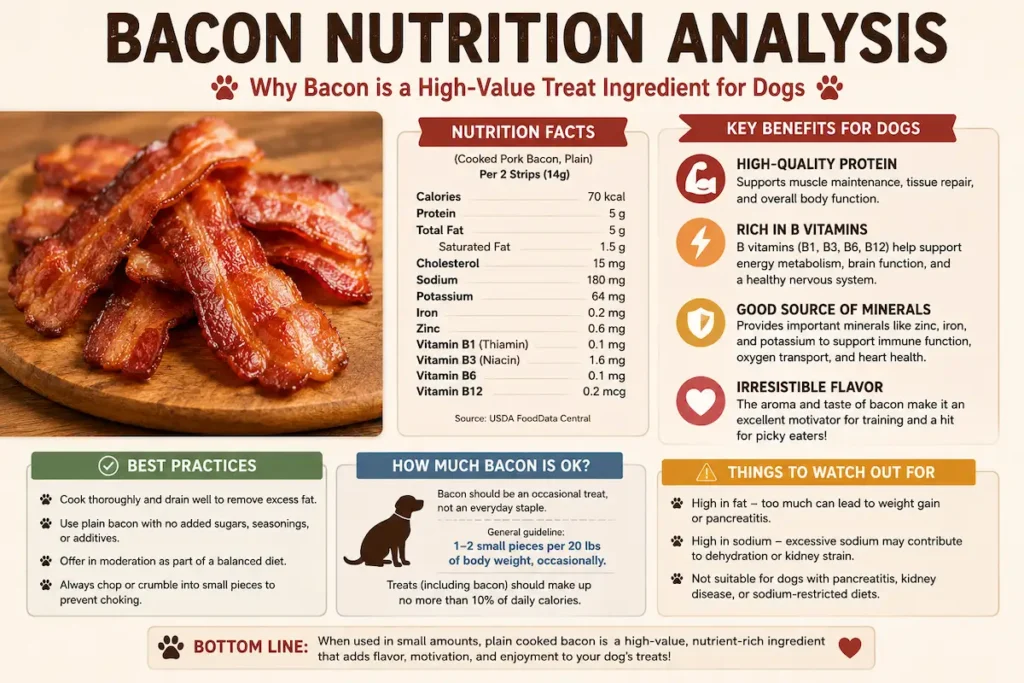
Dogs experience smell at a sensitivity level approximately 10,000 to 100,000 times greater than humans — and bacon’s volatile aromatic compounds are among the most powerful in any food.
From a training and motivation perspective, bacon treats work because the smell reaches the dog long before the treat does, creating an anticipatory response that makes the reward exceptionally salient.
This is why bacon-based treats appear so consistently on lists of high-value training rewards used by professional dog trainers. It’s not anecdote — it’s basic olfactory science applied to canine motivation.
The Real Concerns with Bacon for Dogs
None of this changes the actual nutritional reality of bacon, which deserves honest treatment.
1️⃣ Fat content is the primary concern. Bacon is one of the highest-fat meats available — approximately 42g of fat per 100g, compared to 3.6g in chicken breast.
- For dogs prone to pancreatitis — including Miniature Schnauzers, Cocker Spaniels, and Yorkshire Terriers — high-fat meals and treats are a genuine medical risk that can trigger a painful and potentially serious episode.
- For healthy dogs, occasional small amounts are manageable; for pancreatitis-prone dogs, bacon treats are contraindicated regardless of the occasion.
2️⃣ Sodium content is the second concern. Commercial bacon contains significant sodium — typically 400–500mg per two strips.
Dogs have much lower sodium requirements than humans, and high-sodium treats consumed regularly contribute to hypertension, kidney stress, and fluid retention.
In the quantities used across the recipes in this guide, the sodium per treat is modest — but frequency matters enormously.
3️⃣ Processed meat additives are the third concern. Most commercial bacon contains preservatives, nitrates, and sometimes artificial flavors.
These aren’t acutely toxic at treat quantities, but they’re not ingredients worth feeding regularly when better options are available for daily treat use.
The Special Occasion Framework
The “special occasion only” positioning in the title of this article is a genuine recommendation, not a marketing hedge. Here’s what that framework looks like in practice:
✅
Appropriate occasions for bacon treats:
- Dog birthdays and gotcha days — once per year per event
- Major training milestones — first successful recall, first off-leash achievement
- High-stakes training environments where standard treats genuinely aren’t working
- Post-vet-visit recovery rewards — the dog earned it
- Multi-dog celebration events
⛔️
Not appropriate for:
- Daily training treats
- Regular rotation with standard meals and treats
- Dogs with pancreatitis, heart conditions, or kidney disease — consult a vet
- Dogs on sodium-restricted diets
- Puppies under 6 months — digestive systems aren’t equipped for high-fat treats
Preparing Bacon Safely for Dog Treats
How bacon is prepared matters significantly — the recipes above use several techniques that reduce the impact of bacon’s less desirable qualities:
✅ Cook fully, drain aggressively. Fat that renders out during cooking and is blotted away with paper towels isn’t in the treat.
Using 3–4 strips of bacon and removing as much fat as possible post-cooking produces a much leaner treat than using fewer strips with retained fat.
✅ Use plain bacon only. Maple, hickory, peppered, and applewood smoked varieties contain additional sugar, spices, and sometimes artificial flavors.
The label should list: pork, water, salt, and possibly sodium nitrate. Anything beyond that is a reason to choose a different product.
✅ Use as a flavor accent, not a primary ingredient. Every recipe in this guide uses bacon as one component of a multi-ingredient treat — not as the entire treat.
This naturally moderates the fat and sodium content while preserving the motivational smell profile that makes bacon treats effective.
✅ Never feed raw bacon. Raw pork carries parasite and bacterial risks. Always cook fully before incorporating into any treat recipe.
Bacon Treat Portion Guide
| Dog Size | Weight | Max Per Occasion | Frequency |
|---|---|---|---|
| Extra Small | Under 10 lbs | ½ small biscuit or 1 training bite | Special occasions only |
| Small | 10–20 lbs | 1 small biscuit or 2 training bites | Special occasions only |
| Medium | 20–50 lbs | 1–2 biscuits or 3–4 training bites | Special occasions only |
| Large | 50–90 lbs | 2–3 biscuits or 4–5 training bites | Special occasions only |
These portions apply to healthy adult dogs with no history of pancreatitis, heart disease, or kidney issues. For any dog with those conditions, consult a vet before offering any bacon-containing treat.
Storage Guide
- Baked bacon biscuits — refrigerator for up to 5 days; freeze for up to 2 months
- No-bake bacon balls — refrigerator for up to 4 days; freeze for up to 2 months
- Frozen bacon pops — freezer-safe bag for up to 2 months
- Bacon pupcakes (frosted) — refrigerator for up to 3 days
- Labeling tip — label all bacon treats clearly in the freezer so they aren’t confused with everyday treats and served too frequently
Final Thoughts
Bacon dog treats are exactly what they should be — joyful, indulgent, and occasional. They exist in the same category as birthday cake for humans: not something to have every day, not something to feel guilty about having at all, and worth every bit of the reaction they produce when they appear.
The six recipes here make bacon work as well as it possibly can in a dog treat — fat rendered out, sodium moderated by dilution with other ingredients, and bacon positioned as a flavor accent that delivers maximum motivation with minimum excess.
Make the bacon birthday pupcake. Pull out the training bites for the moment that needs it most. Watch the dog’s reaction and enjoy it completely. Just put the rest in the freezer and save them for next time. 🙂