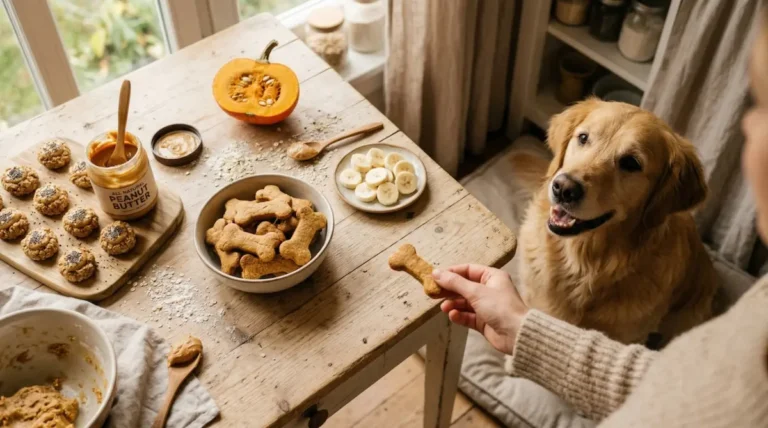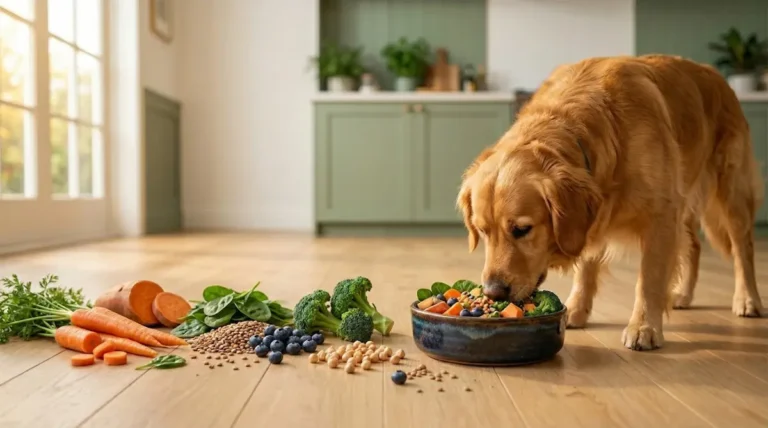
You’re slicing an apple, making breakfast, or putting away dinner, and suddenly there’s a hopeful face waiting nearby for a bite.
The good news? Plenty of everyday human foods can make tasty, nutritious extras for dogs. The catch is that how a food is prepared matters just as much as the food itself.
A plain carrot is very different from buttery glazed carrots, and cooked boneless chicken is very different from a seasoned chicken wing.
This guide covers 50 human foods dogs can and cannot eat, including how to serve them, their main nutritional benefits, and which foods should stay completely off the menu.
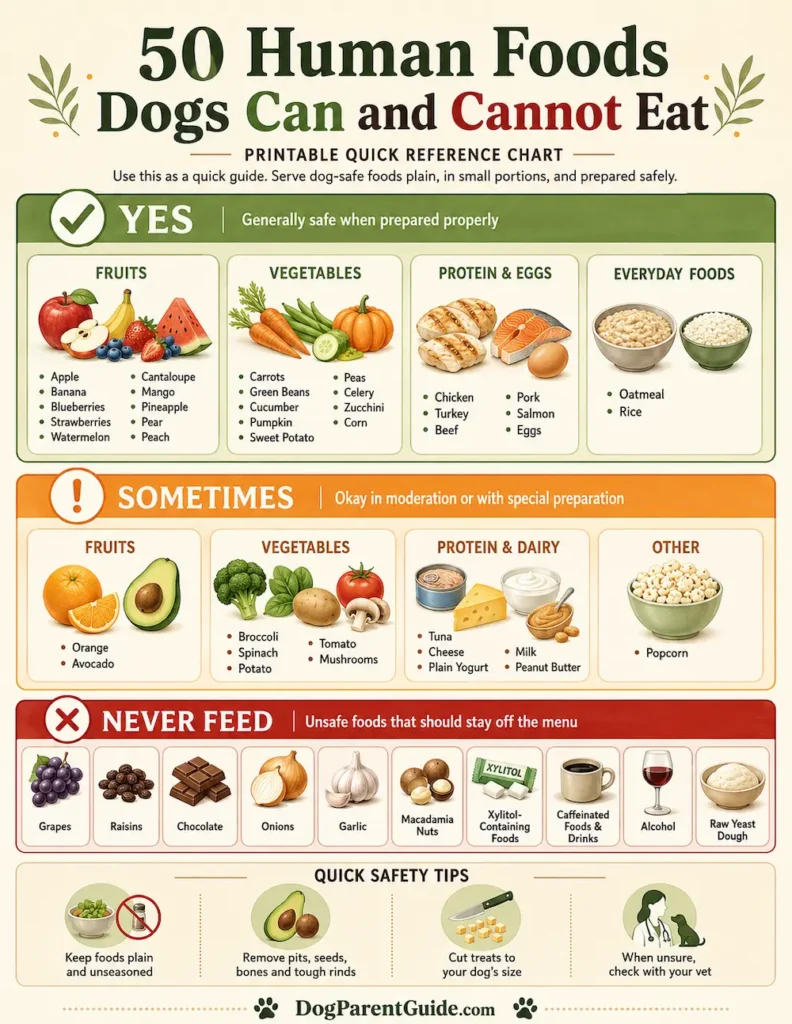
Save the quick chart below for those “Can my dog have this?” moments.
📋 Human Foods Dogs Can and Cannot Eat: Quick Chart
✅ Yes: Generally safe when prepared properly
⚠️ Sometimes: Okay in moderation or with special preparation
❌ No: Do not intentionally feed
| Human Food | Safe? | Serving Note | Nutrition |
|---|---|---|---|
| Apple | ✅ Yes | Raw; remove core & seeds | Fiber + vitamin C |
| Banana | ✅ Yes | Raw, mashed or frozen; small portions | Potassium + fiber |
| Blueberries | ✅ Yes | Fresh or frozen | Fiber + antioxidants |
| Strawberries | ✅ Yes | Fresh; remove stems | Fiber + vitamin C |
| Watermelon | ✅ Yes | Remove rind & seeds | Water + vitamins A & C |
| Cantaloupe | ✅ Yes | Remove rind; small cubes | Vitamins A & C |
| Mango | ✅ Yes | Remove skin & pit | Vitamins A & C |
| Pineapple | ✅ Yes | Fresh flesh; small pieces | Vitamin C + manganese |
| Orange | ⚠️ Sometimes | Flesh only; small amount | Vitamin C + fiber |
| Pear | ✅ Yes | Remove core & seeds | Fiber + vitamin C |
| Peach | ✅ Yes | Flesh only; remove pit | Vitamins A & C |
| Avocado | ⚠️ Caution | Tiny ripe flesh only; avoid pit | Fiber + unsaturated fat |
| Grapes | ❌ No | Never feed | None worth the risk |
| Raisins | ❌ No | Never feed | None worth the risk |
| Carrots | ✅ Yes | Raw or cooked; cut to size | Fiber + beta-carotene |
| Green Beans | ✅ Yes | Raw or cooked; plain | Fiber + vitamins |
| Cucumber | ✅ Yes | Raw slices or chunks | Water + vitamin K |
| Pumpkin | ✅ Yes | Cooked or plain purée | Fiber + beta-carotene |
| Sweet Potato | ✅ Yes | Cook thoroughly; serve plain | Fiber + beta-carotene |
| Broccoli | ⚠️ Sometimes | Raw or cooked; small portions | Fiber + vitamin C |
| Peas | ✅ Yes | Fresh or frozen; plain | Fiber + plant protein |
| Spinach | ⚠️ Sometimes | Raw or cooked; small amount | Folate + vitamin K |
| Celery | ✅ Yes | Raw or cooked; chop small | Water + fiber |
| Zucchini | ✅ Yes | Raw or cooked; plain | Water + vitamin C |
| Corn | ✅ Yes | Cooked kernels only | Carbs + fiber |
| Potato | ⚠️ Sometimes | Fully cooked; never green | Carbs + potassium |
| Tomato | ⚠️ Sometimes | Ripe red flesh only | Vitamin C + potassium |
| Mushrooms | ⚠️ Sometimes | Store-bought varieties only | B vitamins + selenium |
| Chicken | ✅ Yes | Fully cooked, plain & boneless | Protein + B vitamins |
| Turkey | ✅ Yes | Cooked, skinless & boneless | Protein + B vitamins |
| Beef | ✅ Yes | Cooked, lean & plain | Protein + iron + zinc |
| Pork | ✅ Yes | Fully cooked & unseasoned | Protein + B vitamins |
| Salmon | ✅ Yes | Fully cooked & deboned | Protein + omega-3s |
| Tuna | ⚠️ Sometimes | Plain; occasional servings | Protein + omega-3s |
| Eggs | ✅ Yes | Fully cooked & plain | Protein + vitamins |
| Cheese | ⚠️ Sometimes | Tiny pieces; watch fat/lactose | Protein + calcium |
| Plain Yogurt | ⚠️ Sometimes | Unsweetened; xylitol-free | Protein + calcium |
| Milk | ⚠️ Sometimes | Small amounts only | Protein + calcium |
| Peanut Butter | ⚠️ Sometimes | Xylitol-free; small portions | Protein + fat |
| Oatmeal | ✅ Yes | Cooked plain with water | Fiber + carbohydrates |
| Rice | ✅ Yes | Fully cooked & plain | Carbohydrates |
| Popcorn | ⚠️ Sometimes | Plain, air-popped only | Carbs + fiber |
| Chocolate | ❌ No | Never feed | None worth the risk |
| Onions | ❌ No | Raw, cooked or powdered | None worth the risk |
| Garlic | ❌ No | Raw, cooked or powdered | None worth the risk |
| Macadamia Nuts | ❌ No | Never feed | None worth the risk |
| Xylitol-Containing Foods | ❌ No | Never feed | None worth the risk |
| Caffeinated Foods & Drinks | ❌ No | Never feed | None worth the risk |
| Alcohol | ❌ No | Never feed | None worth the risk |
| Raw Yeast Dough | ❌ No | Never feed | None worth the risk |
📌 Quick tip: Save this chart to your phone or print a copy for the kitchen. It’s much easier than trying to remember 50 foods when a dog is staring at the cutting board.
🍎 Fruits Dogs Can Eat
Fruit can be a fun way to add variety to treat time. Many dog-friendly fruits provide fiber, water, vitamins and antioxidants, and most can be served raw with very little prep.
The main things to watch are seeds, pits, cores, stems and tough rinds.
🍎 Apple: ✅ Yes
Fresh apple slices make a crunchy, naturally sweet treat. Apples provide fiber and vitamin C, and the firm texture may help scrape some food debris from the teeth while chewing.
Remove the stem, core and seeds first, then slice the apple into pieces appropriate for your dog’s size.
Want more ways to serve apples safely? This complete guide to apples for dogs includes serving tips and homemade treat ideas.
🍌 Banana: ✅ Yes
Bananas provide potassium and fiber and can be served raw, mashed or frozen. A few small slices are enough since bananas are naturally higher in sugar than many vegetables.
Mashed banana also works well on a lick mat or mixed into homemade treats.
Have more ripe bananas to use up? Try these easy banana dog treats for even more homemade ideas.
🫐 Blueberries: ✅ Yes
Blueberries are one of the easiest fruits to share. Serve them fresh or frozen as tiny treats.
They provide fiber and colorful plant antioxidants, and their naturally small size makes them convenient for training. For toy breeds or very young puppies, a blueberry can be cut in half.
🍓 Strawberries: ✅ Yes
Remove the leafy tops, then serve fresh slices or small chunks. Strawberries provide fiber and vitamin C.
They can also be chopped into yogurt, frozen into small cubes or blended into homemade dog treats.
🍉 Watermelon: ✅ Yes
Watermelon is mostly water, which makes it especially appealing as a warm-weather treat.
Remove the rind and seeds completely, then serve small fresh cubes or freeze them for a cool summer snack. It also provides vitamins A and C.
🍈 Cantaloupe: ✅ Yes
Cantaloupe can be served raw after removing the rind and seeds. Its soft texture makes it easy to cut into small training-size cubes.
It provides vitamins A and C, but like other sweet fruits, a few bites are plenty.
🥭 Mango: ✅ Yes
Ripe mango flesh can be served fresh or frozen and provides fiber plus vitamins A and C.
Always remove the large pit and skin before offering any to a dog. The pit is far too large and hard to be treated like an edible chew.
🍍 Pineapple: ✅ Yes
Small pieces of fresh pineapple can make a juicy occasional snack. Pineapple provides vitamin C and manganese.
Stick to fresh fruit rather than canned pineapple packed in sugary syrup.
🍊 Orange: ⚠️ Sometimes
A small amount of peeled orange flesh is generally fine for most healthy dogs.
Remove the peel and seeds, then start with just a small segment. Citrus can be acidic, so dogs with sensitive stomachs may simply do better without it.
🍐 Pear: ✅ Yes
Fresh pear provides fiber and vitamin C and can be served raw in small slices.
Remove the core, stem and seeds before sharing.
🍑 Peach: ✅ Yes
Ripe peach flesh makes a soft, sweet treat and provides vitamins A and C.
The important part is removing the pit completely. Never allow a dog to chew or play with a peach pit.
🥑 Avocado: ⚠️ Caution
A tiny amount of ripe avocado flesh is different from letting a dog eat an entire avocado.
The flesh provides fiber and unsaturated fat, but it is also calorie-dense and high in fat. Skip the skin and keep the large pit completely out of reach.
🍇 Grapes & Raisins: ❌ No
Grapes and raisins should never be intentionally fed to dogs.
They have been linked to acute kidney injury, and there is no dependable safe amount that can be recommended for home feeding.
If a dog eats grapes or raisins, contact a veterinarian promptly rather than waiting for symptoms.
🥕 Vegetables Dogs Can Eat
Vegetables are some of the easiest human foods to turn into simple dog treats.
Many can be served raw or cooked, depending on the vegetable and the dog. Raw vegetables tend to provide more crunch, while cooking makes them softer and often easier for puppies, senior dogs and dogs with dental problems to chew.
🥕 Carrots: ✅ Yes
Carrots are low in calories and provide fiber plus beta-carotene, which the body can convert to vitamin A.
Serve them raw for a crunchy snack or lightly cooked for a softer bite. Raw carrot pieces may help scrape some food debris from the teeth as a dog chews, although they are not a replacement for regular dental care.
Cut them into smaller pieces for puppies and toy breeds.
Want more serving ideas? See this complete guide to carrots for dogs.
🫘 Green Beans: ✅ Yes
Green beans can be served raw, steamed or cooked until tender.
They provide fiber and relatively few calories, which makes plain green beans useful when a dog enjoys frequent treats but doesn’t need many extra calories.
Avoid canned green beans packed with lots of sodium.
🥒 Cucumber: ✅ Yes
Cucumber is crunchy, high in water and relatively low in calories.
Serve thin raw slices or small chunks as a simple treat. It’s especially handy for dogs that love crunchy snacks but don’t need calorie-dense treats.
🎃 Pumpkin: ✅ Yes
Plain cooked pumpkin provides fiber and beta-carotene.
A spoonful of plain pumpkin purée can be mixed into regular food, spread on a lick mat or frozen into small cubes.
Always choose 100% plain pumpkin, not pumpkin pie filling with sugar and spices.
🍠 Sweet Potato: ✅ Yes
Sweet potato should be cooked before serving.
Plain steamed, baked or mashed sweet potato provides fiber, carbohydrates and beta-carotene. Small cooked cubes can work as treats, while mashed sweet potato makes an easy meal topper.
🥦 Broccoli: ⚠️ Sometimes
Dogs can eat broccoli raw or cooked in small amounts.
It provides fiber and vitamin C, but larger quantities may irritate the digestive system. Chop thick stems and florets into manageable pieces.
🟢 Peas: ✅ Yes
Fresh or frozen peas are easy to sprinkle over a meal or offer as tiny treats.
They provide fiber, plant protein and several vitamins. Plain frozen peas can also make convenient little training rewards once thawed slightly.
🥬 Spinach: ⚠️ Sometimes
A little raw or lightly cooked spinach is fine for most healthy dogs.
It contains folate and vitamin K, but there is little reason to make spinach a major part of a dog’s diet. Think occasional add-in rather than everyday vegetable.
🌿 Celery: ✅ Yes
Celery can be served raw for crunch or cooked for a softer texture.
It provides water and fiber. Chop it into short, small pieces, particularly for puppies and toy breeds.
🥒 Zucchini: ✅ Yes
Zucchini can be served raw, steamed or lightly cooked.
Its mild flavor and high water content make it easy to mix into homemade food, while small raw slices can work as treats.
🌽 Corn: ✅ Yes, kernels only
Plain cooked corn kernels are safe for dogs and provide carbohydrates and fiber.
The corn cob is not safe. It can become lodged in the digestive tract, so keep cobs away from dogs even after dinner is finished.
🥔 Potato: ⚠️ Sometimes
Potato should be served fully cooked and plain.
Boiled or baked potato is much safer than raw or green potato. Skip fries, buttery mashed potatoes and heavily seasoned roasted potatoes.
🍅 Tomato: ⚠️ Sometimes
A little ripe red tomato flesh is generally okay.
Dogs should not be encouraged to eat green tomatoes, stems or leaves from tomato plants. If sharing tomato at all, keep it simple and stick to ripe flesh.
🍄 Mushrooms: ⚠️ Sometimes
Known edible mushrooms from the grocery store are very different from mushrooms growing outside.
Plain cooked store-bought mushrooms are generally a low-risk food, but wild mushrooms are best treated as completely off-limits because toxic species can be difficult to identify.
If a dog regularly struggles with new foods, simpler ingredients may be easier on the stomach. These homemade dog food recipes for sensitive stomachs offer gentler meal ideas.
🍗 Meat, Fish and Eggs Dogs Can Eat
Plain animal proteins can be excellent high-value treats because they provide high-quality protein and essential amino acids.
Cooked meat is the simplest choice for occasional sharing. Raw meat and eggs can carry harmful bacteria, so fully cooking them lowers risk for both dogs and the people handling their food.
🍗 Chicken: ✅ Yes
Plain cooked chicken is one of the easiest proteins to use as a treat.
It provides protein and B vitamins. Remove the skin, bones and seasoning, then shred or cut the meat into small pieces.
Tiny pieces of chicken also work especially well as training rewards.
🦃 Turkey: ✅ Yes
Plain cooked turkey provides lean protein and B vitamins.
Remove bones, fatty skin, gravy and seasoning before sharing. Holiday turkey covered in butter, garlic or onion is not the same thing as a piece of plain turkey breast.
🥩 Beef: ✅ Yes
Lean cooked beef provides protein, iron and zinc.
Plain ground beef or small pieces of lean steak can be used as meal toppers or occasional high-value treats.
Drain excess fat and skip sauces and seasoning.
🐖 Pork: ✅ Yes
Fully cooked plain pork can be offered in small amounts.
It provides protein and several B vitamins. Lean pork is a better choice than bacon, sausage, ham or fatty seasoned cuts.
🐟 Salmon: ✅ Yes
Fully cooked, deboned salmon is one of the more nutrient-dense protein options.
It provides high-quality protein and omega-3 fatty acids. A little flaked salmon can be added to regular food or served as a special treat.
For complete meal ideas, try these easy homemade salmon dog food recipes.
🐟 Tuna: ⚠️ Sometimes
Tuna provides protein and omega-3 fats, but it is better as an occasional food than an everyday protein.
Offer a small amount of plain cooked tuna or canned tuna without heavy oil, seasoning or excessive sodium.
🥚 Eggs: ✅ Yes
Fully cooked eggs make a simple protein-rich topper or snack.
Serve boiled, poached or scrambled eggs plain, without butter, salt or seasoning.
🥛 Dairy, Grains and Everyday Human Foods
Some foods are technically safe but don’t agree with every dog.
Dairy tolerance varies, and foods like cheese and peanut butter can pack a surprising number of calories into a tiny portion.
🧀 Cheese: ⚠️ Sometimes
Small pieces of cheese can work as high-value training treats.
Cheese provides protein and calcium, but it is also calorie-dense and can be high in fat. Some dogs also have trouble digesting lactose.
For toy breeds, a truly tiny cube may be enough.
🥛 Plain Yogurt: ⚠️ Sometimes
Unsweetened plain yogurt can be served by the spoonful, spread lightly on a lick mat or frozen into small treats.
It provides protein and calcium. Some yogurts also contain live cultures, although dogs that do not tolerate dairy may still develop digestive upset.
Always check the label for added sweeteners.
🥛 Milk: ⚠️ Sometimes
Milk contains protein and calcium, but many adult dogs do not digest lactose particularly well.
A small lick may cause no problem, while a larger bowl can lead to gas or diarrhea. There is rarely a good reason to offer milk as a regular dog treat.
🥜 Peanut Butter: ⚠️ Sometimes
A small smear of peanut butter can make a food toy or lick mat much more exciting.
It provides protein and fat, but it is extremely calorie-dense.
Most importantly, check the ingredient label for xylitol before sharing peanut butter with a dog.
🌾 Oatmeal: ✅ Yes
Plain oatmeal cooked with water is generally safe.
Oats provide carbohydrates and soluble fiber. Let oatmeal cool before offering a small spoonful, and skip sugar, flavored packets and artificial sweeteners.
🍚 Rice: ✅ Yes
Plain cooked rice is safe for most dogs and provides easy-to-digest carbohydrates.
It is more useful as part of a balanced homemade meal than as a stand-alone treat, but a small amount can be mixed with other dog-safe ingredients.
🍿 Popcorn: ⚠️ Sometimes
A few plain, fully popped kernels are fine.
Use air-popped popcorn without butter, salt or flavoring. Keep unpopped kernels out of the bowl because they can be hard on teeth and difficult to chew.
🚫 Human Foods Dogs Should Never Eat
Some foods do not need complicated serving instructions. They simply belong away from the dog bowl.
| Never Feed | Why It’s Dangerous |
|---|---|
| 🍇 Grapes & raisins | Risk of kidney injury |
| 🍫 Chocolate | Contains toxic methylxanthines |
| 🧅 Onions | Can damage red blood cells |
| 🧄 Garlic | Can damage red blood cells |
| 🌰 Macadamia nuts | Can cause weakness and tremors |
| 🍬 Xylitol | Can cause severe low blood sugar and liver injury |
| ☕ Caffeine | Can affect the heart and nervous system |
| 🍺 Alcohol | Can cause alcohol poisoning |
| 🥖 Raw yeast dough | Can expand and produce alcohol |
🆘 What If a Dog Eats Something Toxic?
Don’t wait for symptoms after a known exposure to a potentially toxic food.
Have these details ready:
- What the dog ate
- Approximately how much
- When it happened
- The dog’s approximate weight
- The package or ingredient label, if available
Then contact a veterinarian, emergency veterinary clinic or animal poison-control service promptly.
Do not induce vomiting unless a veterinary professional specifically recommends it. The right response depends on the food, amount eaten and the individual dog.
🐶 Puppies, Small Dogs, Large Dogs & Seniors: What Changes?
There isn’t a completely different list of human foods for a Chihuahua and a Great Dane. Toxic foods remain toxic regardless of breed.
What changes is portion size, choking risk, calorie impact and individual health needs.
🐕 Puppies
Growing puppies need most of their calories from complete food formulated for growth.
Keep extras small, introduce new foods gradually and cut firm foods into puppy-friendly pieces.
🐾 Toy & Small Dogs
A piece of cheese or spoonful of peanut butter that looks tiny to a person can represent a significant number of calories for a five-pound dog.
Small dogs also need smaller pieces of crunchy fruits and vegetables to reduce choking risk.
🦮 Large Dogs
Larger dogs can usually handle larger portions, but body size does not make chocolate, grapes, xylitol or other toxic foods safer.
A larger dog still needs moderation with calorie-dense extras.
🐕🦺 Senior Dogs
Older dogs may appreciate softer cooked vegetables if chewing has become difficult.
They may also have kidney, heart, metabolic or digestive conditions that change which otherwise-safe foods are appropriate.
❤️ Dogs With Medical Conditions
A food can be safe for dogs in general and still be a poor choice for one particular dog.
Extra caution is sensible for dogs with pancreatitis, obesity, diabetes, kidney disease, food allergies, digestive problems or prescription diets.
💡 7 Simple Rules for Sharing Human Food With Dogs
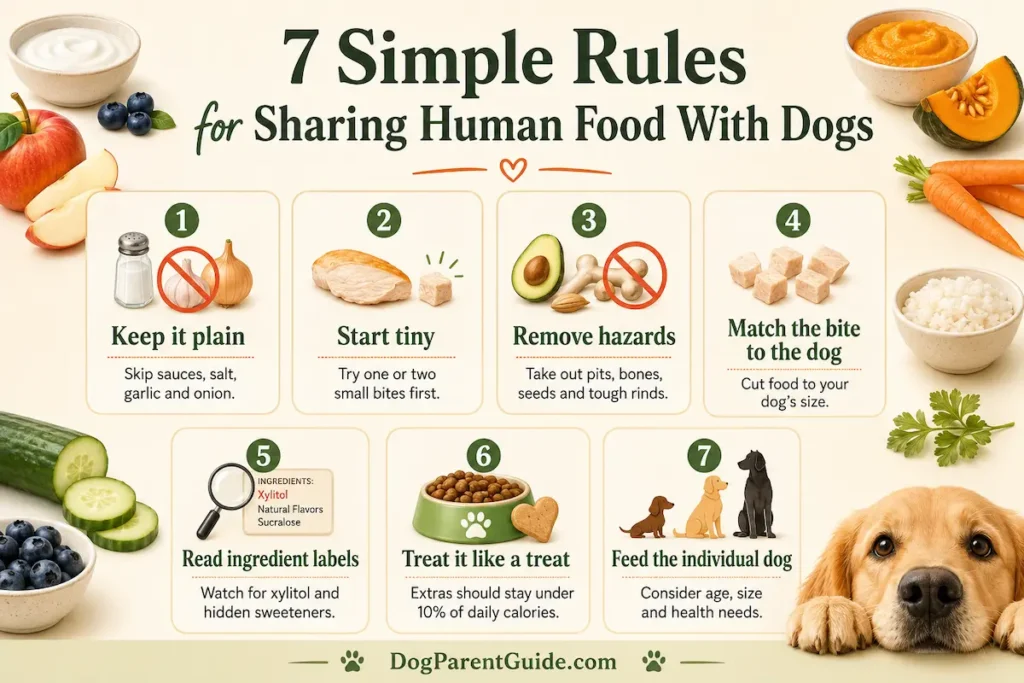
1. 🍽️ Keep it plain.
Skip gravy, sauces, heavy salt, garlic, onion and seasoning blends.
2. 👌 Start tiny.
Even safe foods can upset a stomach that has never tried them before.
3. 🔪 Remove the hazards.
Take out pits, cores, seeds, bones, tough rinds and corn cobs.
4. 🐾 Match the bite to the dog.
A carrot chunk suitable for a Labrador may be far too large for a Yorkie puppy.
5. 🏷️ Read ingredient labels.
Pay special attention to sugar-free foods and products that might contain xylitol.
6. 🦴 Treat it like a treat.
Human food should complement a complete diet rather than replace it.
7. ❤️ Feed the individual dog.
Age, size, weight, allergies, digestive tolerance and medical conditions all matter.
🍽️ How Much Human Food Can Dogs Have?
Even healthy foods still count as extras when they are offered outside a complete and balanced diet.
A useful rule is to keep treats and extras to no more than about 10% of a dog’s daily calories.
That is a limit, not a target.
A couple of blueberries or cucumber slices may barely affect a large dog’s calorie intake. Cheese, peanut butter and fatty meat can add up much faster, particularly for toy breeds.
When introducing a new food, start with one or two small bites. If it agrees with the dog, it can become an occasional treat, training reward or meal topper.
🐾 Final Thoughts
Sharing a little food can be one of those simple everyday moments dogs absolutely love, and there are plenty of safe choices to pick from.
The easiest approach is to keep foods plain, prepare them correctly, serve small portions and know which ingredients should never reach the dog bowl.
Save this 50 human foods dogs can and cannot eat chart for quick reference, and when an unfamiliar food comes up, check first before handing over that hopeful bite.