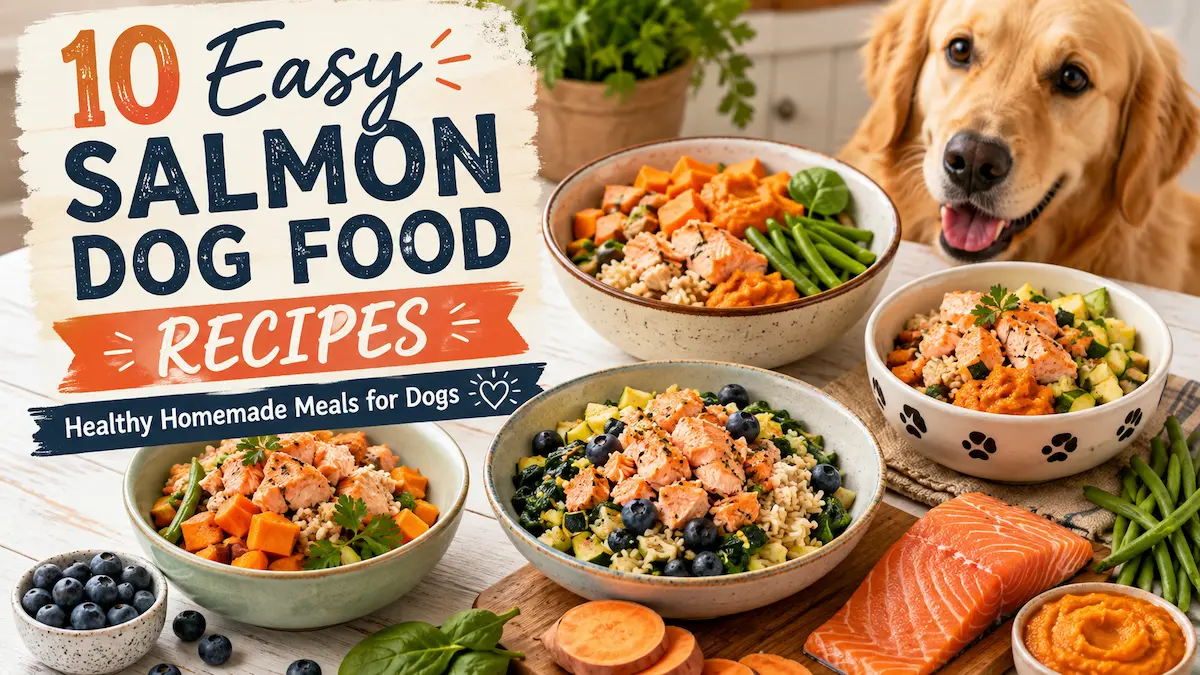
Salmon is one of the richest whole-food sources of EPA and DHA omega-3s you can add to homemade dog food. With regular, appropriately portioned use, many dog parents choose it to support a shinier coat, healthy skin, and comfortable movement.
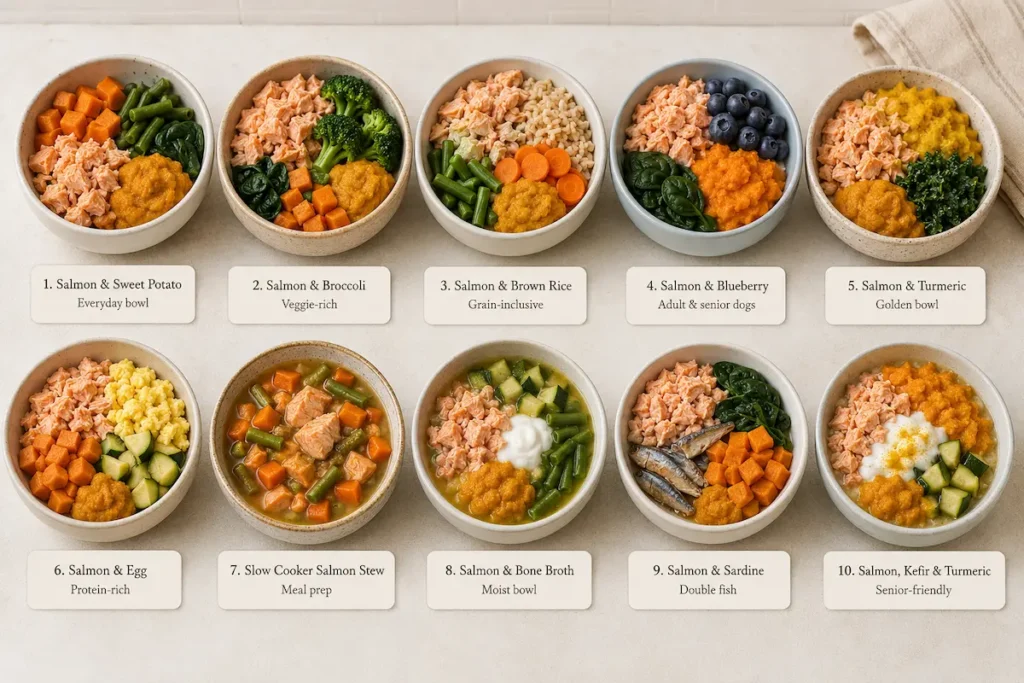
These 10 salmon dog food recipes cover quick weeknight bowls, slow cooker meal prep, grain-inclusive options, soft senior-friendly meals, and colorful recipes built around common dog-friendly ingredients.
⚠️ Critical Safety Warning:
Always cook salmon fully before serving to dogs. Raw salmon can contain a parasite that causes salmon poisoning disease, which is fatal without treatment. Never serve raw salmon to dogs under any circumstances.
🐟 Can Dogs Eat Salmon?
Yes, dogs can eat plain, fully cooked salmon when all bones have been removed.
Salmon provides protein and naturally contains the long-chain omega-3 fatty acids EPA and DHA. Fatty fish such as salmon and sardines are among the primary food sources of these omega-3s.
However, salmon should never be served raw or undercooked. Dogs can contract salmon poisoning disease after eating infected raw or insufficiently cooked salmonid fish.
Cook salmon until it reaches an internal temperature of 145°F (63°C). It should appear opaque and separate easily with a fork.
Quick Salmon Safety Checklist
Before adding salmon to your dog’s bowl:
- Cook it completely.
- Remove every visible bone.
- Do not add salt, butter, sauces, onion, garlic, or seasoning blends.
- Choose canned salmon packed in water with no salt added.
- Introduce salmon gradually if your dog has not eaten it before.
- Ask your veterinarian before serving salmon to a dog with pancreatitis, food allergies, kidney disease, or another medical condition.
🗂️ 10 Salmon Recipes: Benefits & Prep Time Comparison
| Recipe | Key Benefit | Best For | Prep Time |
|---|---|---|---|
| Classic Salmon & Sweet Potato | Foundation recipe | All dogs, everyday | 25 min |
| Salmon & Broccoli | Anti-inflammatory | Joint pain, IBD, skin | 25 min |
| Salmon & Brown Rice | Everyday grain-inclusive bowl | Active adult dogs | 30 min |
| Salmon & Blueberry | Cognitive support | Adult & Senior Dogs | 25 min |
| Salmon & Turmeric | Triple anti-inflammatory | Serious joint/IBD | 25 min |
| Salmon & Egg | Maximum protein | Active, recovery, underweight | 25 min |
| Slow Cooker Salmon Stew | Hands-off cooking | Meal prep | 2–3 hrs low |
| Salmon & Bone Broth | Gut + inflammation | IBD, leaky gut | 30 min |
| Salmon & Sardine Double Omega | Maximum omega-3 | Inflammatory conditions | 25 min |
| Salmon, Kefir & Turmeric | Senior wellness | Senior dogs | 30 min |
⭐ Not sure where to begin? Start with Recipe 1, the Easy Salmon and Sweet Potato Dog Food. It uses simple ingredients, freezes well, and is easy to portion.
10 Salmon Dog Food Recipes for Every Health Need
Recipe 1: Easy Salmon and Sweet Potato Dog Food
Simple enough for weeknight meal prep and versatile enough to become your go-to salmon recipe. Perfect this one first.
🥕 Ingredients (makes approximately 8 cups / 4 days for a 50 lb dog):
- 1.5 lbs fresh salmon fillet (skin removed)
- 2 cups sweet potato, cubed
- 1 cup green beans, chopped
- ½ cup spinach, wilted
- ½ cup plain pumpkin puree
- 1 tablespoon coconut oil
- Canine multivitamin + calcium supplement
👩🍳 Instructions:
- Preheat oven to 375°F (190°C).
- Bake salmon on a lined baking sheet for 18 to 20 minutes until cooked completely through — internal temperature should reach 145°F (63°C).
- Remove all bones — run fingers along the flesh carefully. A missed bone is the primary risk with salmon.
- Flake salmon into small pieces.
- Steam sweet potato until tender. Mash lightly.
- Steam green beans until just soft. Wilt spinach.
- Combine all ingredients with pumpkin puree.
- Cool completely. Add coconut oil and supplements per serving.
❄️ Storage: Refrigerate in airtight containers for up to 3 days or freeze individual portions for up to 2 months. Thaw frozen portions overnight in the refrigerator.
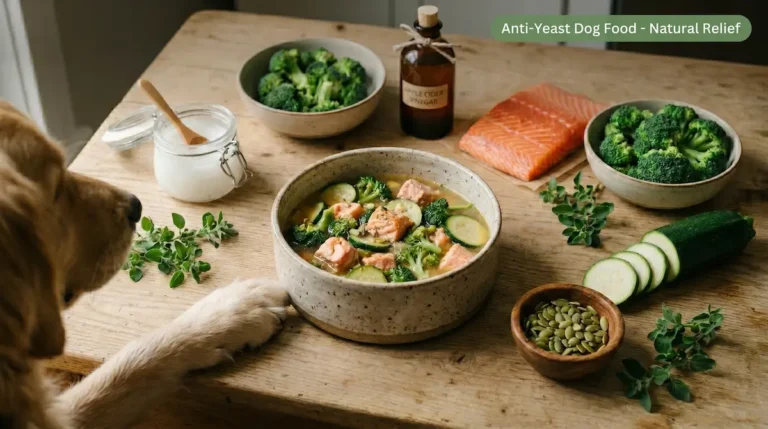
Recipe 2: Salmon and Broccoli Anti-Inflammatory Bowl
Broccoli’s sulforaphane combined with salmon’s EPA and DHA creates one of the most potent whole-food anti-inflammatory combinations available in homemade dog food.
This recipe is the go-to for dogs managing joint pain, IBD, chronic skin conditions, or any systemic inflammatory condition.
🥕 Ingredients:
- 1.5 lbs fresh salmon fillet
- 1.5 cups sweet potato, steamed and mashed
- 1 cup broccoli, steamed and finely chopped
- ½ cup spinach, wilted
- ½ cup plain pumpkin puree
- 1 tablespoon coconut oil
- Canine multivitamin + calcium supplement
👩🍳 Instructions:
- Bake salmon at 375°F (190°C) for 18 to 20 minutes. Remove all bones. Flake.
- Steam sweet potato and mash.
- Steam broccoli until tender — don’t overcook, sulforaphane degrades with excess heat.
- Combine all ingredients.
- Cool completely. Add coconut oil and supplements per serving.
❄️ Storage: Store in the refrigerator for up to 3 days or freeze individual servings for up to 2 months.
💡 Why it works: Salmon naturally provides EPA and DHA, while broccoli adds fiber and beneficial plant compounds. Together, they create a colorful, nutrient-dense bowl that is easy to include in a varied homemade rotation.
Recipe 3: Easy Salmon and Brown Rice Bowl
Brown rice adds B vitamins, fiber, and satisfying texture, making this one of the most practical grain-inclusive salmon recipes in the collection.
🥕 Ingredients:
- 1.5 lbs fresh salmon fillet
- 1 cup brown rice, cooked
- 1 cup green beans, chopped and steamed
- ½ cup carrots, grated and steamed
- ½ cup plain pumpkin puree
- 1 tablespoon coconut oil
- Canine multivitamin + calcium supplement
👩🍳 Instructions:
- Bake salmon at 375°F (190°C) for 18 to 20 minutes. Remove all bones. Flake.
- Cook brown rice according to package instructions in plain water.
- Steam green beans and carrots until tender.
- Combine warm rice with flaked salmon — the heat helps the rice absorb flavor.
- Add vegetables and pumpkin puree.
- Cool completely. Add coconut oil and supplements per serving.
❄️ Storage: Refrigerate for up to 3 days or freeze in portion-sized containers for up to 2 months.
Brown rice may absorb moisture during storage. Add a small spoonful of warm water when serving if the thawed mixture feels dry.
Recipe 4: Salmon and Blueberry Cognitive Support Bowl (Best for Adult & Senior Dogs)
DHA from salmon and anthocyanins from blueberries make this a colorful bowl designed with adult and senior dogs in mind. The soft mashed texture is especially easy to portion and serve.
🥕 Ingredients:
- 1.5 lbs fresh salmon fillet
- ½ cup fresh or frozen blueberries
- 1.5 cups sweet potato, steamed and mashed
- ½ cup spinach, wilted
- ½ cup plain pumpkin puree
- 1 tablespoon coconut oil
- Canine multivitamin + calcium supplement
👩🍳 Instructions:
- Bake salmon at 375°F (190°C) for 18 to 20 minutes. Remove all bones. Flake.
- Steam sweet potato and mash completely.
- Wilt spinach briefly.
- Combine salmon, sweet potato, spinach, and pumpkin puree.
- Gently fold in blueberries last — they break down with aggressive mixing.
- Cool completely. Add coconut oil and supplements per serving.
❄️ Storage: Refrigerate for up to 3 days or freeze for up to 2 months.
The blueberries may release some color and moisture after thawing. This is normal.
Recipe 5: Salmon and Turmeric Anti-Inflammatory Power Bowl
Salmon, turmeric, pumpkin, and kale give this bowl its rich golden color and nutrient-dense ingredient profile. It is a flavorful rotation option for dog parents interested in omega-3-rich homemade meals.
🥕 Ingredients:
- 1.5 lbs fresh salmon fillet
- 1.5 cups sweet potato, mashed
- 1 cup kale, very finely chopped and steamed
- ½ cup plain pumpkin puree
- ¼ teaspoon turmeric, optional and veterinarian-approved
- 1 tablespoon coconut oil
- Canine multivitamin + calcium supplement
👩🍳 Instructions:
- Bake salmon at 375°F (190°C) for 18 to 20 minutes. Remove all bones. Flake.
- Mix turmeric into pumpkin puree before adding — ensures even distribution.
- Steam sweet potato and mash. Steam kale until tender.
- Combine all ingredients including spiced pumpkin.
- Cool completely. Add coconut oil and supplements per serving.
❄️ Storage: Refrigerate for up to 3 days or freeze individual portions for up to 2 months.
Recipe 6: Salmon and Egg Protein-Rich Bowl (Best for Active Dogs)
Eggs are the highest biological value protein available. Combining eggs with salmon creates a protein-rich bowl with a satisfying flavor and texture.
This recipe is specifically suited for active dogs, working breeds, dogs in recovery, and underweight dogs needing caloric density alongside protein quality.
🥕 Ingredients:
- 1.5 lbs fresh salmon fillet
- 3 eggs, scrambled in a dry pan
- 1 cup sweet potato, mashed
- ½ cup zucchini, diced and steamed
- ½ cup plain pumpkin puree
- Canine multivitamin + calcium supplement
👩🍳 Instructions:
- Bake salmon at 375°F (190°C) for 18 to 20 minutes. Remove all bones. Flake.
- Scramble eggs in a dry non-stick pan — no butter, no oil.
- Steam sweet potato and mash. Steam zucchini.
- Combine all ingredients with pumpkin puree.
- Cool completely. Add supplements per serving.
❄️ Storage: Refrigerate for up to 3 days or freeze in individual portions for up to 2 months.
The egg may become slightly firmer after freezing, but it can still be mixed easily into the thawed meal.
Recipe 7: Slow Cooker Salmon and Vegetable Stew (Hands-Off Meal Prep)
The easiest salmon recipe. Salmon cooks significantly faster than meat-based stews (2-3 hours on low rather than 6-8 hours). The broth that forms is liquid gold.
🥕 Ingredients:
- 1.5 lbs fresh salmon fillet
- 1.5 cups sweet potato, cubed
- 1 cup green beans, chopped
- ½ cup carrots, sliced
- ½ cup plain pumpkin puree
- 1.5 cups low-sodium chicken or fish broth (no onion, no garlic)
- Coconut oil and supplements added per serving
👩🍳 Instructions:
- Place salmon in the slow cooker.
- Add sweet potato, green beans, carrots, and broth.
- Cook on low for 2 to 3 hours — check at 2 hours.
- Salmon should flake easily when done — remove all bones carefully.
- Break salmon into small pieces within the broth.
- Stir in pumpkin puree.
- Cool completely. Add coconut oil and supplements per serving.
⚠️ Important: Don’t cook on high. Salmon becomes dry and grainy when overcooked.
❄️ Storage: Refrigerate for up to 3 days or freeze individual portions for up to 2 months.
The broth may separate slightly after thawing. Stir the mixture well before serving.
💡 You might be interested:
Recipe 8: Salmon and Bone Broth Gut-Health Bowl
Bone broth’s gut lining support and salmon’s omega-3 anti-inflammatory action address two of the most connected health systems in dogs: gut integrity and systemic inflammation. This recipe works on both simultaneously.
🥕 Ingredients:
- 1.5 lbs fresh salmon fillet
- 1 cup homemade bone broth (unsalted, no onion or garlic)
- 1 cup zucchini, diced and steamed
- ½ cup green beans, chopped
- ½ cup plain pumpkin puree
- ½ cup plain Greek yogurt (added after cooling)
- Canine multivitamin + calcium supplement
👩🍳 Instructions:
- Bake salmon at 375°F (190°C) for 18 to 20 minutes. Remove all bones. Flake.
- Steam zucchini and green beans until tender.
- Combine salmon, vegetables, pumpkin puree, and bone broth.
- Cool completely before adding Greek yogurt.
- Add supplements per serving.
- Add an extra splash of bone broth per serving.
❄️ Storage: Refrigerate the finished recipe for up to 3 days.
For freezing, leave out the Greek yogurt. Freeze the salmon, vegetable, pumpkin, and broth mixture for up to 2 months.
Thaw the base in the refrigerator, then stir in fresh Greek yogurt before serving.
Omit the yogurt if your dog does not tolerate dairy well.
Recipe 9: Salmon and Sardine Double Omega Bowl (Maximum Anti-Inflammatory)
Two fish proteins, double the omega-3 delivery, one of the most anti-inflammatory meals achievable in homemade dog food.
Sardines add a complementary micronutrient profile alongside salmon’s EPA and DHA, and the combined aroma makes this one of the most enthusiastically received recipes on the list.
🥕 Ingredients:
- 1 lb fresh salmon fillet
- 1 can sardines in water, no salt (drained and mashed)
- 1.5 cups sweet potato, steamed and mashed
- ½ cup spinach, wilted
- ½ cup plain pumpkin puree
- Canine multivitamin + calcium supplement
👩🍳 Instructions:
- Bake salmon at 375°F (190°C) for 18 to 20 minutes. Remove all bones. Flake.
- Mash sardines thoroughly — check for large bones.
- Steam sweet potato and mash. Wilt spinach.
- Combine all ingredients with pumpkin puree.
- Cool completely. Add supplements per serving.
💡 Note: Because this recipe already contains two oily fish, ask your veterinarian before combining it with a separate fish oil supplement.
❄️ Storage: Because this recipe contains two fish proteins, refrigerate it for no more than 2 days. Freeze individual servings for up to 2 months.
Recipe 10: Salmon, Kefir, and Turmeric Senior Wellness Bowl
This soft senior-friendly salmon bowl combines finely flaked fish, mashed sweet potato, tender zucchini, pumpkin, and kefir. Every ingredient was chosen to create a moist texture and a varied nutrient profile for older dogs.
🥕 Ingredients:
- 1.5 lbs fresh salmon fillet
- ½ cup plain kefir (unsweetened — added after cooling)
- 1 cup sweet potato, mashed
- ½ cup zucchini, diced and steamed
- ½ cup plain pumpkin puree
- ¼ teaspoon turmeric, optional and veterinarian-approved
- 1 tablespoon coconut oil
- Canine multivitamin + calcium supplement
👩🍳 Instructions:
- Bake salmon at 375°F (190°C) for 18 to 20 minutes.
- Remove all bones, flake finely (smaller pieces suit senior digestion)
- Mix turmeric and black pepper into pumpkin puree.
- Steam sweet potato and mash completely smooth.
- Steam zucchini until very soft.
- Combine salmon, vegetables, and spiced pumpkin.
- Cool completely before adding kefir.
- Add coconut oil and supplements per serving.
❄️ Storage: Refrigerate the finished recipe for up to 3 days. To freeze it, leave out the kefir. Freeze the cooked salmon and vegetable base for up to 2 months.
After thawing the base overnight in the refrigerator, add fresh kefir before serving.
Omit kefir if your dog is sensitive to dairy.
✨ Why Salmon Is a Game-Changer for Your Dog’s Health
Salmon’s nutritional profile stands apart from every other protein:
1️⃣ EPA and DHA Omega-3 Fatty Acids: Long-chain omega-3 fatty acids that the body can use more directly than plant-based ALA.
- EPA reduces systemic inflammation throughout the body
- DHA supports brain development in puppies and cognitive function in seniors
- Plant-based omega-3 sources require conversion steps that most dogs can’t complete efficiently
2️⃣ Complete Protein: Salmon provides all essential amino acids in excellent ratios, with a digestibility score that rivals chicken and surpasses most red meats.
3️⃣ Astaxanthin: The carotenoid that gives salmon its pink color. This naturally occurring carotenoid contributes to salmon’s distinctive color and antioxidant profile.
4️⃣ Vitamin D: One of the few whole-food sources of Vitamin D available in dog food. Supports calcium absorption, immune function, and bone health.
5️⃣ B Vitamins: Particularly B12 and niacin, supporting nerve function, energy metabolism, and red blood cell formation.
✅ The practical result:
Salmon adds high-quality protein, EPA, DHA, and valuable micronutrients to a varied homemade rotation. Many dog parents choose it when they want to support normal skin, coat, brain, and joint function without relying on a separate fish ingredient.
🍽️ Salmon Dog Food Portion Guide by Weight
Starting estimates for Recipe 1: Easy Salmon and Sweet Potato Dog Food, which makes approximately 8 cups.
| Dog Weight | Starting Daily Amount | Approx. Servings per Batch |
|---|---|---|
| 10 lbs | ½ to ¾ cup | 11 to 16 servings |
| 20 lbs | 1 to 1¼ cups | 6 to 8 servings |
| 30 lbs | 1½ to 2 cups | 4 to 5 servings |
| 50 lbs | 2 to 2½ cups | 3 to 4 servings |
| 70 lbs | 3 to 3½ cups | 2 to 3 servings |
| 90 lbs | 4 to 4½ cups | About 2 servings |
Note: These are starting estimates for moderately active adult dogs. Other recipes may contain more or fewer calories per cup.
Adjust gradually based on your dog’s body condition. If your dog is unintentionally losing weight, increase the portion slightly. If your dog is gaining unwanted weight, reduce it slightly.
🩺 For regular feeding: Ask your veterinarian to calculate your dog’s daily calorie needs. Long-term homemade diets should be balanced with guidance from a board-certified veterinary nutritionist.
🚨 Salmon Safety for Dogs (The Complete Guide)
Cooking salmon for dogs is non-negotiable, not a preference.
Salmon poisoning disease is caused by the bacterium Neorickettsia helminthoeca, which is carried by a parasitic fluke found in some raw or undercooked salmonid fish. Thorough cooking prevents this risk.
✅ Safe Salmon Guidelines:
- Internal temperature must reach 145°F (63°C), use a meat thermometer
- Baking at 375°F for 18 to 20 minutes reliably reaches this temperature for standard fillets
- Remove all bones before serving, run fingers carefully along the flesh after cooking
- Canned salmon in water (no salt) is safe and already cooked, a convenient alternative
- Atlantic salmon from reputable sources carries lower parasite risk than Pacific salmon, but cooking remains the safest practice regardless of source
⚠️ Signs of Salmon Poisoning (appear 6 to 10 days after raw salmon ingestion):
- Vomiting
- Diarrhea
- Lethargy
- Fever
- Swollen lymph nodes
🚑 Emergency veterinary treatment required immediately if these symptoms appear.
🛒 Salmon Buying Guide for Homemade Dog Food
🐟 Fresh Salmon:
- ✅ Choose plain, unseasoned fillets.
- ✅ Wild-caught salmon can be a good option, though omega-3 levels vary by species and source.
- ✅ Fresh or previously frozen salmon both work well.
- ✅ Buy in bulk when it is on sale. Portion and freeze for up to 3 months.
- ✅ Skin-on salmon is fine to buy, but removing the skin helps reduce richness.
- ❌ Avoid smoked, glazed, marinated, or seasoned salmon.
🥫 Canned Salmon:
- ✅ Choose salmon packed in water with no salt added.
- ✅ It is already cooked and convenient for quick meals or toppers.
- ✅ Drain and mash thoroughly before serving.
- ✅ Canned bones are usually softened, but inspect the fish carefully.
- ❌ Avoid salmon packed in oil, brine, sauce, or seasoning.
💰 Cost Management:
Fresh salmon costs more than chicken or turkey. Buy frozen fillets, stock up during sales, or use canned salmon for budget-friendly meals.
✔️ The practical approach: Make salmon recipes once or twice per week as part of a broader rotation rather than making it the daily protein. This keeps costs manageable while still delivering consistent omega-3 benefits.
❌ 5 Common Salmon Dog Food Mistakes
Mistake 1: Not removing all bones
Even small bones can cause choking or internal injury.
✅ Solution: After cooking, run your fingers carefully along every inch of the salmon flesh. When in doubt, flake the salmon completely and inspect visually. Bones show up clearly against pink flesh.
Mistake 2: Skipping the calcium supplement
Homemade food without calcium supplementation leads to severe nutritional deficiencies over time.
Salmon contains phosphorus but minimal calcium. The imbalance causes bone and metabolic problems within months.
✅ Solution: Always add calcium per the supplement instructions. Non-negotiable.
Mistake 3: Overcooking in the slow cooker
Salmon cooks fast. 2 to 3 hours on low is the maximum. Overcooking makes salmon dry, grainy, and less palatable.
✅ Solution: Check at 2 hours. If it flakes easily, it’s done. Don’t leave it cooking longer.
Mistake 4: Storing recipes with probiotics incorrectly
Recipes with yogurt or kefir (Recipes 8 and 10) should not be frozen with the probiotic ingredient included.
✅ Solution: Freeze the base, then add yogurt or kefir fresh after thawing. Freezing kills most beneficial bacteria.
Mistake 5: Feeding only salmon without rotation
Salmon is nutritionally exceptional but not complete on its own long-term. Feeding only salmon for months can create imbalances despite supplementation.
✅ Solution: Rotate with chicken, turkey, or beef to provide nutritional variety.
🔄 A Simple Salmon Meal Rotation
Salmon can be included once or twice weekly as part of a varied rotation, depending on your dog’s overall diet, calorie needs, and veterinary guidance.
Here is one simple example for dog parents who use these recipes as occasional homemade meals alongside a balanced diet:
✔️ Standard Rotation:
- Tuesday: Recipe 1 (Classic Salmon and Sweet Potato)
- Saturday: Recipe 2 or 5 (Anti-Inflammatory or Turmeric bowl)
✔️ For senior dogs: Swap one of the above for Recipe 10 (Senior Wellness Bowl) every week consistently.
Final Thoughts
Salmon deserves a permanent place in every homemade dog food rotation.
The EPA and DHA it delivers are simply not replaceable by any other whole food at the same concentration.
And the visible improvements in coat quality, joint mobility, and skin health that follow regular salmon inclusion are among the most rewarding things to observe in a dog transitioning to homemade food.
Start with Recipe 1 for an easy introduction to homemade salmon dog food. Add Recipe 2 once the routine is established. Watch the coat change.
The results make the slightly higher ingredient cost completely irrelevant. ✨