
Homemade meatballs for dogs are easy to batch cook, freeze, and use as treats, toppers, training rewards, or part of a homemade meal.
With simple ingredients like beef, turkey, chicken, salmon, pumpkin, sweet potato, carrots, and oats, you can make plenty of dog-friendly variations at home.
Unlike regular meatballs made for people, these recipes skip ingredients like onion, garlic, heavy seasoning, and rich sauces. Below are 10 easy homemade dog meatball recipes, plus tips for cooking, portioning, storing, freezing, and serving them.
A quick note before you start: These recipes are intended primarily as treats, toppers, training rewards, or components of a larger diet. They have not been formulated to provide every nutrient a dog needs as a complete daily diet.
Dogs with allergies, digestive conditions, pancreatitis, kidney disease, or another medical condition may need different ingredients or portions, so check with your veterinarian when needed.
🍖 10 Easy Meatball Recipes for Dogs
Most of these recipes follow the same easy method: combine the ingredients, roll the mixture into balls, and bake until fully cooked.
What changes is the protein, texture, vegetable, and way you can use each batch.

🥕 1. Beef & Carrot Dog Meatballs
⭐ Best for: An easy everyday topper
These are the meatballs I would start with if you have never made dog meatballs before. The ingredient list is short, the mixture is easy to shape, and grated carrot adds moisture without making the meatballs overly soft.
🥣 Ingredients
- 1 pound lean ground beef
- 1 medium carrot, finely grated
- 1 large egg
- 1/2 cup rolled oats, lightly ground
👩🍳 Instructions
- Preheat the oven to 375°F.
- Line a baking sheet with parchment paper.
- Add the beef, grated carrot, egg, and oats to a large bowl.
- Mix gently until everything is evenly distributed.
- Roll into small meatballs appropriate for your dog’s size.
- Arrange them on the baking sheet with a little space between each one.
- Bake until the centers are fully cooked. Ground beef should reach 160°F internally. USDA recommends 160°F as the safe minimum internal temperature for ground meats.
- Let the meatballs cool completely before serving.
🍽️ How to Serve
Crumble one over your dog’s regular dinner or cut a meatball into several smaller pieces for treats.
If your dog already loves beef-based homemade food, these also make a convenient way to add variety in shape and texture without introducing a completely unfamiliar protein.
🎃 2. Turkey & Pumpkin Meatballs
⭐ Best for: Soft, freezer-friendly meatballs
Pumpkin makes these turkey meatballs softer and more moist than the beef version, which can be useful if your dog prefers a tender texture.
🥣 Ingredients
- 1 pound lean ground turkey
- 1/2 cup plain pumpkin puree
- 1 large egg
- 1/2 cup rolled oats
Use plain pumpkin puree, not pumpkin pie filling with added sugar and spices. If you usually keep a can of pumpkin on hand, there are plenty of other simple pumpkin recipes for dogs you can make with it too.
👩🍳 Instructions
- Preheat the oven to 375°F.
- Combine the turkey, pumpkin, egg, and oats.
- Let the mixture sit for about 5 minutes so the oats can absorb some moisture.
- Shape into small balls.
- Place them on a parchment-lined baking sheet.
- Bake until completely cooked through. Ground poultry should reach 165°F.
- Cool before serving.
These freeze especially well, so this is a good recipe when you want to make a larger batch. If turkey is one of your dog’s regular proteins, you can also try these easy ground turkey recipes for dogs for more meal ideas.
🍠 3. Chicken & Sweet Potato Meatballs
⭐ Best for: A mild, soft-textured option
Cooked sweet potato helps hold these meatballs together while giving them a softer interior.
🥣 Ingredients
- 1 pound ground chicken
- 3/4 cup cooked mashed sweet potato
- 1 large egg
- 1/3 cup oat flour
- 1 tablespoon finely chopped fresh parsley, optional
👩🍳 Instructions
- Heat the oven to 375°F.
- Mix the chicken, sweet potato, egg, oat flour, and optional parsley.
- Shape the mixture into small balls with slightly damp hands.
- Arrange on a lined baking sheet.
- Bake until the chicken reaches 165°F internally.
- Allow them to cool thoroughly.
Because sweet potato adds quite a bit of moisture, don’t worry if this mixture feels softer than traditional meatball dough.
🥬 4. Beef, Egg & Spinach Meatballs
⭐ Best for: A savory meal topper
Instead of making vegetables the dominant ingredient, this version uses just a small amount of finely chopped spinach mixed through the beef.
🥣 Ingredients
- 1 pound lean ground beef
- 1 large egg
- 1/3 cup finely chopped spinach
- 1/2 cup cooked brown or white rice
👩🍳 Instructions
- Preheat the oven to 375°F.
- Chop the spinach very finely.
- Mix it with the beef, egg, and cooked rice.
- Form the mixture into meatballs.
- Bake until the beef reaches 160°F internally.
- Cool completely.
I particularly like this style for a topper because you can crumble a meatball over a normal meal instead of serving several whole meatballs at once.
🥒 5. Turkey & Zucchini Meatballs
⭐ Best for: Moist veggie-packed meatballs
Zucchini works differently from pumpkin or sweet potato because it contains much more water.
The trick is squeezing out some of that water before mixing.
🥣 Ingredients
- 1 pound lean ground turkey
- 1 small zucchini, grated
- 1 large egg
- 1/2 cup rolled oats
👩🍳 Instructions
- Preheat your oven to 375°F.
- Grate the zucchini and gently squeeze out excess liquid with a clean kitchen towel.
- Combine the zucchini with the turkey, egg, and oats.
- Shape into small balls.
- Bake until the turkey reaches 165°F.
- Cool before serving.
If the mixture seems too wet to hold its shape, mix in another spoonful of oats rather than adding a large amount all at once.
🥕 6. Chicken, Carrot & Oat Meatballs
⭐ Best for: Easy batch cooking
This recipe is firmer than the chicken and sweet potato version, making it especially convenient if you want meatballs that hold their shape well after freezing and thawing.
🥣 Ingredients
- 1 pound ground chicken
- 1/2 cup finely grated carrot
- 1 large egg
- 2/3 cup rolled oats, lightly ground
👩🍳 Instructions
- Heat the oven to 375°F.
- Add all ingredients to a bowl.
- Mix just until combined.
- Shape into small meatballs.
- Bake until fully cooked and the chicken reaches 165°F.
- Cool completely.
You can freeze these individually and grab only one or two at a time when needed.
🐟 7. Salmon & Sweet Potato Dog Meatballs
⭐ Best for: A fish-based alternative
Not every dog meatball needs to be made from ground meat.
Cooked salmon flakes nicely into mashed sweet potato, creating a softer ball that is quite different from the beef, turkey, and chicken recipes above.
🥣 Ingredients
- 2 cups cooked salmon, skin removed if desired and carefully checked for bones
- 1 cup cooked mashed sweet potato
- 1 large egg
- 1/2 cup oat flour
👩🍳 Instructions
- Preheat the oven to 350°F.
- Carefully inspect the salmon and remove any remaining bones.
- Flake the salmon into a large bowl.
- Add the sweet potato, egg, and oat flour.
- Mix until the ingredients hold together.
- Form small balls and arrange them on a lined baking sheet.
- Bake until firm and heated through.
- Let them cool completely.
If starting with raw salmon rather than already cooked salmon, cook the fish thoroughly first. USDA guidance lists 145°F as the minimum internal temperature for fish.
These are especially handy if you want some protein rotation rather than making every batch from beef or poultry.
🥒 8. Mini Beef & Zucchini Meatballs
⭐ Best for: Small dogs and smaller portions
This recipe deliberately makes tiny meatballs rather than standard-size ones.
That sounds like a small difference, but portion size matters. A meatball that looks tiny beside a human dinner plate can still represent a substantial treat for a small dog.
🥣 Ingredients
- 1 pound lean ground beef
- 1/2 small zucchini, finely grated and squeezed dry
- 1 large egg
- 1/3 cup oat flour
👩🍳 Instructions
- Preheat the oven to 375°F.
- Mix the beef, zucchini, egg, and oat flour.
- Roll teaspoon-size portions into mini balls.
- Place them on a lined baking sheet.
- Bake until the centers reach 160°F.
- Cool before serving.
You can also cut each mini meatball into halves or quarters for an even smaller reward.
🫐 9. Turkey & Blueberry Meatballs
⭐ Best for: An occasional treat-style variation
These are intentionally a little different.
Instead of treating the blueberry as a major ingredient, use a small amount so you still have a sturdy turkey meatball with little pops of fruit.
🥣 Ingredients
- 1 pound ground turkey
- 1/3 cup fresh blueberries, lightly crushed
- 1 large egg
- 1/2 cup rolled oats
👩🍳 Instructions
- Preheat the oven to 375°F.
- Lightly crush the blueberries.
- Combine them with the turkey, egg, and oats.
- Shape into small meatballs.
- Bake until the turkey reaches 165°F internally.
- Cool completely.
Because I think of this combination more as a fun treat than a dinner component, I would keep servings small.
🐾 10. Mini Chicken Training Meatballs
⭐ Best for: High-value training rewards
Training meatballs should not really look like regular meatballs.
The goal here is to make very small pieces that can be eaten quickly during a training session without repeatedly giving your dog large bites.
🥣 Ingredients
- 1 pound ground chicken
- 1/3 cup plain pumpkin puree
- 1 large egg
- 1/2 cup oat flour
👩🍳 Instructions
- Preheat your oven to 375°F.
- Mix all ingredients together.
- Instead of rolling large balls, make very small bite-size pieces.
- Place them on a lined baking tray.
- Bake until the chicken reaches 165°F.
- Cool and refrigerate or freeze.
For training, you can break each mini meatball into even smaller pieces.
The reward does not need to be big to feel valuable to your dog.
WSAVA recommends keeping treats to no more than about 10% of a dog’s daily calorie intake, with the rest of the calories coming from the dog’s regular complete diet.
🧅 Can Dogs Eat Regular Human Meatballs?
Not automatically.
Human meatballs often contain ingredients such as onion, garlic, onion or garlic powder, excessive salt, spicy seasonings, rich sauces, cheese, or seasoned breadcrumbs. Some recipes also use higher-fat meat.
Onion, garlic, chives, leeks, and related Allium vegetables can be harmful to dogs and may damage red blood cells.
That means removing visible onion pieces from an already-cooked meatball does not necessarily make it safe, especially when onion or garlic powder may be mixed throughout.
Store-bought meatballs can have the same problem, so check the complete ingredient list rather than assuming they are dog-friendly.
When I want meatballs specifically for my dog, I prefer making a simple batch at home so I know exactly what is in them.
📏 How Big Should Meatballs for Dogs Be?
There is no universal meatball size that works for every dog, but this gives you a practical starting point:
| Dog Size | Meatball Idea | How I Would Serve It |
|---|---|---|
| Small dogs | Marble-size or smaller | Whole or broken into pieces |
| Medium dogs | Small walnut-size | Whole or halved |
| Large dogs | Walnut-size | Whole or crumbled over food |
| Training rewards | Pea-size pieces | One small piece at a time |
Think of this as a size guide, not a feeding chart.
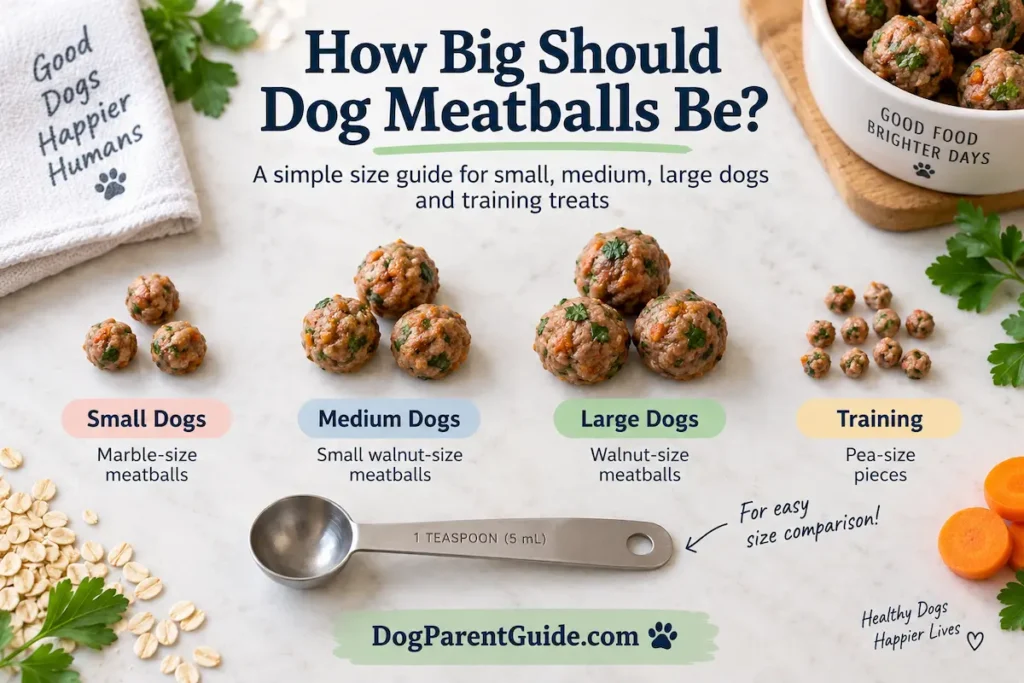
Actual portions depend on the recipe, your dog’s size, activity level, health, and everything else your dog eats that day.
For training, smaller is usually better. One mini meatball can often be broken into several rewards instead of giving multiple whole meatballs.
🍽️ Are Dog Meatballs a Meal, Treat, or Topper?
This distinction matters more than it may seem.
A homemade meatball made from meat, vegetables, egg, and oats can contain useful nutrients, but that does not automatically make it a nutritionally complete diet.
FDA explains that foods described as complete and balanced must meet established nutrient profiles or pass appropriate feeding trials. Treats and snacks generally are not intended to provide the entire diet.
🦴 As a Treat
A small meatball can work as an occasional high-value treat.
Just remember that homemade treats still contain calories.
WSAVA recommends that treats make up no more than approximately 10% of a dog’s daily calories.
This becomes especially important when everyone in the house gives “just one.”
🥣 As a Topper
This is probably my favorite way to use homemade dog meatballs.
Break or crumble a small amount over your dog’s regular food.
You get the smell and novelty of a homemade recipe without replacing most of a diet that is already formulated to meet your dog’s nutritional needs.
🍲 As Part of a Homemade Meal
A meatball can also be one component of a properly planned homemade diet.
But protein alone is not enough.
Dogs need the right overall balance of protein, fat, minerals, vitamins, essential fatty acids, and other nutrients.
If homemade food makes up a substantial portion of your dog’s diet, it is worth understanding your dog’s protein requirements and the common mistakes people make when preparing homemade dog food.
Do not assume that adding vegetables and an egg automatically turns a meatball recipe into a complete meal.
🔥 Best Ways to Cook Dog Meatballs
For most batches, I prefer baking because it is easy to cook many meatballs at once without adding much extra fat.
🍪 Baking
Arrange the meatballs on a parchment-lined baking sheet and cook until fully done.
As a food-safety reference, USDA recommends minimum internal temperatures of:
- 160°F for ground beef
- 165°F for ground chicken and turkey
- 145°F for fish
An instant-read thermometer is the easiest way to check the center.
🌬️ Air Frying
An air fryer works well for smaller batches, but small meatballs can dry out quickly. Check them regularly and avoid adding unnecessary oil.
🍳 Pan Cooking
You can also cook meatballs in a skillet. Use little or no added butter, skip human-style sauces and seasonings, and make sure the centers are completely cooked.
❄️ How to Store and Freeze Homemade Dog Meatballs
One of the biggest advantages of dog meatballs is that they are easy to batch prep.
You do not have to make a fresh mixture every time your dog needs a topper.
🧊 Refrigerator Storage
After cooking, allow the meatballs to cool and place them in a covered container in the refrigerator promptly.
USDA guidance says cooked meat, poultry, and seafood can generally be refrigerated for 3 to 4 days.
If you know your dog will not finish the batch within that window, freeze the extras instead of trying to stretch refrigerator storage.
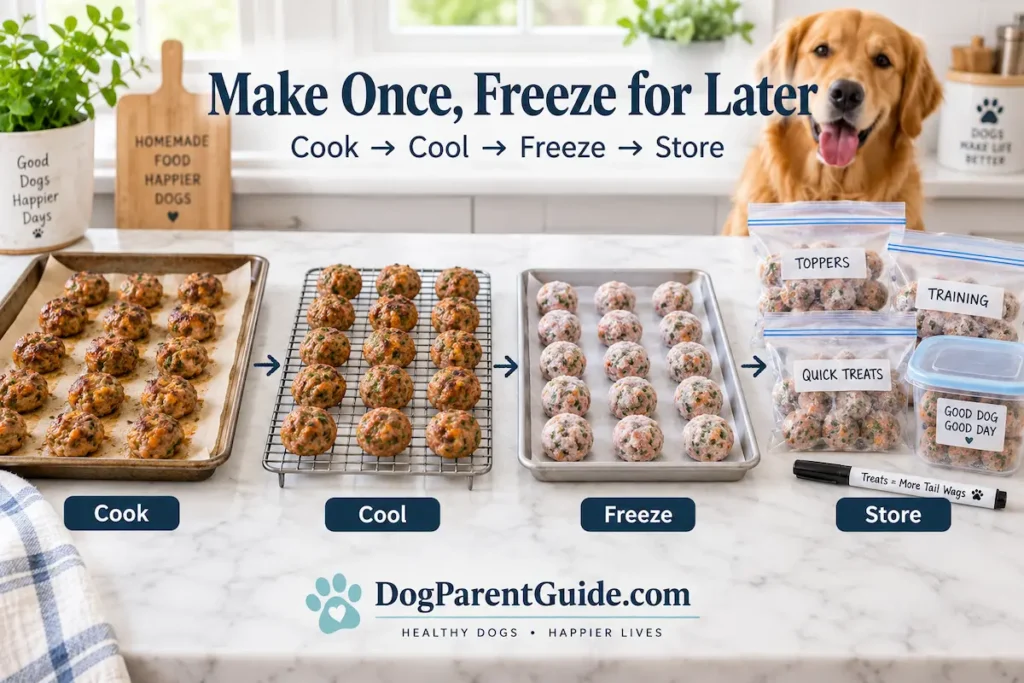
❄️ Easy Freezer-Stash Method
I like this method because the meatballs do not freeze together in one giant block.
- Cook the meatballs completely.
- Let them cool.
- Arrange them in a single layer on a tray.
- Freeze until firm.
- Transfer them to a freezer-safe container or bag.
- Label the bag with the recipe and date.
- Remove only what you need.
You can even divide the freezer stash by purpose:
✅ TOPPERS
Larger meatballs that you plan to crumble over meals.
✅ TRAINING
Mini meatballs or pre-cut pieces.
✅ QUICK TREATS
Individual portions for occasional rewards.
For thawing, the refrigerator is the simplest option. USDA guidance also recommends refrigerating or freezing cooked leftovers promptly rather than leaving perishable food at room temperature for extended periods.
🔄 Easy Ingredient Swaps
Once you understand the basic meatball formula, there is plenty of room for variation.
| If the Recipe Uses | You Can Try |
|---|---|
| Ground beef | Ground turkey or chicken |
| Pumpkin | Mashed sweet potato |
| Carrot | Zucchini |
| Rolled oats | Oat flour |
| Chicken | Lean turkey |
| Large meatballs | Mini training-size bites |
Just remember that swaps can change texture.
Pumpkin and zucchini add more moisture, while sweet potato and oats can help the mixture hold together. If the mixture is too wet, add a little oat flour or oats. If it is too dry, a small amount of pumpkin, sweet potato, or egg may help.
⚠️ Ingredients to Keep Out of Dog Meatballs
Simple recipes are usually easier to manage.
I would leave these out of meatballs made specifically for dogs:
- Onion
- Garlic
- Chives
- Leeks and shallots
- Onion or garlic powder
- Excessive salt
- Hot peppers
- Spicy seasoning blends
- Rich sauces
- Xylitol-containing ingredients
- Cooked bones
If you want a broader kitchen-safety reference, this guide covers more foods that can be dangerous for dogs, including common ingredients and everyday foods that may cause problems.
WSAVA lists onions, leeks, shallots, garlic, chives, xylitol, grapes, raisins, chocolate, macadamia nuts, alcohol, and several other foods among ingredients that should not be used as dog treats. It also advises against giving dogs bones because of the potential for injury.
This is also why I prefer making dog meatballs separately rather than setting aside a few meatballs from a human recipe after everything has already been mixed.
🐾 7 Tips for Better Homemade Dog Meatballs
1. Keep the Ingredient List Simple
You do not need ten ingredients to make a good dog meatball.
A protein, a binder, and perhaps one dog-friendly vegetable is often plenty.
2. Grate Vegetables Finely
Large chunks make small meatballs harder to shape.
Finely grated carrot or zucchini distributes much more evenly.
3. Squeeze Watery Vegetables
Zucchini can release enough water to turn a meatball mixture into something closer to soup.
A quick squeeze before mixing makes a big difference.
4. Do Not Oversize the Meatballs
It is easier to give another small piece than to take back half of an oversized treat after your dog has swallowed it.
Smaller portions also give you more flexibility.
5. Cook Them Completely
Do not judge doneness only by the browned exterior.
Check the center, especially with larger poultry meatballs. USDA notes that appearance and texture alone are not reliable indicators of food safety, so a food thermometer is the better way to confirm temperature.
6. Cool Before Serving
A meatball that feels only warm on the outside can still be very hot inside.
Break one open and make sure it has cooled before offering it to your dog.
7. Freeze Extras Early
Do not wait until day four to decide what to do with a large leftover batch.
If you know you made too many, freeze the extra portions soon after they have cooled.
🥣 4 Easy Ways to Serve Dog Meatballs
Making the meatballs is only half the fun.
There are several ways to use the same batch.
🍽️ 1. Crumble One Over Dinner
Take one small meatball and crumble it over your dog’s regular food.
This creates plenty of aroma and interest without turning the topper into the entire meal.
🐾 2. Use Tiny Pieces for Training
Take a mini meatball and break it into several pea-size rewards.
This works particularly well when you want something higher value than your dog’s normal dry treat.
🧊 3. Build a Freezer Topper Stash
Freeze different recipes separately.
You might keep one bag of turkey and pumpkin, one of beef and carrot, and another of salmon and sweet potato.
That gives you easy variety without cooking every day.
🥕 4. Add Meatballs to a Planned Homemade Meal
If you already prepare homemade food for your dog using an appropriately balanced recipe, meatballs can simply become another way to prepare part of the protein portion.
The shape does not change the nutritional requirements of the overall diet.
❤️ Homemade Dog Meatballs Make Batch Prep More Fun
Homemade dog meatballs are an easy way to add variety to treats, toppers, and training rewards. You can start with a simple beef and carrot batch, try turkey and pumpkin for the freezer, or switch proteins when you want something different.
Keep portions appropriate, remember that these recipes are not automatically complete meals, and freeze the extras in small batches so you always have a homemade option ready when you need one.