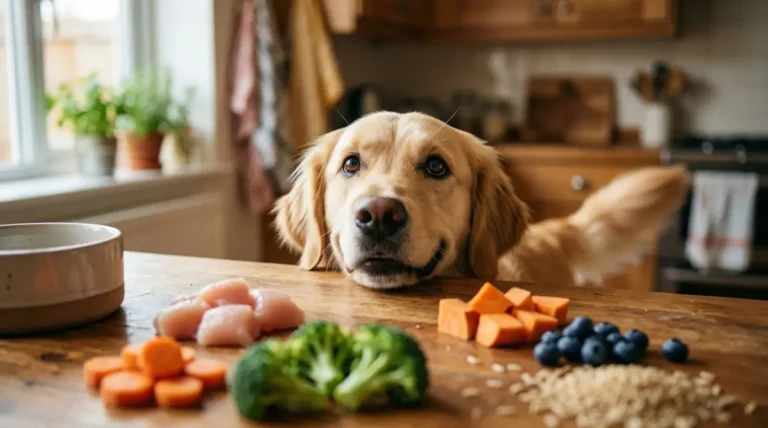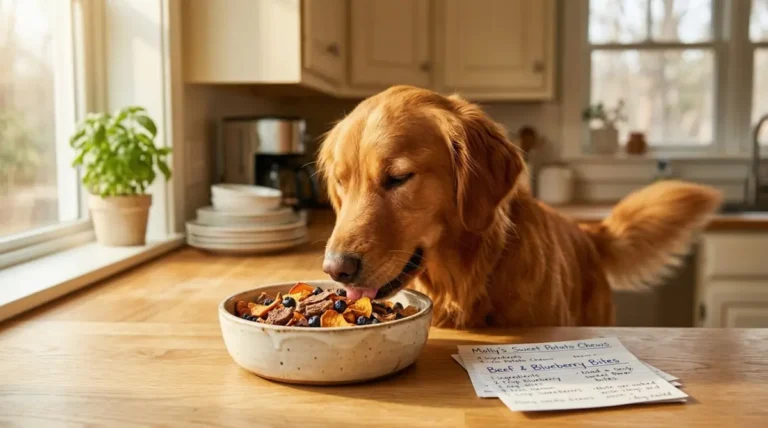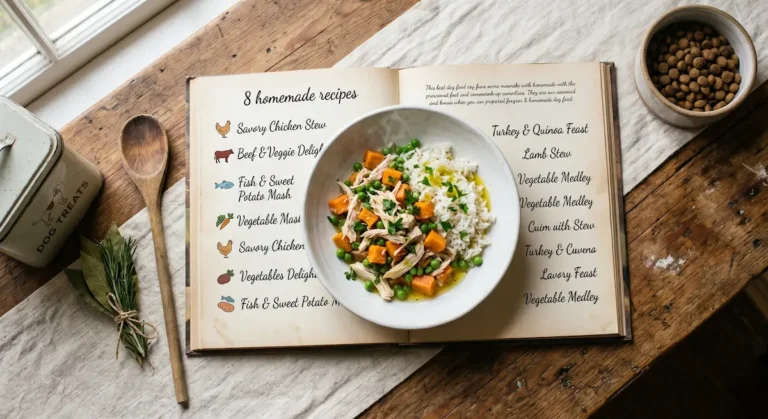
Looking for easy dog food crockpot recipes that do not require hours of hands-on cooking? A slow cooker makes it easy to prep larger batches with simple ingredients like chicken, beef, turkey, rice, pumpkin, and vegetables, then portion them for the days ahead.
If you want even more recipe inspiration, you can also explore our healthy crockpot dog food recipes for additional slow-cooker meal ideas.
These 10 recipes focus on practical crockpot cooking, including when to add different ingredients, how much liquid to use, which setting works best, and how to keep the finished texture from becoming too dry or mushy.
Important: These recipes are homemade meal ideas and cooking templates, not automatically complete and balanced diets for long-term feeding.
If homemade food will provide most or all of your dog’s daily calories, work with your veterinarian or a board-certified veterinary nutritionist to make sure the diet meets your dog’s nutritional needs.
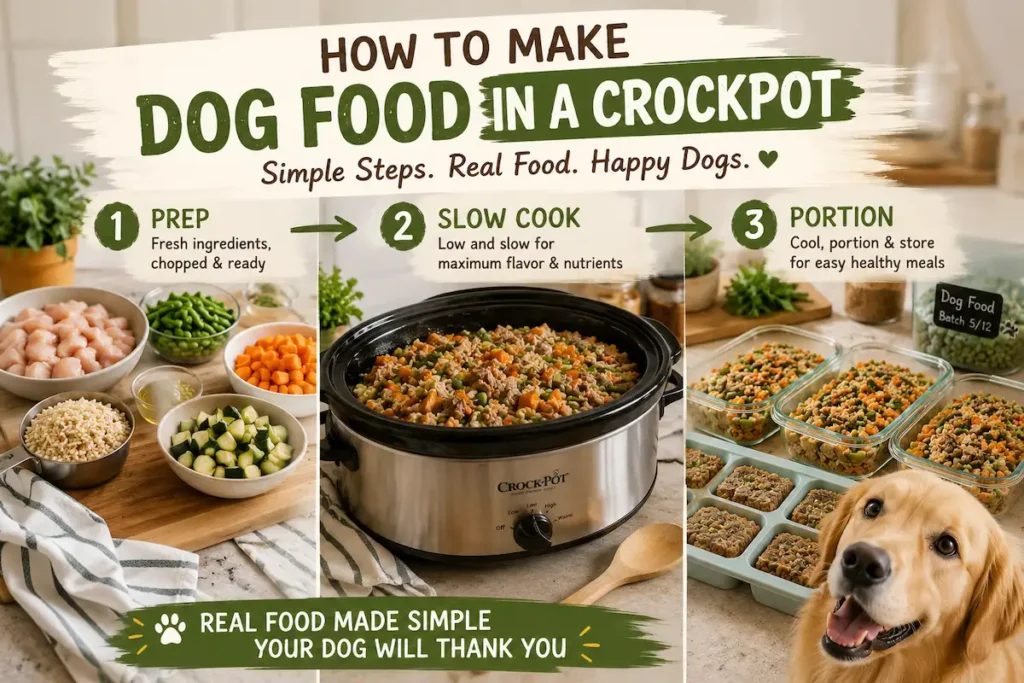
🥣 How to Make Dog Food in a Crockpot
The biggest advantage of a crockpot is not simply convenience. It is consistency.
Once you understand which ingredients belong in the pot early and which should wait until later, repeating your weekly meal-prep routine becomes much easier.
1. Start With the Protein
Chicken, turkey, lean beef, and other dog-safe proteins can all work in a slow cooker.
Boneless chicken breast and thighs are especially easy because they become tender enough to shred. Beef stew meat also benefits from a long cooking time because the pieces soften considerably.
Ground meat works too, but I generally prefer browning ground beef or turkey first when it contains noticeable fat. That lets you drain some of the rendered fat before it becomes part of the entire batch.
2. Add Ingredients That Need the Longest Cooking Time
Firm vegetables and slower-cooking carbohydrates can usually go in early.
Examples include:
- carrots
- sweet potatoes
- butternut squash
- brown rice
- barley
Cut vegetables into fairly uniform pieces so they finish cooking at roughly the same time.
3. Add Enough Liquid, But Do Not Flood the Crockpot
Slow cookers lose much less moisture than an uncovered pot on the stove, so you usually do not need enough water to completely submerge everything.
The right amount also depends heavily on the carbohydrate.
Brown rice, barley, quinoa, and oats all absorb liquid differently. Meat and vegetables release moisture while they cook, too.
It is better to follow the amount listed in the individual recipe rather than using one universal crockpot ratio.
4. Add Delicate Vegetables Later
Not every vegetable needs six hours in a slow cooker.
Ingredients such as:
- spinach
- peas
- zucchini
- chopped green beans
can often be added during the final 20 to 40 minutes.
This prevents every ingredient from turning into the same soft texture and makes it easier to control the finished consistency.
5. Shred, Mash, or Chop to Suit Your Dog
Once everything is cooked, adjust the texture.
You might leave larger soft pieces for a big adult dog, shred the protein more finely for a small dog, or lightly mash the batch if your dog prefers softer food.
That flexibility is one reason crockpot cooking works particularly well for homemade meal prep.
6. Cool Before Adding Heat-Sensitive Extras
Do not assume every ingredient belongs in the crockpot from the beginning.
Fish oil and some supplements are better added after cooking according to the specific product or veterinary formulation you are following.
The supplement itself should determine how it is used. Do not randomly add a multivitamin, calcium powder, or other supplement simply because a homemade bowl “looks like it needs something.”
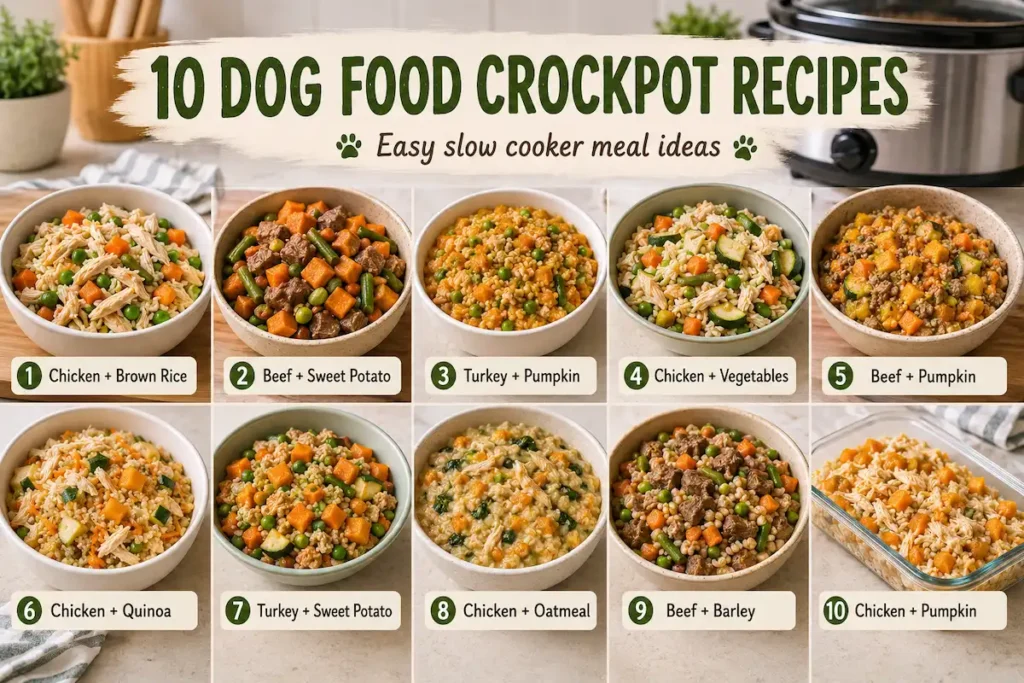
🍲 10 Dog Food Crockpot Recipes
1. Easy Chicken & Brown Rice Crockpot Dog Food
🐶 Best for: First-time crockpot meal prep
This is a good place to start if you have never made dog food in a slow cooker. Chicken shreds easily, brown rice creates a familiar base, and carrots and green beans add texture and variety.
🥕 Ingredients
- 3 lbs boneless, skinless chicken
- 1 cup dry brown rice
- 1 cup chopped carrots
- 1 cup chopped green beans
- ½ cup peas
- 4 cups water or dog-safe low-sodium broth
👩🍳 Instructions
- Add chicken, brown rice, carrots, and liquid to the crockpot.
- Cook on LOW for about 6 to 7 hours.
- Add green beans and peas during the final 30 minutes.
- Remove the chicken and shred it with two forks.
- Return it to the crockpot and mix everything thoroughly.
- Cool before portioning.
💡 Why This Bowl Makes Sense
Chicken provides the main animal protein, while brown rice contributes carbohydrate and carrots, green beans, and peas provide fiber and plant variety.
It is deliberately straightforward, which also makes it easier to adjust under the guidance of your veterinarian or veterinary nutritionist.
⏱️ Crockpot Tip
Brown rice needs considerably more time and liquid than quick-cooking grains. If you substitute white rice, do not assume the same timing will produce the same texture.
If your dog enjoys chicken and rice, these easy chicken and rice dog food recipes give you a few more Instant Pot and crockpot variations to try.
2. Beef & Sweet Potato Dump-and-Go Batch
🐶 Best for: Minimal-prep cooking
This recipe is built around ingredients that tolerate a long, gentle cook without needing much attention.
🥕 Ingredients
- 3 lbs lean beef stew meat
- 2 medium sweet potatoes, cubed
- 1 cup chopped carrots
- 1 cup green beans
- ½ cup peas
- 3½ to 4 cups water
👩🍳 Instructions
- Place the beef, sweet potato, carrots, and water in the slow cooker.
- Cook on LOW for 7 to 8 hours.
- Add green beans and peas during the final 30 minutes.
- Break the tender beef into appropriately sized pieces.
- Stir well and allow the batch to cool.
💡 Why This Bowl Makes Sense
Beef adds protein as well as nutrients such as iron and vitamin B12, while sweet potato contributes carbohydrate, fiber, and carotenoids.
The combination also produces a naturally soft, hearty texture after several hours of cooking.
⏱️ Crockpot Tip
Beef stew meat is one ingredient where the LOW setting really shines. Give it enough time to soften rather than using HIGH simply because it is faster.
3. Turkey & Pumpkin Freezer-Friendly Crockpot Batch
🐶 Best for: Portioning and freezing
Pumpkin blends smoothly into a cooked batch and makes this recipe especially easy to portion into individual containers.
🥕 Ingredients
- 3 lbs lean ground turkey
- 1 cup plain pumpkin puree
- 1 cup brown rice
- 1 cup chopped carrots
- 1 cup green beans
- 4 cups water
👩🍳 Instructions
- Lightly brown the turkey and drain excess rendered fat if needed.
- Add turkey, rice, carrots, and water to the crockpot.
- Cook on LOW for 6 to 7 hours.
- Add green beans for the final 30 minutes.
- Stir in the plain pumpkin after cooking.
- Cool completely before portioning.
💡 Why This Bowl Makes Sense
Pumpkin provides soluble and insoluble fiber, while turkey offers a different protein option from the chicken and beef used in many homemade meals.
For dogs that already tolerate these ingredients well, the soft, cohesive texture can make the batch easy to eat and easy to portion.
⏱️ Crockpot Tip
Adding pumpkin near the end gives you much better control over thickness. If the cooked mixture is already very thick, you can adjust the amount rather than ending up with an overly dense batch.
For turkey-based meal ideas beyond the crockpot, you can also browse these ground turkey dog food recipes.
4. Chicken & Vegetable Large-Batch Slow Cooker Meal
🐶 Best for: Weekly meal prep or multi-dog homes
This recipe keeps the ingredient list simple while making enough food to divide into several meals.
🥕 Ingredients
- 3½ lbs boneless chicken
- 1 cup brown rice
- 1 cup diced carrots
- 1 cup chopped zucchini
- 1 cup green beans
- ½ cup peas
- 4½ cups water
👩🍳 Instructions
- Add chicken, rice, carrots, and water.
- Cook on LOW for 6 to 7 hours.
- Add zucchini, green beans, and peas during the final 30 minutes.
- Shred the chicken.
- Mix thoroughly so the ingredients are evenly distributed.
- Cool before dividing into meal-size portions.
💡 Why This Bowl Makes Sense
Using several dog-safe vegetables increases ingredient variety without making the recipe overly complicated. Chicken provides protein, rice supplies carbohydrate, and the vegetables add fiber, moisture, and micronutrients.
⏱️ Crockpot Tip
Do not fill your slow cooker to the very top simply because you want a larger batch. Leave enough room for safe, even cooking and follow the manufacturer’s capacity guidance for your appliance.
5. Lean Beef & Pumpkin Soft Crockpot Meal
🐶 Best for: Dogs that prefer softer textures
Long cooking, finely broken beef, and pumpkin create a particularly soft final consistency.
🥕 Ingredients
- 3 lbs lean ground beef
- 1 cup plain pumpkin puree
- ¾ cup rolled oats
- 1 cup chopped carrots
- 1 cup chopped zucchini
- 3½ cups water
👩🍳 Instructions
- Brown the beef and drain excess fat.
- Add beef, oats, carrots, and water to the crockpot.
- Cook on LOW for 5 to 6 hours.
- Add zucchini during the final 30 minutes.
- Stir in pumpkin once cooking is complete.
- Mash lightly if you want an even softer texture.
💡 Why This Bowl Makes Sense
Pumpkin and oats both contribute fiber, while lean beef supplies animal protein. The finished consistency can be useful for dogs that simply prefer softer food or have difficulty managing large chunks.
⏱️ Crockpot Tip
Rolled oats thicken considerably as they absorb liquid. Check the batch toward the end and add a little warm water if the consistency becomes much thicker than you want.
6. Chicken, Quinoa & Zucchini Crockpot Bowl
🐶 Best for: A rice alternative
Rice does not need to appear in every homemade meal. Quinoa provides another way to build the carbohydrate portion of a slow-cooker recipe.
🥕 Ingredients
- 3 lbs boneless chicken
- ¾ cup quinoa, thoroughly rinsed
- 1 cup diced butternut squash
- 1 cup chopped zucchini
- ½ cup grated carrot
- 4 cups water
👩🍳 Instructions
- Rinse the quinoa well.
- Add chicken, quinoa, squash, carrot, and water to the crockpot.
- Cook on LOW for about 5 hours.
- Add zucchini during the final 20 to 30 minutes.
- Shred the chicken and mix it back into the batch.
- Cool completely.
💡 Why This Bowl Makes Sense
Quinoa contributes carbohydrate, fiber, and some plant protein, while chicken remains the primary animal protein. Butternut squash and carrots add additional plant variety.
⏱️ Crockpot Tip
Quinoa cooks faster than brown rice. Check this batch earlier than you would a chicken-and-rice recipe because quinoa can become very soft if left cooking for too long.
7. Turkey & Sweet Potato Budget Crockpot Batch
🐶 Best for: Budget-conscious batch cooking
Affordable homemade meal prep often comes down to using familiar ingredients efficiently rather than searching for unusual “superfoods.”
🥕 Ingredients
- 3 lbs ground turkey
- 2 medium sweet potatoes, diced
- 1 cup frozen green beans
- 1 cup frozen peas and carrots
- ½ cup chopped zucchini
- 4 cups water
👩🍳 Instructions
- Brown the turkey lightly and drain excess fat if necessary.
- Add turkey, sweet potato, and water to the slow cooker.
- Cook on LOW for 5 to 6 hours.
- Add frozen vegetables and zucchini during the final 30 minutes.
- Stir thoroughly and lightly mash some sweet potato into the mixture.
- Cool before portioning.
💡 Why This Bowl Makes Sense
Turkey and sweet potato create a simple protein-and-carbohydrate base, while frozen vegetables can make batch cooking more convenient and reduce prep.
Frozen plain vegetables can be perfectly practical. Just check the ingredient list and avoid seasoned or sauced mixtures.
⏱️ Crockpot Tip
Cut sweet potatoes into relatively small, even cubes. Oversized chunks may stay firm long after the rest of the batch is ready.
8. Soft Chicken & Oatmeal Senior-Friendly Batch
🐶 Best for: Older dogs that prefer a softer meal texture
“Senior-friendly” here refers to texture, not to a complete diet formulated specifically for senior nutritional requirements.
🥕 Ingredients
- 3 lbs boneless chicken
- 1 cup rolled oats
- 1 cup pumpkin puree
- 1 cup finely chopped carrots
- ½ cup chopped spinach
- 4 cups water
👩🍳 Instructions
- Add chicken, oats, carrots, and water.
- Cook on LOW for 5 to 6 hours.
- Remove and finely shred the chicken.
- Stir in pumpkin.
- Add spinach while the food is still hot and let it wilt.
- Mix until the batch reaches a soft consistency.
💡 Why This Bowl Makes Sense
Chicken offers protein, pumpkin and oats contribute fiber, and the long cooking time creates a soft texture that may be easier for some older dogs to chew.
Senior dogs can have very different calorie and nutrient needs, however, so age alone should not determine the recipe or portion.
⏱️ Crockpot Tip
You can shred the chicken very finely or lightly mash the entire finished batch if texture is the main reason you chose this recipe.
9. Beef & Barley Hearty Slow Cooker Meal
🐶 Best for: A denser crockpot texture
Barley is particularly well suited to slow cooking because it has plenty of time to soften and absorb liquid.
🥕 Ingredients
- 3 lbs lean beef stew meat
- ½ cup pearl barley
- 1 cup chopped carrots
- 1 cup green beans
- ½ cup peas
- 4½ to 5 cups water
👩🍳 Instructions
- Add beef, barley, carrots, and water.
- Cook on LOW for 7 to 8 hours.
- Add green beans and peas for the final 30 minutes.
- Break the beef into smaller pieces.
- Stir thoroughly and cool.
💡 Why This Bowl Makes Sense
Beef supplies the animal protein, while barley contributes carbohydrate and fiber. After slow cooking, barley creates a thicker and more cohesive bowl than many rice-based recipes.
⏱️ Crockpot Tip
Use pearl barley rather than assuming every type of barley cooks identically. Different forms can require different cooking times and amounts of liquid.
10. Chicken & Pumpkin Simple-Ingredient Crockpot Meal
🐶 Best for: Keeping the ingredient list straightforward
More ingredients do not automatically make homemade dog food better. Sometimes a simpler cooking template is easier to prepare, monitor, and adjust.
🥕 Ingredients
- 3 lbs boneless chicken
- 1 cup plain pumpkin puree
- 1 cup brown rice
- 1 cup chopped carrots
- 4 cups water
👩🍳 Instructions
- Add chicken, rice, carrots, and water.
- Cook on LOW for 6 to 7 hours.
- Remove and shred the chicken.
- Stir in pumpkin after cooking.
- Mix until evenly combined.
- Cool before serving or storing.
💡 Why This Bowl Makes Sense
Chicken provides protein, rice contributes carbohydrate, and pumpkin and carrots add fiber and plant nutrients without creating a long ingredient list.
That simplicity can also make it easier to notice how your dog responds to individual foods.
⏱️ Crockpot Tip
Do not confuse “simple ingredients” with “nutritionally complete.” A recipe can look wholesome and still be missing essential nutrients when fed as the primary long-term diet.
🐕 Which Crockpot Recipe Should You Make First?
You do not need to make all 10.
Start with the recipe that solves the practical problem you have right now.
| If You Want… | Try This Recipe |
|---|---|
| An easy first crockpot batch | Chicken & Brown Rice |
| Minimal hands-on prep | Beef & Sweet Potato |
| Easy freezer portions | Turkey & Pumpkin |
| A larger weekly batch | Chicken & Vegetables |
| A softer texture | Beef & Pumpkin |
| Something besides rice | Chicken & Quinoa |
| Budget-friendly meal prep | Turkey & Sweet Potato |
| A softer senior-friendly texture | Chicken & Oatmeal |
| A thicker, hearty bowl | Beef & Barley |
| Fewer ingredients | Chicken & Pumpkin |
Once you understand how one batch behaves in your own slow cooker, experimenting with another becomes much easier.
If you want more slow cooker ideas built around different life stages and dog sizes, these slow cooker dog food recipes for puppies, seniors, and large dogs are another useful place to explore.
⏱️ LOW vs. HIGH: Which Crockpot Setting Is Better?
The HIGH setting is not automatically wrong, but LOW is often more forgiving for dog food batches containing tougher meat, firm vegetables, or slower-cooking grains.
LOW Works Especially Well For:
- beef stew meat
- brown rice
- barley
- large batches
- recipes that need several ingredients to soften together
HIGH Can Work For:
- quicker chicken batches
- smaller portions
- recipes without slow-cooking grains
But do not assume you can simply cut every LOW cook time in half.
Your slow cooker model, batch volume, meat size, grain choice, and amount of liquid can all affect the result.
For the first attempt at any recipe, check the food before the maximum recommended cook time rather than leaving it completely unattended until the very end.
💧 How Much Water Should You Add to Crockpot Dog Food?
This is one of the easiest places to go wrong.
A crockpot traps steam and retains moisture much better than an uncovered saucepan. At the same time, rice, barley, quinoa, and oats can absorb substantial amounts of liquid.
That means there is no useful universal rule such as:
“Always add four cups of water.”
Four cups may work beautifully for one combination and create soup or scorched grains in another.
✔️ If the Batch Looks Too Dry
Add a small amount of warm water, mix, and recheck the consistency.
Do not immediately pour in several cups.
✔️ If the Batch Looks Too Wet
First remember that the mixture may thicken as it cools.
You can also:
- leave the lid slightly open near the end if your slow cooker instructions allow it
- mash some sweet potato or pumpkin into the mixture
- drain a small amount of excess liquid if absolutely necessary
For future batches, reduce the starting liquid slightly.
Can You Use Broth?
Yes, but plain water is often easier.
If you use broth, read the label carefully. Onion and garlic are unsafe for dogs, and many commercial broths contain one or both. The FDA lists onions and garlic among potentially dangerous foods for pets.
Choose an unseasoned, dog-safe option with no onion or garlic and preferably modest sodium.
🥕 What Goes in First and What Goes in Last?
One of the easiest ways to improve crockpot dog food is to stop cooking every ingredient for exactly the same number of hours.
| Add Early | Add Near the End | Usually Add After Cooking |
|---|---|---|
| Meat | Spinach | Fish oil |
| Brown rice | Peas | Certain supplements |
| Barley | Green beans | Pumpkin when used for texture control |
| Sweet potato | Zucchini | Other additions specified by your dog’s formulated recipe |
| Carrots | Some frozen vegetables |
This is not a rigid rule for every recipe. It is a useful cooking framework.
The goal is to give long-cooking ingredients enough time without turning every delicate vegetable into puree.
🚫 7 Crockpot Dog Food Mistakes to Avoid
1. Using Broth Without Checking the Ingredients
A broth labeled “natural” or “low sodium” can still contain onion or garlic.
Always check.
The FDA also warns that grapes, raisins, chocolate, xylitol, onions, garlic, and several other common human foods can be dangerous for dogs.
2. Adding Too Much Liquid
Remember that the slow cooker traps moisture.
Start with the recipe amount rather than filling the crockpot as if you were making soup.
3. Cooking Every Vegetable for Eight Hours
Spinach and zucchini do not need the same cooking time as carrots and sweet potatoes.
Adding softer vegetables later gives you much more control over texture.
4. Adding Every Supplement Before Cooking
The cooking pot is not the place to improvise supplement use.
If your dog’s formulated homemade diet calls for a vitamin-mineral supplement, calcium source, fish oil, or another addition, follow the specific instructions for that recipe and product.
5. Assuming Meat + Rice + Vegetables = Balanced
This is probably the most important mistake.
A colorful bowl can still fall short on calcium, trace minerals, vitamins, essential fatty acids, or other nutrients.
Studies reviewed by AAHA have found that the majority of home-prepared recipes evaluated from books and websites were not complete and balanced.
6. Leaving Excess Ground-Meat Fat in Every Batch
Fat is an essential part of a dog’s diet, but homemade meals can vary dramatically in fat and calorie density depending on the cut of meat.
If a ground meat releases a large amount of fat during browning, draining excess rendered fat can make the finished batch more predictable.
Dogs with medical conditions requiring fat restriction need an individually appropriate diet from their veterinarian rather than a generic “low-fat” crockpot recipe.
7. Feeding One Internet Recipe Every Day Forever
Rotation alone does not fix an unbalanced diet, either.
Chicken on Monday, beef on Tuesday, and turkey on Wednesday can still leave the overall diet short on important nutrients.
If homemade food is going to provide most or all of your dog’s calories long term, formulation matters more than ingredient variety.
And if homemade food will make up a large part of your dog’s diet, it is worth reviewing the most common homemade dog food mistakes and learning what goes into creating balanced homemade dog food recipes for long-term feeding.
📏 How Much Crockpot Dog Food Should You Feed?
Avoid relying on broad feeding charts that say something like:
“A 60-pound dog needs two cups twice daily.”
Two cups of Chicken & Pumpkin and two cups of Beef & Barley can contain very different amounts of energy.
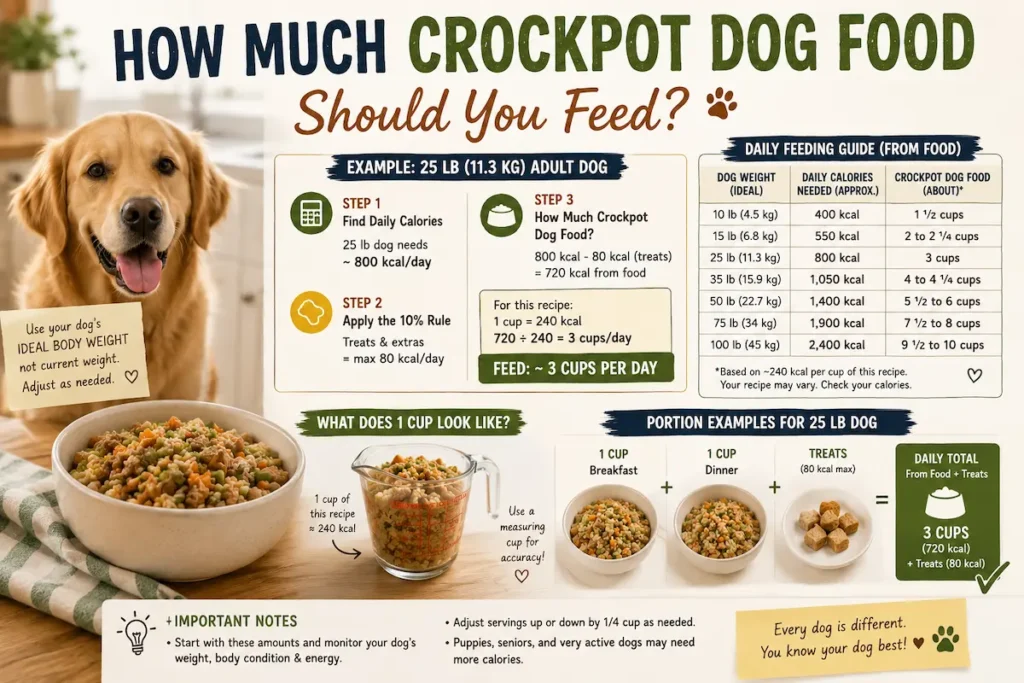
The appropriate portion depends on factors such as:
- body weight
- body condition
- age
- activity
- neuter status
- calorie density of the specific recipe
- treats and other foods eaten during the day
- individual medical needs
AAHA recommends individualized nutritional assessment that considers the dog, the diet, and feeding management rather than relying on body weight alone.
If you already know your dog’s daily calorie target, calculate the calories in the finished recipe and portion from there rather than measuring only by cup volume.
🧊 How to Meal Prep Crockpot Dog Food for the Week
The slow cooker really earns its place in the kitchen when you turn one batch into several ready-to-use portions.
Step 1: Cool the Food Safely
Do not leave a large pot of warm food sitting on the counter for hours.
Transfer the food into smaller containers so it cools more efficiently before refrigeration.
Step 2: Divide the Batch Into Portions
Portion by your dog’s calculated meal amount rather than guessing each day.
For multi-dog households, label portions by dog if their calorie needs differ.
Step 3: Refrigerate the Next Few Meals
Keep only the amount you expect to use within the safe refrigerated storage window.
Step 4: Freeze the Rest
Freezing individual portions prevents you from repeatedly thawing and refreezing an entire large container.
Silicone freezer trays, individual containers, or freezer-safe bags can all work.
Step 5: Thaw in the Refrigerator
Move the next portion from freezer to refrigerator ahead of time.
That creates a simple rotation:
Cook → Cool → Portion → Refrigerate → Freeze → Thaw
Once you establish the routine, crockpot dog food becomes much less of a “cooking project” and much more like ordinary weekly meal prep.
🧮 A Simple Crockpot Dog Food Formula
When you understand the cooking method, it becomes easier to recognize why certain combinations work well in a slow cooker.
A practical framework looks like this:
🎯 Protein
- Cookable carbohydrate
- Dog-safe vegetables
- Appropriate cooking liquid
- Any required post-cook additions
For example:
🐔 Chicken
- brown rice
- carrots and green beans
- water
- supplements specified by a properly formulated recipe
But there is one important distinction:
This is a cooking formula, not a nutritional balancing formula.
You cannot reliably create a complete long-term canine diet simply by choosing one ingredient from each category.
A dog’s requirements include specific amounts and ratios of amino acids, fats, vitamins, minerals, and other nutrients that are not obvious from looking at a bowl.
⚖️ Does Homemade Crockpot Dog Food Need Supplements?
Often, yes, when it is being used as a primary long-term diet.
One of the biggest misconceptions around homemade feeding is that using “whole foods” eliminates the need to think about micronutrients.
It does not.
For example, boneless meat is naturally high in phosphorus relative to calcium. Simply adding vegetables and rice does not automatically correct that imbalance.
A properly formulated home-prepared diet may therefore include a specific calcium source, vitamin-mineral supplement, essential fatty acid source, or other ingredients in carefully calculated amounts.
That does not mean you should buy a general dog multivitamin and add a scoop to every recipe.
AAHA emphasizes following professionally formulated home-prepared recipes exactly, including the specified vitamin, mineral, and amino-acid supplements.
If these crockpot recipes are being used as occasional meals or toppers, they play a different nutritional role than a recipe intended to provide 100% of your dog’s daily calories.
If they are replacing a complete commercial diet long term, work with your veterinarian or a board-certified veterinary nutritionist to turn the cooking template into a properly formulated diet.
🐾 Final Thoughts
The best dog food crockpot recipes are not simply lists of meat and vegetables. The real advantage of using a slow cooker is learning how to manage the entire process: which ingredients need hours of cooking, which should go in later, how much liquid your batch needs, and how to turn one crockpot into several correctly portioned meals.
If this is your first attempt, start with the Chicken & Brown Rice recipe. Once you see how your own crockpot handles meat, grains, vegetables, and liquid, the other recipes become much easier to adjust.
And remember the most useful distinction in this guide: a crockpot can make homemade dog food easier to cook, but nutritional balance still needs to be handled separately and intentionally.